



It is the third Sunday of May, 1381, in the village of Fobbing, Essex. The tax collector, Thomas Bampton, dismounts his horse. Dust rises from the lane. With him ride clerks carrying rolls of names and a demand: one shilling from every English man and woman over fifteen. For many, that is a year’s wages pressed into a single coin.
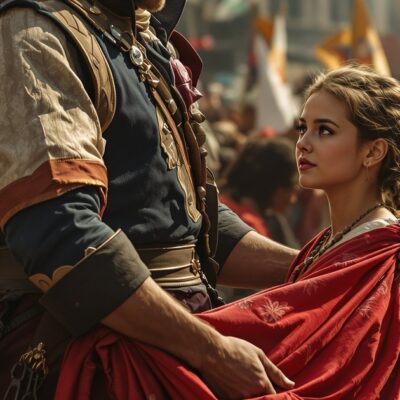
Among the villagers is a girl of fifteen. Her father says she is too young to pay. Bampton disagrees. He orders her forward, lifts her skirt to check her age, and reaches for the shilling. The village men step in. Staves appear. Bampton’s clerks scatter. That hand on the girl’s body becomes the match.
Within a week, the fire spreads through Essex and Kent. At Brentwood, a crowd stones the tax commissioners. At Maidstone, rebels break open the prison and pull out John Ball, the traveling preacher who has spent years telling the poor that the divisions between lord and serf are man-made, not holy. Men who have never left their manors now march with knives, scythes, and longbows. They burn manorial court rolls because the records are the chains. They free prisoners because captivity is the system’s language.
By June 12, tens of thousands gather on Blackheath, across the Thames from London. Some accounts say the crowd swells to 60,000. Smoke from campfires hangs over the river. They are shepherds, ploughmen, laborers, and their families. They have no single leader, though Wat Tyler, a former soldier from Kent, speaks for the London-bound column. They send word to the king. Richard II is fourteen years old. He sails toward them in a royal barge and asks what they want.
They answer with one voice: an end to serfdom, fixed rents, and the poll tax. They want to be treated as men.
On June 13, the rebels pour across London Bridge. Shopkeepers open their doors; some join. The mob does not ransack poor neighborhoods. It heads for symbols. The Savoy Palace, the London residence of John of Gaunt, the king’s uncle and the tax’s architect, is emptied and set alight. In the cellar, someone finds a barrel the rebels believe holds silver coins. They shatter it with axes. Gunpowder inside explodes. The palace collapses in flame. It is the loudest sound London has heard.
The next morning, the rebels enter the Tower of London. The king has spent the night inside, and the fortress is supposed to be impregnable. The gates open without a fight. Men who tilled fields walk the royal corridors. They find Simon Sudbury, the Archbishop of Canterbury and Lord Chancellor, and Robert Hales, the Lord High Treasurer. The two men are dragged to Tower Hill. Sudbury is sixty-two. Before he kneels, he presses a coin into his executioner’s hand because the man is shaking so badly he cannot hold the axe steady. The blade falls twice. The heads are stuck on pikes and paraded through the streets.
At Mile End, Richard meets a faction of the rebels and promises charters of freedom. He agrees to abolish serfdom and pardon everyone. Many believe him and start home. But the harder core, led by Wat Tyler, stays. They want the promises sworn before the king himself, not carried away on parchment.
On June 15, Tyler rides into Smithfield on a small horse. He is unshaven, muddy, and furious. He demands an end to all lordship, the redistribution of church lands, and a single law for rich and poor. He drinks ale in front of the boy king. William Walworth, the Mayor of London, sees insult in the gesture. He stabs Tyler in the neck. Tyler falls. His followers draw their bows.
Richard, alone, rides toward the armed crowd. ‘I will be your captain,’ he shouts. ‘Follow me.’ The bows lower. The moment holds. Then royal soldiers arrive. The rebellion unravels. Within days, the charters are torn up, the pardons revoked, and gallows rise in every county. Men hang from trees along the roads they marched.
The new film The Uprising, directed by Paul Greengrass and starring Andrew Garfield, imagines the revolt through the eyes of one unnamed farmer. That namelessness is not a screenwriter’s convenience. It is the entire point. The historical record remembers Wat Tyler, John Ball, and the boy king. It forgets the thousands who filled the roads from Kent to London. Yet the revolt only happened because ordinary people decided, one by one, that a shilling was not worth more than a daughter’s body, and that a lifetime of forced labor was not the natural order.
The poll tax was the spark, but the tinder was older. For generations, English peasants owed labor to the manor, needed permission to marry or leave the village, and watched their children grow thin while lords hunted in stocked forests. The rebellion was not simply about money. It was about being seen. When the rebels burned the court rolls, they were not destroying paper. They were erasing the proof that they belonged to someone else.
The tragedy is how briefly the kingdom listened. A fourteen-year-old king outlasted the rage of a generation. Within months, serfdom tightened again. The poll tax was dropped, but other taxes took its place. The men who marched were hanged, drawn, quartered, or sent back to the fields with heavier fines than before.
Still, something shifted. The lords no longer slept quite so soundly. They had seen ploughmen inside the Tower. They had seen a boy king bargain with laborers. The fear reversed, if only a little.
Six hundred and forty years later, the same questions sit heavy in every movement that gathers in streets: What does a fair share look like? Who owns the work? When does a tax become theft?
The girl from Fobbing never gets her name in the chronicles. She never sees the charter Richard tears up. But in the moment when the village men step between her and the collector’s hand, the future trembles. That is the real story. The uprising does not begin with a king or a knight. It begins with someone ordinary deciding, finally, that enough is enough.