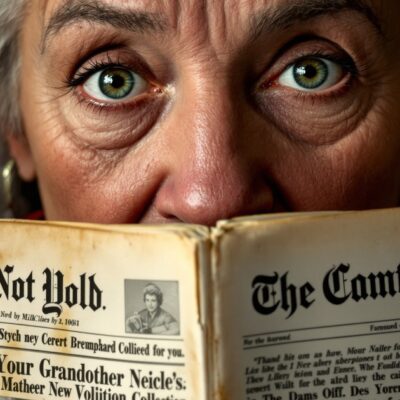


The closet still smells like her. Cedar blocks, mothballs, the faint sweetness of the face powder she wore even to read the morning paper. I am on my knees in my grandmother’s bedroom three days after the funeral, sorting through a life that suddenly fits in cardboard boxes, when my hand hits something rigid behind the winter coats. Not shoeboxes. Not old photo albums. Newspapers. Dozens of them, stacked in chronological chaos, bound with twine so dry it turns to dust between my fingers. The New York Times. Sunday editions from 1963, 1972, 1986, 1999. Some carry the ghosts of coffee rings. Others have her handwriting crawling through the margins like a second story.
I pull one out almost by accident. November 23, 1963. The headline takes up half the front page. Below it, smaller stories about harvest reports and a teachers’ strike in Queens. On the editorial page, she has written the word “no” so hard the pen tore the paper. I have never seen her handwriting look angry before.
This does not match my life. At all. I get my news the way almost everyone I know does: half-awake, thumb moving upward, one headline dissolving into the next before my eyes can fully focus. I have read three articles about the same disaster before I remember to drink my coffee. The news does not feel like a ritual to me. It feels like an assault I have agreed to, a room full of people shouting and me pretending I can hear all of them at once. I have told myself this is what it means to be informed. Standing in her closet, holding paper that has outlived the people who printed it, I am no longer sure.
I take three papers home. Then five. Then a whole box. I spread them across my kitchen table and read them with my coffee, the way she must have. The first one I finish is from July 21, 1969. Two men have walked on the moon. The front page is almost reverent. Inside, there is also a story about a housing protest in Harlem, a review of a movie I have never heard of, and a photograph of children watching the landing on a television set dragged onto a Brooklyn sidewalk. No one is asking me to click anything. No algorithm is trying to guess what will make me afraid. The paper simply says: this happened. This mattered. Here is what we know.
The feeling is almost physical. My shoulders drop. I read one story all the way through, then another. I notice things I would have missed in a feed: a small obituary for a woman who taught piano in Flatbush for fifty years, my grandmother’s old neighborhood; a wedding announcement with a name circled in red; a letter to the editor about subway fares that she has underlined twice. She was not just consuming information. She was having a conversation with a city she loved. She was keeping score. She was paying attention.
And then I see it. On every front page, tucked beneath the name of the paper in small, certain type: “All the News That’s Fit to Print.” I have seen the phrase my whole life without really looking at it. Now it feels like a door swinging open.
I learn that the Times first appeared on September 18, 1851, and that its founders promised to cover “every subject of public importance.” The first issue cost one cent. I learn that Adolph Ochs added the famous motto in 1897, partly as a rebuke to the sensationalism of his era, the yellow journalism, the headlines that screamed lies and called it courage. The paper was trying to make a case for restraint. For care. For the radical idea that the public deserved information it could trust.
I sit with that for a long time. The problem I have with the news, I realize, is not that people stopped telling the truth. It is that I stopped trusting truth when it came quietly. I have been trained to distrust anything that does not first hijack my nervous system. I scroll past careful reporting because it does not feel urgent enough, and I reward the loudest voices because they feel like action. I have mistaken my own anxiety for engagement. My grandmother’s newspapers do not have that problem. They do not need to make me feel something in order to be real.
I start going back to the box every weekend. I find a 1987 issue with a recipe clipped out and a note that says “try this for Sunday.” I find a 1995 edition with the obituary of a man she once worked beside at the phone company, and next to his name she has written “always kind.” This is the moment that breaks me a little, standing in my kitchen with my coffee going cold, holding paper that she touched, reading the names of people who would be completely forgotten if not for her pen and this strange habit of saving the news. She believed the lives around her counted. She wrote it down to prove it.
I do not think newspapers are perfect. I know their history too well to believe that. But I have begun to understand what they meant to her, and what they might mean to me. On Sunday mornings now, I walk to the corner store and buy a paper. I bring it home, fold it badly, and read one story all the way through before I look at my phone. Sometimes I underline a sentence. Sometimes I clip something out. It is a small act. It does not save journalism, and it does not solve the world. But it reminds me that attention is a form of love, and that some things deserve to be held in your hands.
My grandmother saved those papers not because the world was simpler then. It was not. She saved them because it mattered enough to remember. And now, when I turn the page and the newsprint leaves gray fingerprints on my skin, I feel like I am touching something she wanted me to know. The world is still here. It still needs witnesses. Someone has to sit down, pay attention, and say: this happened. This mattered. This is worth keeping.