
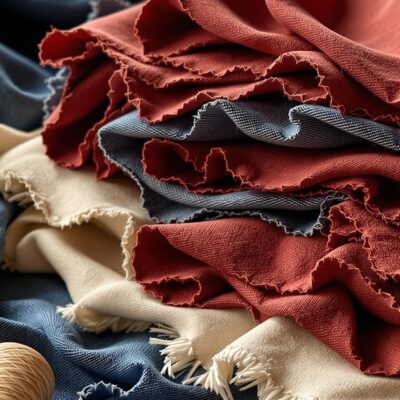

Image note: The accompanying AI-generated still life illustrates reused fabric and sewing materials. It is not a photograph of a Gee’s Bend quilt, an artist’s belongings, or a specific artwork. The linked sources show the real quilts.
The old clothes that ask you to look again
Some of the quilts celebrated in American museums began with materials that had already done a day’s work: worn clothing, used sacks, fabric that was available rather than fabric selected from a shop. In Gee’s Bend, Alabama, those practical beginnings are part of the story, but they are not the whole explanation for what the women made.
It is tempting to stop at the transformation. An old shirt becomes something useful; something useful becomes something beautiful; a museum eventually notices. That version is satisfying, and it leaves out the most interesting part.
A piece of cloth does not choose where to go. Someone decides how much of it to use, what to put beside it, when to repeat a shape, and when to change direction. Those decisions belong to an artist, even if the finished object will spend its first years keeping a family warm.
The story of Gee’s Bend invites a different kind of attention. Instead of asking how ordinary household work suddenly became art, it asks why so many people needed a museum to tell them what was already there.
A tradition shaped by more than necessity
Gee’s Bend is a community in Alabama’s rural Black Belt. According to Souls Grown Deep’s account of its quiltmakers, the area’s quilting tradition reaches back to the nineteenth century, when quilts provided warmth in unheated homes.
Scarce resources meant that old work clothes and used fertilizer and flour sacks supplied much of the fabric well into the twentieth century. Reusing materials remained important even after inexpensive new cloth became more widely available.
That continuity matters. Recycling was not simply an embarrassing early stage to abandon when better options appeared. Used materials continued to offer possibilities within a living artistic practice.
But it would be wrong to make deprivation sound like a gift. The community history documented by Souls Grown Deep describes slavery, exploitative sharecropping, and a devastating Depression-era seizure of families’ livestock, equipment, and stored food. These were hardships imposed on people, not ingredients required for great art.
The same history records a different force: continuity made possible by access to land and housing. Federal programs in the 1930s helped families purchase land and build homes, allowing people to remain where earlier generations had lived.
Within that continuity, knowledge could pass between generations. The women were not creating from nothing; they were learning, remembering, experimenting, and making choices inside a tradition they knew.
The point where a pattern becomes a person’s own
Souls Grown Deep describes many of the quilts as improvisational, using the local expression “my way.” A maker might begin with a basic form and then take her own direction through combinations of shapes, colors, and patterns.
That is a useful correction to the idea that resourcefulness means merely getting by. Working with what is available can involve sophisticated judgment, and familiarity with a traditional form does not require making it exactly the same each time.
Consider the difference between inheriting instructions and inheriting a skill. Instructions tell you where the next piece goes; a skill helps you decide what to do when the available piece is different, or when another arrangement feels more compelling.
Mary Lee Bendolph offers one specific example of this combination of inheritance and change. The Metropolitan Museum of Art’s account of her quilt Foundation says she learned quilting from her mother in the 1950s.
The museum also describes how the landmark Gee’s Bend exhibition in 2002 encouraged a new stage in her work. Seeing earlier quilts from her own community inspired her, and her developing designs referred both to that tradition and intentionally to modern abstract art.
That detail complicates the familiar picture of a maker untouched by the wider world. Bendolph was looking, responding, and developing her work through encounters with other art, including the art of her neighbors and predecessors.
The Met records friendships and mutual influence between Bendolph and artists Thornton Dial and Lonnie Holley. Her story is not just one of solitary talent waiting for discovery; it includes artistic conversation, curiosity, and continuing change.
What recognition changed, and what it did not
The 2002 exhibition began at the Museum of Fine Arts, Houston, before bringing the quilts to other audiences. It helped place generations of work within a much wider public discussion of American art.
There is something moving about that shift, but the museum wall was not the starting point of the quilts’ value. The makers had already invested knowledge, labor, and individual decisions in them; families had already lived with the results.
Recognition can change access, visibility, and the way a work is studied. It cannot travel backward and become the reason someone had skill in the first place.
Even a straightforward museum record makes this clear when you slow down. Foundation is dated 2004, its materials listed as denim, cotton, and polyester, and its artist named as Mary Lee Bendolph. These are specific choices and a specific maker, not an anonymous example of people being ingenious in difficult circumstances.
Keeping the names attached matters. So does resisting the urge to turn every quilt into the same uplifting lesson, when different women worked across different generations and made different things.
The discovery is not that hardship automatically produces beauty. It is that useful objects can contain serious artistic thinking, and that our categories sometimes make that thinking harder to see.
A different way to notice the work around you
You do not need to become a collector to respond to this story. Start with the actual works on the linked museum and foundation pages, then give one quilt enough time for its individual decisions to become visible.
Look at a repeated shape, a change in color, or the relationship between a larger area and a smaller one. Read the artist’s name and the date before moving on; learning who made something is a small but meaningful form of respect.
Closer to home, the same attention can change a conversation. If someone repairs clothes, makes furniture, cooks, or sews, ask about a decision rather than offering only a quick compliment. How did they learn that technique, and what have they changed about it?
That is not a claim that every household object belongs in a museum. It is an invitation to notice the judgment inside work that usefulness can make easy to overlook.
A quilt can keep someone warm and carry an artist’s unmistakable choices at the same time. The two purposes do not cancel each other out, and the people doing that work deserve to be seen before a famous institution tells the rest of us to look.