

I was watching the wrong part of the problem
A cockatoo can reach a cashew with a tool. That sounds like the moment worth watching, but what caught my attention in a 2023 experiment happened before the bird reached the food.
There was a journey involved, and a decision about what to carry. Suddenly the interesting question was not simply whether a small parrot could solve a puzzle, but whether it could prepare for a problem it had not yet started working on.
I find that distinction surprisingly relatable. Anyone who has returned to the kitchen for the thing they forgot knows the difference between responding to the next obstacle and gathering what the whole job will require.
That comparison is a way into the research, not a claim that birds think exactly as we do. The study involved captive Goffin’s cockatoos, controlled tasks, and a food reward; it did not give researchers direct access to a bird’s private experience.
Still, the setup left me with a better question than whether parrots are clever. What would we have to change about a task to find out what kind of cleverness we were actually seeing?
One cashew, two very different jobs
The researchers presented the birds with a box holding a cashew behind a membrane. Beside it were two objects with different uses: a short, pointed stick and a longer, flexible tool made from a plastic straw split lengthwise.
The short tool could break through the barrier, but it could not reach the reward. The longer tool could retrieve the cashew, but the membrane first had to be opened.
As the University of Veterinary Medicine Vienna explains in its research announcement, this was inspired by chimpanzees using different tools to open termite mounds and then probe for termites. The researchers adapted the problem rather than assuming birds would solve it in the same way.
According to the Cell Press account carried by ScienceDaily, seven of the ten cockatoos tested worked out how to extract the cashew. Two birds, Figaro and Fini, succeeded within 35 seconds on their first attempt.
Those quick successes are eye-catching, but speed was not the whole point. Even a bird that used both tools correctly might simply have been responding to one visible difficulty after another.
First there is a barrier, so use the object that breaks it. Then there is food out of reach, so use the object that retrieves it; that sequence alone would not show that the bird treated the objects as a set.
This was the distinction the team needed to test. Watching a successful result can tell us that an animal accomplished something without telling us how it organized the task.
The researchers made the obvious answer less useful
For the next stage, the team alternated between two kinds of box. One still had the membrane, while the other allowed access without that first barrier.
Both tools remained available, but now the same routine was not always necessary. A bird facing the open box needed the longer retrieving tool, not the short tool used for punching through a membrane.
The cockatoos adjusted to this difference. That flexibility mattered because it made the task more than a fixed sequence repeated regardless of what was in front of them.
The researchers also noticed birds picking up one tool, putting it down, and switching to the other before making their first insertion. Correct choices were more likely after this switching behavior, an observation the team identified as a subject for further investigation.
I would resist calling that a bird visibly weighing its options in a human sense. The switching is something the researchers observed; its relationship to a bird’s internal decision-making needs more work.
It is tempting to turn every pause into a familiar story about hesitation, confidence, or doubt. A more useful response is to notice the behavior without filling the silence with a thought the animal never reported.
The box comparison established that the birds could adapt their tool use to the problem. But there was still another question: would that difference influence what they carried before they got there?
The journey revealed what the finished task could not
Now the researchers separated the tools from the place where they would be used. The cockatoos first had to climb a ladder to a raised platform, then in later tests make a horizontal flight and finally a vertical flight.
The box waiting at the destination could require either one tool or both. The birds could make separate journeys, so carrying everything at once was not their only route to success.
Some discovered a way to transport the objects together by fitting the short stick into the groove of the split straw. This allowed them to bring the pair on a single trip rather than return for the second object.
The university’s account reports that four cockatoos eventually transported both tools together, including during flying tasks. Three used this combined transport consistently when both tools were required and less frequently when the box lacked a membrane.
That pattern was the important part. Bringing two objects everywhere might reflect a habit, whereas changing what you bring according to the task provides stronger evidence that you recognize different requirements in advance.
The birds did not all behave identically. The Cell Press account notes that Figaro carried both tools on almost every trial, a useful reminder that a group result should not erase individual strategies.
The finding supports the interpretation that at least some of these cockatoos could represent the tools as a set before using them. It does not establish that every parrot does this, or that the birds planned in every sense humans use that word.
A different way to notice another creature
What stays with me is how much the answer depended on the question. If the experiment had ended when the first cashew came out, the birds would still have looked capable, but a more revealing part of their behavior would have remained untested.
Adding a journey made preparation visible. Removing the membrane on some trials helped distinguish a flexible response from a routine that happened to work.
For me, the human takeaway is not that we should copy a cockatoo’s productivity habits. It is that attention improves when we stop treating an impressive outcome as the end of our curiosity.
The same restraint matters when watching animals at home. A behavior can be interesting without becoming a performance they owe us, and this experiment is not a recommendation to offer pet birds sharp sticks or pieces of plastic.
Appropriate enrichment should suit the individual animal and use safe materials, with professional guidance where needed. The laboratory apparatus belongs to the research context, not an improvised challenge designed for a social-media clip.
I began with the cashew because the reward made the puzzle easy to understand. I ended up thinking about the departure: a small bird leaving with something it would only need after the first part of the job was done.
That is enough to make the familiar category of a clever bird feel less complete. We do not have to invent its thoughts to recognize that there is more worth observing before the obvious moment arrives.
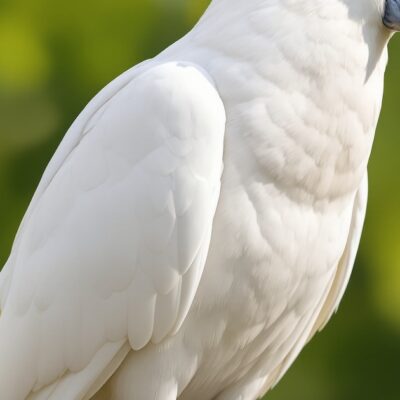
Image: AI-generated illustration of a Goffin’s cockatoo, not a photograph of the research birds or experimental apparatus.