
At the bottom of a tide pool in Okinawa, a peacock mantis shrimp tilts its two independently moving eye stalks like a submarine raising periscopes. Each eye scans the reef in twelve to sixteen color channels, sees ultraviolet light slanting through the water, and reads the polarization of light the way we read the angle of a shadow. It is hunting. It is also, in a sense we can barely grasp, seeing a different ocean than the one we photograph.
We think our eyes give us the world. They do not. They give us our world, a narrow treaty negotiated by ancient genes and daily survival. Human eyes have three color receptors. The mantis shrimp has more than four times as many. A dragonfly’s compound eye carries up to thirty thousand individual lenses, each one a separate window. Those numbers are not party tricks. They are evidence that reality is crowded with versions we never notice.
The documentary opens with a spectacled owl, painted in dark feathers, its eyes two bright coins of yellow. The image is arresting because it feels like a meeting across a border. The owl sees the forest at light levels that would leave us stumbling. Its retina is packed with rods, not the color-loaded cones we prize. Color fades, but motion does not. A mouse’s heartbeat-scurry under dry leaves becomes a signal flare. For the owl, night is not absence. It is a different room in the same house.
Then there are bees, those familiar garden workers. To us, a yellow buttercup is simply yellow. To a bee, the petals are landing strips lit in ultraviolet, invisible patterns shouting nectar here. The flower is not pretending to be plain. It is speaking a language we were never taught. The sky, too, is rewritten. Bees detect polarized light, so they find their way by the sun even when clouds hide it. Their map is drawn in directions, not landmarks. We call them lost when they vanish from our sight. They are returning home on a compass made of light.
We keep discovering strangers in our midst. Deep-sea fish carry tubular eyes that point upward, always scanning the faint silhouettes of prey against the last scraps of sunlight. Spiders with eight eyes arrange them like security cameras, sacrificing color for the twitch of a wing. Cats trade the reds and oranges we love for motion so sharp they can track a dust mote in twilight. Every eye is a bargain, a budget spent on whatever keeps that creature alive one more day. There is no perfect vision. There is only enough vision.
The most unsettling idea is not that animals see more. It is that they see differently. We assume our spectrum is the floor plan of the universe, but it is one apartment in an infinite building. The colors we name are a tiny sliver of electromagnetic radiation. Infrared, ultraviolet, polarized light, these are not science-fiction concepts. They are weather that falls on Earth every second, weather most of us cannot feel. The mantis shrimp swims through rainbows we have no words for.
There is a moment in the film, quiet and almost childlike, when the camera lingers on the eye of a cat. The slit pupil contracts to a black line. The reflection of a window floats in the green iris like a distant room. For a second, you remember being small and pressing your face close to an animal’s face, searching for recognition. You wanted to know if it saw you the way you saw it. The answer, it turns out, is no. It sees something else entirely. And somehow that is more moving than simple recognition would ever be.
That is the ache at the heart of wonder. We cannot swap retinas. We cannot unzip our skulls and slip into the consciousness of an owl or a bee. We are stuck with our three-color, motion-limited, daylight-biased view. But the boundary is not a wall. It is a window, and the glass is thinner than we thought. When we learn how another creature senses the planet, the planet grows. A meadow becomes a gallery of hidden signs. A night forest becomes a theater of movement and sound. The ocean becomes a light show we have been snorkeling through half-blind.
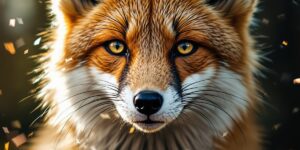
Watching the documentary, I keep returning to the spectacled owl. Those yellow eyes do not look blind or simple. They look weighted with a secret. They remind me that attention is a kind of love, and that love does not require understanding. We do not need to translate the owl’s night into human terms to honor it. We only need to stop assuming our terms are the only ones.
The next time you pass a dragonfly hovering over a pond, try to hold two truths at once. The dragonfly is small. Its world is enormous. You are sharing air with a creature whose brain processes time in slow motion, whose eyes wrap most of the way around its head, whose ancestors were watching the world long before our branch of the family tree learned to stand upright. It does not need your awe to exist. But your awe changes you.
We will never see the ultraviolet runway of a flower or the polarized ceiling of the sky. We will never watch a forest floor through the patient, rod-dense gaze of an owl. But we can let the possibility loosen our grip on certainty. We can look at the animals beside us and admit, with something like relief, that the world is bigger than the colors we were born with. The alien world is not light-years away. It is in the next glance, the next yellow eye, the next heartbeat of wings. And it has been waiting for us to notice.