
The first thing Pierre notices is the dust. It is not darkness. It is not the flat gray soup that has filled his world for longer than he can measure. It is light, splitting into tiny golden pieces as it falls through the window of his recovery room at Chimp Haven. He blinks. His left eye twitches. Then, slowly, he lifts one enormous hand and turns it palm-up toward the sun, studying the creases and the faded scar across his knuckles as though he has never seen them before. In a way, he has not.
Pierre is fifty-four years old. That is elderly for a chimpanzee, the human equivalent of a man well into his eighties. For the last stretch of his long life, cataracts had been stealing his sight grain by grain until the theft was complete. The trees, the sky, the faces of the people who brought him food, the friends he had known for decades—all of it dissolved into a featureless fog. He moved through the world by memory, by smell, by the familiar give of the ground beneath his feet. He learned to flinch before he collided with the mesh walls of his enclosure. He learned to sit very still, because stillness was safer than motion when you could not trust your eyes.
At Chimp Haven, the world’s largest chimpanzee sanctuary tucked into the pine woods of Louisiana, more than three hundred retired chimpanzees live out their days on two hundred forested acres. Many arrived from research facilities, from roadside zoos, from lives that asked too much of them and gave too little back. The sanctuary’s promise is simple: here, you do not have to earn your rest. But rest is hard when you are blind. Pierre began to withdraw. He stopped climbing. He stopped grooming with his group. During meal times, while the others snatched fruit and vegetables from the scatter, he would wait, listening, hoping a piece would land close enough for him to find by scent alone. Chimpanzees read faces the way humans read headlines—an eyebrow, a lip curl, a lowered chin can mean friendship or warning or submission. Without sight, Pierre lost the thread of those conversations. He became lonely in a crowd of his own kind.
The caretakers saw it. They watched him trace the perimeter of his enclosure with one hand extended, fingertips brushing the metal, mapping his shrinking universe. They watched him miss a grape by inches, then freeze, confused by his own failure. They knew cataract surgery existed for chimpanzees, but it was rare, risky, and had never been attempted on a resident at Chimp Haven. Pierre’s age complicated everything. Anesthesia is dangerous enough for a young chimp; for a fifty-four-year-old heart, it carries a quiet threat. And there is no way to explain to a frightened animal that the strange lights, the masked faces, the brief loss of consciousness, are meant to help. The team had to weigh the possibility of a better life against the chance that the attempt itself could end it.
They chose hope.
The surgery happens on a morning when the Louisiana air is thick and sweet. A veterinary ophthalmologist removes the clouded lenses that have turned Pierre’s world into milk. The operating room is quiet except for the beep of monitors and the soft instructions passed between steady hands. When it is over, Pierre is carried back to a warm, dim recovery space where he sleeps off the anesthesia. No one knows yet whether the procedure has worked. Sight can take hours or days to return, and sometimes it does not return at all.
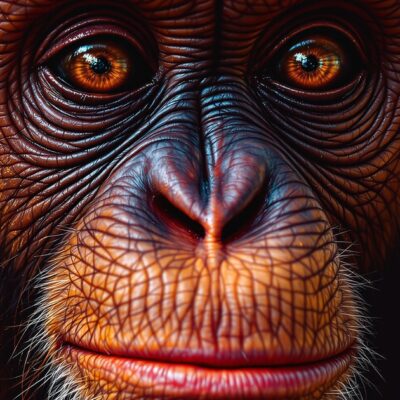
The next day, the veterinary team gathers near his enclosure. A keeper kneels at the mesh, close enough for him to smell her shampoo and the banana on her breath. They remove the protective cone and the last of the ointment. Pierre squints. His nostrils flare. Then his eyes—those dark, thoughtful eyes—lock onto her face. He does not look through her. He looks at her. The keeper feels her throat tighten. She has cared for Pierre for years, spoken to him, sung to him, brought him frozen treats on summer afternoons, and until this moment she does not realize how much she has missed being seen. She whispers the same greeting she has said a thousand times before. He leans closer, pressing the flat of his face against the mesh, and studies her as if he is memorizing every line.
Within days, the change is impossible to miss. Pierre locates his red ball across the enclosure and crosses the dirt to retrieve it. He notices a cicada buzzing against the window and follows its path with his head. He watches a younger chimp swing from a fire hose and responds with a soft grunt that sounds almost like laughter. The social invitations start coming back. A female companion approaches and offers her back for grooming; for the first time in ages, Pierre accepts. Another chimp flashes a play face—lips pursed, head bobbing—and Pierre mirrors it. The fog has lifted, and with it, the wall that separated him from his own world.
There is a particular afternoon, about a week after the surgery, when Pierre climbs the lowest platform of his climbing structure. It is only three feet off the ground, nothing like the high nests the younger chimps prefer, but for Pierre it is a triumph. From there he can see the oak canopy, the flashes of blue sky, the distant movement of caregivers carrying buckets. He sits with his hands folded in his lap, and for a long time he simply looks. The wind moves through the pines. Somewhere, a crow calls. Pierre does not need to do anything with the view. He only needs to know it is still there.
What the surgery restored was more than vision. It gave Pierre back his place in the small society of chimps and humans who love him. It returned the ability to choose—to approach a friend, to inspect a new toy, to move toward food instead of waiting for it to find him. For a chimp who spent the first part of his life serving human purposes he never chose, that small autonomy matters enormously. The cataracts took his sight, but they almost took his belonging, too.
Chimp Haven will remember Pierre’s operation as the first cataract surgery performed for a sanctuary resident. That fact will live in the records. But the part that stays with the people who were there is quieter. It is the image of an old chimpanzee, blinking in the morning light, turning his hand over and over as if the world has just handed him a gift. It is the moment he looked at his keeper and she knew, without any language they shared, that he recognized her. It is the proof that even late in life, after years of darkness, the curtain can still rise.
Pierre is not young. His knees ache. His hair is sparse and silver. No one can promise him decades. But on this day, with the Louisiana sun warm on his face and the green world spread out before him, none of that matters. He can see. He can see his friends, his food, his keeper’s smile. He can see home.