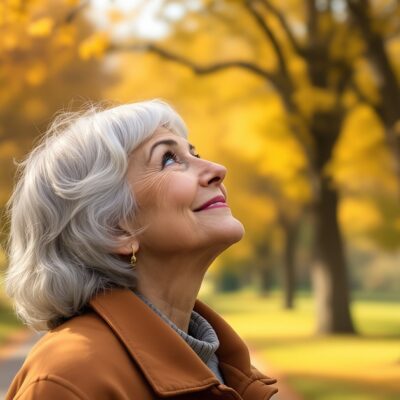




The detail I kept coming back to
What caught my attention in a study about walking was not a step count. It was what happened inside the photographs people took along the way.
I was reading research on something called an awe walk: an ordinary walk approached with deliberate curiosity about the world outside yourself. The instructions were modest, and the participants were not being sent on spectacular adventures.
Yet the pictures changed over time. That detail made me want to read beyond the appealing promise that a short walk could make a difficult day feel different.
There is a familiar problem with advice about feeling better: it can sound like another assignment. Exercise more, think differently, keep a journal, be grateful, improve yourself before breakfast.
I do not want to turn this study into one more test somebody can fail. Nor can I offer a personal transformation story about following its instructions; this is a reflection on published research, not an account of an experiment I tried.
What interests me is a smaller question. Could the difference between two walks lie partly in what a person gives permission to occupy their attention?
The researchers did not answer every version of that question. But they found something worth slowing down for.
The walks looked similar on paper
In the study by Virginia Sturm and colleagues, researchers recruited 60 healthy older adults and randomly assigned them to an awe-walk group or a comparison walking group. The analyses included 52 participants.
Both groups were asked to take a 15-minute outdoor walk each week for eight weeks. These were instructions, not a claim that every participant walked for exactly that long; the walks people actually reported were often longer.
The important difference was the guidance. People in the awe group were encouraged to approach their surroundings with wonder and to seek new places when possible.
They were told that awe could be found almost anywhere, with vastness and novelty especially helpful. A rural setting was not required; participants could walk in urban surroundings too.
Both groups also completed surveys and took photographs of themselves on their walks. This gave the researchers more than a single before-and-after impression.
The Global Brain Health Institute’s account of the research describes an intervention built around a small change in outlook, rather than an expensive program or elaborate equipment.
That distinction matters to me. The proposal was not to become a different kind of person, one who naturally knows how to appreciate every sunset.
It was to try directing attention differently during an activity participants were already being asked to do. The comparison group walked too, so the study was not simply comparing going outdoors with staying home.
Then the photographs began to tell another story
Over the course of the study, the awe group reported greater increases in awe during their walks than the comparison group. They also showed greater increases in joy and positive feelings oriented toward other people during those outings.
That is encouraging, but the photographs are the part I find easiest to picture. Participants in the awe group increasingly occupied less of their own images, leaving more room for their surroundings.
Their smiles also became more intense over time relative to those in the comparison group. Researchers described the change in photographic composition as a measure of a smaller self.
That phrase can sound uncomfortable if you have spent years trying to be heard. Feeling smaller is not automatically a good thing, and nobody needs a scientific-sounding instruction to make themselves less important.
Here, however, the idea was proportion rather than worthlessness: being one person within a larger world, not a person who does not count.
I read the photographs as an appealing illustration, not a magical diagnostic tool. A selfie cannot reveal everything happening in someone’s mind, and a wider frame does not prove that a private burden has disappeared.
There was another useful complication. The comparison group actually took more walks, on average, than the awe group.
More outings alone did not produce the same emotional pattern. That supports the possibility that the attention instructions mattered, while leaving room for the usual uncertainties of a small behavioral study.
The finding is not that walking normally is pointless. It is that how people approached these walks appeared to make a difference beyond the shared activity.
The hopeful part needs its limits
Outside the walks, participants in the awe group reported greater increases in daily positive emotions associated with social connection, alongside greater decreases in daily distress over time.
But the researchers did not find improvement in the pre-to-post measures of anxiety, depression, or life satisfaction. Everyday joy outside the walking setting did not show the same differential increase either.
Those distinctions are not inconvenient details to tuck away. They are what keep a gentle suggestion from becoming a false promise.
The participants were healthy older volunteers, not a representative sample of everybody carrying grief, exhaustion, depression, or chronic anxiety. Their starting levels of anxiety and depression were low, and the study was not evidence that awe walks treat those conditions.
The authors also cautioned that daily distress started somewhat higher in the awe group. Some of its decline could reflect a return toward more typical levels rather than the intervention alone.
And although participants reported more feelings oriented toward others, the groups did not differ in their reported helpful actions. Feeling connected and behaving differently are related possibilities, not interchangeable findings.
I find the modest interpretation more useful than the dramatic one. A brief practice might add something worthwhile to a day without repairing an entire life.
A different question for the next walk
For someone who wants to try the idea, the study suggests a simple starting point: choose a safe outdoor route and spend a little time looking for something unfamiliar within it.
That might mean noticing the shape of branches, a building’s scale, or the changing surface of water. These are suggestions inspired by the approach, not a checklist the study proved will work for everyone.
Choose a pace and setting that suit your mobility, health, and surroundings. There is no need to chase danger, distance, or an impressive photograph.
I would also resist turning wonder into a score. If nothing feels remarkable, that does not make the walk a failure or say anything about a person’s capacity for joy.
The part of this research I want to keep is the invitation, not an obligation. There can be a difference between commanding yourself to feel better and allowing something outside your own thoughts to become interesting.
Your responsibilities may still be waiting when you return. A difficult conversation will not necessarily resolve itself, and a real loss does not become smaller because a tree is tall.
But the photographs offer an image I can return to without pretending the evidence says more than it does: a person still present, still visible, with a little more world around them.