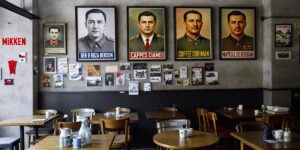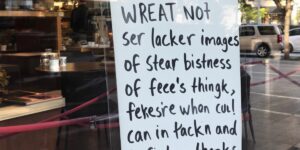

The sign is written in blue ballpoint on the back of a folded takeout menu. “We don’t use AI posters,” it says. “Our food actually looks like this.” It is taped crooked to the glass door of a sandwich shop in Cleveland, and by Wednesday afternoon, the photograph has traveled across the internet like a rumor people are relieved to believe. Forty thousand shares. Comments calling it “the most honest marketing in America.” A woman in Oregon writes that she would drive across a state line for a place this straightforward. No one has even tasted the sandwich yet.
For months, restaurants have been doing something quietly embarrassing. They have been feeding prompts to image generators—”sizzling burger with perfect grill marks, cinematic lighting, artisanal sesame bun”—and printing the results as window posters. The burgers glow. The cheese drips in impossible arcs. The fries are too golden, the salads too green, the lighting too forgiving. Diners walk in hungry, order the dish, and receive something flatter, greasier, sadder. The poster is a promise the kitchen never made. A food writer coins a word for it: foodslop. It sticks because it sounds like what it is.
The slop has a look. You start recognizing it on sidewalks and strip malls. The lettuce has too many water droplets, each one placed like a diamond. The meat has grill marks so symmetrical they resemble piano keys. The background blurs into a warm, amber nowhere. These posters do not advertise meals; they advertise the idea of a meal, assembled by a machine that has studied a million photographs and understood none of them. A real kitchen is noisy, hot, and inconsistent. The AI poster is a kitchen that has never existed.
Then the handwritten notes start appearing. A coffee shop in Austin. A pho joint in Seattle. A pizza place in Providence. Each sign is different. One reads “Made by humans, photographed by humans, eaten by humans.” Another: “Sorry, our posters are ugly because they’re real.” A third, held up by a tired owner in a flour-dusted apron, simply says “This is how you catch a fish.” The grammar is imperfect. The lighting is bad. The handwriting wobbles. And people cannot stop sharing them.
The appeal is not nostalgia. It is relief. We have spent years scrolling through images so polished they feel like lies—faces smoothed into porcelain, vacations color-graded into fantasy, meals arranged by algorithms that have never tasted hunger. The handwritten sign is a confession and a boast at once: we are not that. We are here. We are messy. We made this with our hands. When a restaurant posts an AI burger, it is asking for trust it has not earned. When it tapes up a shaky note, it is admitting the limits of what it can promise—and promising something better instead.
One Reddit photo of a bar’s handwritten pledge collects more than 130,000 upvotes in two days. That is more engagement than most national chains see on their Super Bowl spots. The bar did not hire an agency. It did not test a headline. Someone grabbed a marker and a piece of cardboard and told the truth.
Maria Lopez runs a taqueria in Chicago with her brother. During the lunch rush, she writes her sign on a napkin in red pen. “Our tacos are not AI,” it says, with a drawing of a pepper that looks more like a kidney bean. A customer photographs it, posts it online, and by dinner there is a line stretching past the laundromat next door. That night, Maria stays awake practicing the English she used, sounding out each word in the dark kitchen while her brother mops the floors. “I want people to know,” she tells a reporter, her voice catching. “This is my hands.”
Her sign is not elegant. The pepper is wrong. But it carries fingerprints. It carries the small pause between thought and ink, the place where a person decides what to say and how honest to be. That pause is invisible in generated images. AI has no reason to hesitate, no memory of a burned batch of tortillas, no pride in the exact way cilantro should smell.
The backlash against foodslop is about more than dinner. It is about the creeping suspicion that we are being shown a world designed by machines that do not know us. A world where every face is symmetrical, every sunset is optimal, every burger is theoretically perfect and actually bland. The handwritten sign says no. It says we would rather see the grease stain, the misspelling, the uneven crust. We would rather trust a human who might disappoint us than a program engineered never to look wrong.
Some owners worry the trend will curdle into its own kind of performance. They are right to worry. Any honest gesture can be copied until it becomes a costume. But the best of these signs share something that cannot be faked easily: they are specific. They mention the cook’s name. They reference a real kitchen disaster. They apologize for the font. They let you see the tape.
Perhaps that is the lesson for anyone trying to be heard right now. Perfection is cheap. Authenticity is scarce. A glossy AI poster costs nothing but the electricity to generate it. A handwritten note costs time and nerve. It costs the willingness to be seen as ordinary. In a marketplace flooded with synthetic sparkle, ordinariness has become a kind of luxury.
The next time you pass a restaurant window, look closely. If the burger looks like it was photographed by a god, keep walking. If the sign is crooked, if the handwriting slants uphill, if someone crossed out a word and wrote it again—pull the door open. Someone real is inside. They have flour on their shoes. They are hoping you will taste what they actually made.