

The castle that asks a different question
When you look at a medieval castle, what do you notice first? The towers, perhaps, or the thickness of the walls, or the thought of someone trying to get through a gate that was designed to keep them out.
There is another question hiding behind all that stone: how did ordinary people actually put it there? Not kings issuing instructions, but workers choosing materials, making tools, moving loads, and solving the next problem before the next wall could rise.
In the Guédelon Forest in Burgundy, France, a team has made that question into a construction project. They are building a new castle using techniques and materials associated with the Middle Ages, with the early thirteenth century as their reference.
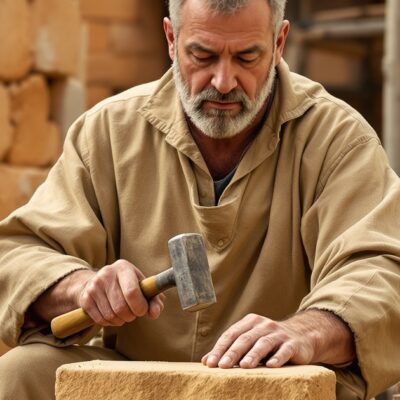
According to Guédelon’s official visitor website, around forty workers take part in the challenge. The work brings together quarrymen, stonemasons, carpenters, blacksmiths, tile-makers, rope-makers, and other craftspeople.
That sounds like a remarkable tourist attraction, and visitors are certainly part of the story. But the most interesting thing about Guédelon is not simply that people are building something old-fashioned.
It is that a finished-looking answer can sometimes be less useful than an awkward, unfinished question. To understand why, you have to go back to a completely different castle.
A discovery behind the walls
The idea began a few miles away at Saint-Fargeau. In the project’s account of its origins, fortification specialists Nicolas Faucherre and Christian Corvisier presented Michel Guyot with findings about his castle: medieval stone walls were hidden within the later red-brick building.
Their report included a drawing of the earlier castle and the suggestion that reconstructing it would be an extraordinary undertaking. That possibility caught Guyot’s attention.
By the winter of 1995, he had gathered a small group of supporters. Among them was Maryline Martin, whose interest, the project’s history explains, included the opportunity to create training, meaningful work, and a long-term future for people.
The team did not ultimately choose to recreate Saint-Fargeau. Instead, they decided to build a new castle, drawing inspiration from neighboring examples and the architecture associated with the reign of Philip Augustus.
That distinction matters. Guédelon was not an ancient ruin waiting for someone to fill in its missing pieces, nor was it a rediscovered fortress emerging from the undergrowth.
The site had been an ironstone quarry, abandoned in the 1950s. There were no old castle walls there to restore, according to the project’s explanation of its archaeological approach.
Starting from that absence made the challenge unusually honest. The team would have to make decisions rather than simply point to existing stones, and those decisions would need reasons beyond looking convincing from a distance.
Where the difficult work becomes the point
A building can preserve evidence without preserving every instruction needed to build it. Looking at a surviving wall is one kind of investigation; trying to make a credible wall with appropriate materials and tools is another.
Guédelon describes itself as an open-air laboratory for experimental archaeology. Its goal is to recreate construction processes and the organization of work that might have existed on an early thirteenth-century site.
The word “might” deserves attention. This is not a claim that every medieval builder worked in exactly the same way, or that one modern project can recover every detail of a vanished working life.
Instead, the construction allows ideas to meet practical resistance. A choice must work with the available material, fit the building’s historical framework, and survive scrutiny from people who study the period.
A scientific advisory committee has been involved from the beginning. Archaeologists, historians, and castle specialists advise on construction choices, while the work itself supplies information about techniques, tools, and managing a site.
The relationship goes both ways. Research helps guide the builders; the builders’ experience gives researchers something that cannot always be obtained by examining a completed structure alone.
The project is unusually open about uncertainty. Its own description includes the need to unlearn, take things down, begin again, and doubt a decision before finding a more credible approach.
For anyone used to seeing only polished results, that may be the most unfamiliar part. Here, admitting that something needs another attempt is not automatically a mark against the work; it can be part of what makes the work useful.
A window reveals the bigger idea
One example is much smaller than a tower. On its experimental archaeology page, Guédelon describes research into how the castle’s windows could have been closed against the outside world.
Under the project’s historical framework and hypothetical scenario, its modest lord would not have chosen glass for those windows. The team explains that glazing was not widespread in modest dwellings in the first third of the thirteenth century.
Working with the University of Lyon II and the Cluny Museum of the Middle Ages, researchers found visual documents that helped them begin experiments. Their approach uses linen painted with pigments from the site, waxed, and stretched over wooden frames.
It is a wonderfully specific problem. The question is not merely whether a window looks medieval, but what material makes sense for this particular building and the people imagined to occupy it.
The team also leaves open the possibility of experimenting with glass-making using sand from the site. That is a possible future experiment, not an achievement to add to the finished list.
This is where the castle becomes more than a demonstration of patience. The small decisions reveal a method: define the question, consult evidence, try a plausible solution, and remain willing to revise it.
A tower makes an impressive photograph. A window covering can reveal how carefully the people behind that photograph are thinking.
The people behind the stone
Visitors are not kept apart from the central purpose of Guédelon. The project says that explaining traditional craftsmanship to a broad audience is one of its main aims, with observation and conversation helping people understand the work.
That changes what there is to notice. The castle is not only an object to admire; it is a reason to pay attention to quarrying, woodworking, transport, and all the connected skills that a finished building can hide.
There is no need to pretend that medieval life was easy to find value in that attention. Appreciating a craft does not require romanticizing the conditions in which earlier generations practiced it.
What feels moving is simpler: knowledge is being made visible through people doing difficult, specific work. The project gives the question of how something was built as much attention as the outline of the building itself.
And it offers a different way to think about progress. Sometimes progress is another layer of stone; sometimes it is discovering that yesterday’s assumption needs to come down before the next layer goes up.
If you could stop beside one craftsperson and ask a question, what would you want to understand? The wall may catch your eye first, but the person working on it may change what you see.