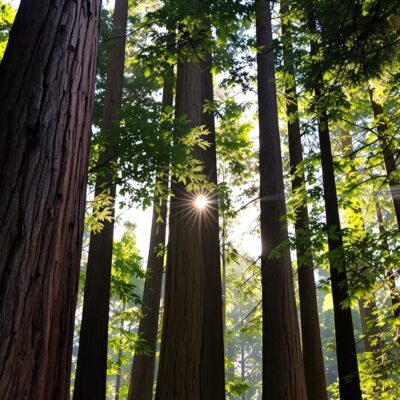



The morning smelled like pine and dust instead of fog. That was the first thing Sarah noticed when she stepped onto the trail in Redwood National Park last July. By 9 a.m. the thermometer had already climbed past 90 degrees, and the air felt borrowed from somewhere south of the forest. Above her, a coast redwood rose 300 feet into a hazy sky, its needles stiff and silent. A tree that had watched centuries pass — that had survived loggers, fire, and flood — was now being asked to survive something it had never seen before: a summer that refused to cool off.
It seems impossible that the tallest living things on Earth could be fragile. Some coast redwoods are older than the Roman Empire. They can pull water straight from ocean fog, move it up a trunk the height of a football field, and live through more than two thousand winters. Yet when temperatures spike, their photosynthesis slows. The very process that turns light into life begins to stall. Scientists are still trying to measure how much damage is being done, but the question itself is the warning.
For most of their long history, redwoods had it easy. The California coast kept them cool. Summer mornings arrived wrapped in fog so thick it dripped from the needles. A single mature tree can absorb hundreds of gallons of water from that fog each year, sometimes meeting nearly half its summer needs without ever touching the ground. Its shallow roots fan out like fingers, drinking from a mist that slides in from the Pacific and never asks permission.
That mist also controlled the thermostat. Under the canopy, temperatures stayed mild. The forest felt like a different world from the highway just miles away — darker, quieter, wetter. Ferns grew thick enough to cushion your footsteps. Salamanders moved through duff that never fully dried. The redwoods made their own weather, and every living thing nearby benefited.
Now the fog is thinning. Heat domes settle over the coast and stay. In the redwood belt, temperatures that once belonged to the Central Valley are becoming normal. The needles, designed to breathe in cool air and exhale moisture, begin to close their pores to stop water loss. That saves water, but it also shuts out the carbon dioxide the tree needs to feed itself. Photosynthesis drops. Growth slows. The giant stands still — and waits.
The cruelty of this kind of damage is that you cannot always see it right away. A redwood does not collapse the first time it overheats. It quietly records the insult in tighter growth rings, fewer seeds, thinner needles, roots that stop reaching. By the time the crown turns brown, the trouble has been building for years. Researchers walk the same plots season after season, measuring chlorophyll and sap flow, searching for a threshold that no one has yet found. They know the trees are stressed. They do not yet know where the breaking point is.
Sarah felt that uncertainty like a weight. She had grown up camping beneath these trees, her grandfather reading aloud from a field guide while she tried — and failed — to wrap her arms around a trunk wider than a car. Last summer, kneeling beside a tagged tree that a scientist had first measured in 1982, she pressed her palm against bark that was warm to the touch. For a moment she was not a technician gathering data. She was a granddaughter standing in front of something her grandfather had loved, watching it struggle for reasons that felt bigger than both of them. She wanted to say she was sorry. She wanted to promise it would be okay. She did not know if she could keep that promise.
What redwoods are showing us is not only a climate story. It is a story about how life responds when the conditions that shaped it disappear. These trees were built for stability. They grew tall because the world around them stayed predictable — cool summers, wet winters, reliable fog. Remove that predictability and even a giant becomes uncertain. Its biology has no playbook for heat that arrives early, stays late, and comes back again before the canopy has recovered.
The warning signs are everywhere if you know how to read them. Fog season is shorter. Heat records keep falling. Seedlings in logged or burned areas fail where they once took root. Forest creatures that depended on the redwood microclimate move higher or vanish. Each signal is quiet, but together they say the same thing: the shelter these trees built for the rest of us is starting to fail.
We will not outlive the redwoods we plant today, but the redwoods we save may outlive the worst of our choices. That is the strange math of these trees. They ask us to think past our own lifespan, to protect a future we will never see. It is not enough to be sad about a browning canopy. We have to be faithful — to the fog, to the cool hollows, to the child who will one day stand where Sarah stood and look up.
That child will not care about the data. She will care whether the trunk is still there to press her hand against, whether the air still smells like wet bark and centuries, whether the forest feels like a promise kept. The redwoods cannot speak, but they are telling us anyway. It is still possible to listen before the quiet becomes permanent.