

The awkward journey that caught my attention
What stopped me in this octopus story was not a dramatic escape. It was the awkward middle: a small animal moving across the seabed while carrying something that made the journey harder.
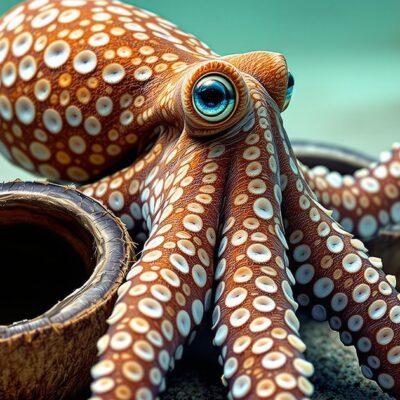
In observations published in 2009, researchers documented veined octopuses transporting coconut shell halves beneath their bodies. The animals arranged the shells, spread their arms around them, and moved in a distinctive way the researchers called stilt walking.
I can understand why the movement attracted attention before the explanation did. An octopus balanced over a stack of curved shells is an arresting sight, but the interesting question is not whether it looks funny.
It is why an animal would carry an awkward object that offered no protection while it was being carried. The useful part of the behavior happened later, and stopping the story at the unusual walk would miss it.
This is an older observation, not a newly announced discovery. Returning to it now offers something more durable than a surprising animal clip: a chance to separate what a creature visibly does from the assumptions we bring to it.
That distinction matters because a soft-bodied animal crossing open ground has a problem to solve. The shell was not simply a prop in a charming underwater performance.
A shell on the seabed was only the beginning
The species was the veined octopus, Amphioctopus marginatus. According to Associated Press reporting published by the Guardian, the observations came from dives around North Sulawesi and Bali between 1998 and 2008.
The report described animals selecting halved coconut shells from the seabed, emptying them, transporting them, and bringing two halves together to form a hiding place. That sequence matters more than any single photograph of an octopus inside a shell.
Finding shelter in an available object was not, on its own, the surprising part. The researchers were already familiar with octopuses occupying shells, and a creature making use of cover is not automatically doing something that scientists would classify as tool use.
The difference was in what happened between finding the object and using it for protection. Instead of remaining inside a ready-made refuge, the octopus could take the pieces along.
I find that an important correction to the easiest version of the story. Calling the animal a little homeowner may be affectionate, but it replaces a specific behavior with a human character before we have understood the evidence.
We do not need a fictional personality to make the observation worth our attention. There is already a real puzzle in the arrangement of the shells and the decision to move with them.
The burden came before the benefit
The Cell Press account carried by ScienceDaily describes the octopus spreading over stacked shells with their open sides facing upward. Its arms stiffened around the assembly, allowing it to move across the seafloor with the shells underneath.
That was not the same as being safely tucked inside. During transport, the shells did not provide the protective enclosure they could offer once arranged as shelter.
The publisher’s account reported 500 diver hours and observations of 20 veined octopuses. On four occasions, individuals carried stacked shell halves over considerable distances, reaching as much as 20 meters.
Those numbers help keep the story in proportion. They describe a striking field observation, not a test showing that every octopus behaves this way or that all members of the species carry shells whenever they travel.
The work also does not give us a transcript of an animal’s thoughts. Carrying an object with a later use is observable; saying the animal imagines tomorrow exactly as a person does would go beyond what these accounts establish.
That limit does not make the behavior less impressive. It makes the description more useful, because we can appreciate the coordination and sequence without pretending that the human explanation in our heads is the animal’s own explanation.
For me, the awkward walk is where the story becomes more than a novelty. The object only makes sense when we allow the sequence to continue beyond the moment that first catches our eye.
Why the researchers called it a tool
Julian Finn, Tom Tregenza, and Mark Norman published their report as Defensive tool use in a coconut-carrying octopus in Current Biology. Their interpretation depended on the separation between carrying the shells and deploying them.
A hermit crab occupies a shell that protects it while it moves. In these observations, the octopus transported material that would provide protection later, after the pieces were positioned for that purpose.
Assembling two separate halves added another part to the sequence. The animal was not merely moving into an intact container already waiting in its path.
There was still room for scientific disagreement about the label. The Associated Press report included an outside biologist’s caution that definitions of tool use vary, making sweeping claims about a first example difficult to settle.
I would rather keep that caution than turn the finding into a contest about which animal earned a human-sounding title. The behavior remains remarkable even if researchers debate the boundary around a word.
The scientists also suggested that the behavior may previously have involved natural shells, before discarded coconut halves became available. That was an evolutionary suggestion, not something their observations directly reconstructed.
Nor is an animal’s use of a discarded object an argument for leaving waste in the sea. A resourceful response to material in the environment does not make dumping harmless or desirable.
A better way to watch something unfamiliar
The takeaway I keep is about attention, not about treating an octopus as a motivational speaker. We can miss the function of a behavior when we judge only its most conspicuous moment.
The carried shells looked cumbersome because they were cumbersome. Understanding what came afterward did not erase that cost; it explained why the researchers considered the whole sequence worth investigating.
There is a practical habit here for anyone who enjoys watching animals. Notice what happened before the eye-catching action, what happened after it, and which parts of the explanation are observations rather than guesses.
That approach also leaves room for the animal to remain unfamiliar. It does not have to look like us, solve a human puzzle, or fit a sentimental story to deserve thoughtful consideration.
If you encounter marine life, the story is an invitation to observe without interfering, not to move animals or arrange objects for a better clip. The meaningful thing is the behavior the animal can perform without our staging it.
I began with the awkwardness of an octopus carrying shells. I ended with a more generous question: what might become clear if I watched long enough to see the next part?
Featured image: AI-generated illustration inspired by the reported behavior, not a documentary photograph of the research.