




The Halloween dish I almost mistook for ordinary mash
At first glance, a bowl of potatoes and cabbage seems like an unlikely place to look for Halloween. There are no elaborate decorations, no spectacular icing tricks, and nothing that requires a trip down a seasonal shopping aisle.
That is what draws me to colcannon. Read about this Irish dish for a little longer, and an everyday combination starts to carry something much bigger than a recipe.
The ingredients are familiar: potatoes, cabbage or kale, milk, and butter. Yet the stories attached to the bowl involve hopes for the coming year, local customs, and people making an ordinary meal feel like an occasion.
I am not claiming an inherited family recipe or a childhood memory of eating it. What interests me is the possibility it offers now: a celebration does not have to become another complicated project before it deserves a place at the table.
If you have ever wanted to make an evening special while looking at a very ordinary cupboard, that is an appealing starting point. But before getting to the saucepan, there is an important distinction to make.
This is not a single, fixed tradition that every Irish household followed in exactly the same way. The differences are part of what makes the story worth keeping.
A familiar bowl with an unexpected second purpose
Irish Heritage News describes accounts from the 1930s Schools’ Folklore Collection showing colcannon eaten at Halloween across much of Ireland. Its report also notes regional differences in how common the dish was and what people called it.
In parts of Connacht and Ulster, names included “cally” or “callie.” In parts of Leinster, its association with the occasion was strong enough for Halloween to be called “Colcannon Night.”
The bowl could contain more than dinner. Rings, coins, and other small objects were sometimes hidden in the food, with their discovery interpreted as a prediction about the eater’s future.
A ring could suggest marriage; a coin could suggest wealth or luck. But the meanings were not consistent everywhere, and the heritage account explicitly describes traditions that differed or even contradicted one another.
That matters because a neat list of symbols can make a living tradition sound like a standardized game. These were local practices, passed between people, not instructions issued from one central kitchen.
IrishCentral’s account of Halloween colcannon also describes the hidden-charms custom and variations involving cabbage, kale, and spring onions. Read together, the sources show a shared association without requiring every family’s version to be identical.
I would keep the conversation and leave the hidden objects out. Coins, rings, buttons, and other nonfood items can be choking hazards or damage teeth, and wrapping them does not make them suitable ingredients.
What belongs in the pot, and what can change
Colcannon gives you a useful way to think about tradition: some elements make the dish recognizable, while other choices leave room for the cook. Potatoes and greens provide the foundation of this version, with milk and butter bringing them together.
The heritage account records additions including spring onions, parsley, carrots, and parsnips, depending on place and custom. Kale is another established option rather than a modern attempt to make cabbage more fashionable.
For a straightforward starting point, the recipe below adapts the four-serving quantities published by Irish Heritage News. It uses cabbage, leaves the optional vegetables out, and simplifies the potato cooking into a conventional simmer followed by thorough draining.
You will need:
- 1 kilogram floury potatoes, peeled and cut into evenly sized chunks
- 400 grams savoy cabbage, tough core removed and leaves finely sliced
- 100 milliliters whole milk, plus a little extra only if needed
- 3 tablespoons salted butter, divided between cooking and serving
- Salt and white or black pepper, to taste
- Optional: 1 bunch spring onions, trimmed and finely sliced
This makes about four servings; whether that is a side dish or the center of a meal depends on appetite and what accompanies it. A floury potato, such as a russet, is a practical choice for a soft mash.
You do not need a decorative serving bowl or an elaborate topping. Keeping the ingredients simple also lets you notice the contrast between the potatoes and greens, rather than burying both under additions.
The small cooking details that make the bowl work
Put the potato chunks in a saucepan, cover with cold water, and add a pinch of salt. Bring to a boil, then reduce to a steady simmer until a knife slides easily through a piece, usually around 15 to 20 minutes depending on size.
Meanwhile, cook the sliced cabbage in a separate saucepan with a little boiling water until tender. Start checking after a few minutes; the thickness of your slices will affect the time.
Drain the cabbage well, then stir through a little of the measured butter. Drain the potatoes thoroughly too, return them to their warm pan off the heat, and let excess steam escape briefly before mashing.
Warm the milk in a small pan without letting it boil over. Mash the potatoes by hand, gradually adding the warm milk and most of the remaining butter, keeping a little butter for serving.
Fold in the cooked cabbage and the optional spring onions. Taste before adding more salt, especially because the butter is salted, then season with pepper.
The goal is soft and creamy, not loose or watery. If the potatoes need more liquid, add a small splash of warm milk at a time rather than pouring in a large amount.
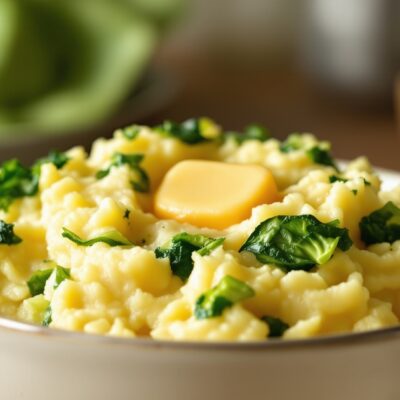
Serve hot, with a small well in the center for the reserved butter. If the mixture cools during preparation, warm it gently over low heat while stirring so it does not catch.
The practical lesson is not secret technique. Draining the vegetables and adjusting the milk gradually give you more control than treating the stated liquid quantity as something that must be added regardless of texture.
A tradition you can share without pretending it is yours
The part I find most inviting is not the idea that dinner might predict a future marriage or a lucky year. It is that a familiar food could help people mark a night as different from the nights around it.
There is room to appreciate that without claiming Irish ancestry, inventing a grandmother’s story, or presenting one recipe as the only authentic version. Name the dish, acknowledge where it comes from, and let the differences remain visible.
If you want a safe nod to the fortune-telling custom, keep it entirely outside the food. Invite everyone to name one thing they hope the next year brings, with no pressure to make the answer profound or public.
That suggestion is a modern table activity, not a claim about a historical ritual. It preserves a little anticipation while leaving the potatoes free of surprises nobody should swallow.
A bowl of colcannon cannot make uncertainty disappear. It can, however, give an ordinary evening a warm center: something useful to make, a story worth learning, and a reason to sit down before the butter stops melting.
Image: AI-generated food illustration, not a documentary photograph of a particular household or historical celebration.