


The fight was not the whole story
In a study of ravens, some of the most revealing behavior came from birds that had not been in the fight. Researchers watched what happened after aggression ended, when an uninvolved bird could approach the one that had received it.
That is a different place to look for intelligence. There was no puzzle box, hidden snack, or clever tool to admire, just the difficult business of living around others and dealing with what happens when an encounter goes badly.
The researchers were interested in something that sounds familiar but is surprisingly hard to establish: whether those approaches might be consolation. A bird sitting close to another bird gives us a behavior we can record; it does not give us direct access to either animal’s feelings.
That distinction is what makes this story worth staying with. The evidence is more interesting than a simple claim that ravens are just like people, and more moving than dismissing every friendly encounter as meaningless.
The work was published in 2010, not announced this week. Its enduring question is still an inviting one: after watching a conflict, what can the next interaction tell us about the relationships that were already there?
Watching ten minutes instead of one dramatic moment
In their PLOS ONE study, Orlaith Fraser and Thomas Bugnyar examined a group of 13 hand-reared ravens housed at an Austrian research station. The observations were collected between August 2004 and June 2006.
These were captive birds, an important boundary around the findings. Their experiences and living arrangements cannot automatically stand in for every raven in the wild, and the researchers explicitly called for work across other populations and stages of development.
After an aggressive encounter, the observer followed the recipient of aggression for ten minutes. Friendly behaviors included sitting in contact, preening, and touching another bird with the beak; aggressive interactions were recorded too.
But a friendly moment after a fight does not necessarily mean the fight caused it. If two birds regularly spend time together, they might have approached one another anyway.
To address that problem, the researchers compared those observations with matched periods for the same bird at a similar time on another day. The comparison gave ordinary social behavior a place in the story instead of treating every close encounter as exceptional.
They collected 152 pairs of post-conflict and control observations. Those repeated comparisons mattered more than any single touching scene could have, because the question was whether a pattern emerged, not whether a moment looked comforting to a human observer.
The study also separated two directions of contact: a bystander approaching the victim and the victim approaching a bystander. They might look similar in a photograph, but their possible meanings are not identical.
The relationship before the trouble mattered
Both kinds of friendly contact occurred sooner after conflicts than in matched control periods. There was evidence of a social response to what had happened, rather than simply the usual background level of birds spending time together.
Who approached whom was part of that pattern. Bystanders involved in these interactions tended to share valuable relationships with the recipient of aggression, assessed through behaviors such as preening, sitting together, and support during conflicts.
Here, valuable is a research description, not a judgment about a bird’s worth. It refers to benefits within a particular relationship, giving researchers a way to investigate social closeness without inventing an inner monologue for the animals.
There was a further qualification: when the analysis controlled for baseline friendly contact, relatives stood out. That detail prevents the result from becoming a sweeping claim that any raven will comfort any other raven nearby.
The uninvolved birds were also more likely to initiate friendly contact after higher-intensity conflicts. That fit the possibility that they were responding when the recipient was more distressed, although the study did not directly establish the animal’s emotional state.
Contemporary reporting in WIRED highlighted the same central observation: the birds that spent time with the victim were especially likely to approach afterward. The existing relationship was not background decoration; it helped explain the next interaction.
Meanwhile, contact initiated by the victim was associated with a lower likelihood of renewed aggression afterward. The authors suggested that seeking out a bystander could help provide protection, a different possible function from consolation offered by someone else.
Why the question mark belongs in the answer
The paper’s title asks whether ravens show consolation. Keeping that question mark is not an attempt to drain the feeling from the story; it is a way of respecting what the researchers actually investigated.
Consolation is a demanding interpretation. It implies that an interaction eases distress and that the animal offering it is responding to another’s emotional state, rather than merely performing a familiar behavior for some other reason.
The observed patterns supported that possibility, particularly the importance of close relationships and more intense conflicts. They did not establish human-like empathy beyond doubt or directly demonstrate a reduction in the victim’s distress.
The researchers also noted a subtle uncertainty about who truly started an exchange. Vocalizations were not recorded, so an apparently spontaneous approach could have followed a signal from the victim that the study did not capture.
Nor was friendly contact a simple substitute for everything else. Reconciliation between the original opponents was not established at the group level, and the birds could remain at risk of renewed aggression after a conflict.
What remains is substantial: a carefully observed pattern suggesting that ravens’ relationships shape their responses after trouble. That is enough to challenge a picture of their social lives as nothing more than competition, without turning them into tiny feathered therapists.
A reason to notice what happens next
There is a human takeaway here, but it is a reflection, not a treatment recommendation derived from a bird study. The loudest event can capture all our attention while the quieter response afterward goes almost unnoticed.
In our own lives, we can choose to notice that second moment. After a difficult exchange, a private check-in can offer someone company without demanding an account of what happened or announcing their distress to everyone nearby.
That might mean asking whether they would prefer space or company, then respecting the answer. It does not require forcing a reconciliation, assuming touch is welcome, or pretending that kindness alone resolves an unsafe situation.
The ravens do not prove a moral rule for people. What their behavior offers is a reason to be curious about relationships we might otherwise overlook, and to resist judging an entire social world by its most dramatic clashes.
For anyone watching birds outdoors, that curiosity can remain quiet and nonintrusive. Observe from a distance rather than approaching, feeding, or provoking animals to recreate something described in research.
The lasting image is not a fight with a neat ending. It is the possibility that the next approach matters, and that understanding it requires paying attention to the bond that existed long before the trouble began.
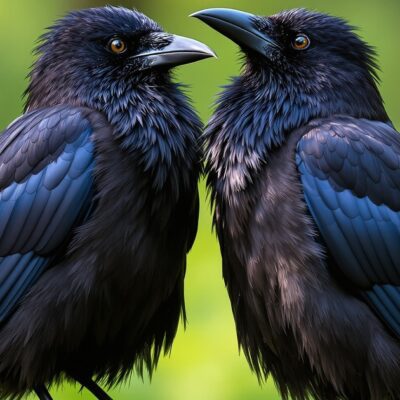
Illustration: AI-generated ravens, not a documentary photograph of the study birds or a recorded post-conflict interaction.