The rescuers had a reason to hide
At Monterey Bay Aquarium, some of the people caring for orphaned sea otter pups cover their faces and bodies before feeding them. The disguise is not for the visitors, and it is not a game for the animals.
It is a precaution against an outcome that might sound, at first, like a success: a rescued pup becoming comfortable with people. For an animal meant to return to the ocean, that familiarity can become a problem.
There is an immediate tug in the story of a small animal that needs help. We want the reassuring moment when it recognizes its rescuer, comes closer, and decides it has found someone safe.
This program asks its caregivers to work toward something different. They provide intensive care while trying not to become the center of the pup’s world.
The goal is not to raise an unusually friendly otter. It is to give an orphan the skills and relationships it needs to live as a wild one.
That difference explains the hidden faces. But it also leads to the more surprising part of the work: the human team cannot supply everything the young animals need, however carefully it feeds and protects them.
Keeping a pup alive was not the whole job
The aquarium began rehabilitating sea otters in 1984, according to Bay Nature’s reporting on the program. In the early years, staff raised pups by hand, providing care around the clock.
That is substantial work, but a full stomach is only one part of being ready for life outside. Young otters also need to develop the behaviors that make independent living possible.
In its description of the program, the aquarium identifies diving, foraging, and grooming among the critical skills. These are not optional accomplishments to celebrate after rehabilitation; they are part of what rehabilitation has to deliver.
And the relationship with humans has to be handled carefully throughout. A pup learning to associate people with food may carry that association into a place where strangers are boating, swimming, or spending time along the shore.
Bay Nature’s 2023 account describes a rehabilitation specialist putting on a black face shield and long gown before bottle-feeding a two-week-old pup. Staff called the outfit a Darth Vader suit, but the reason for it was entirely practical.
The disguise was meant to reduce the chance of the animal learning human faces, forms, smells, or sounds as signals of food. It was part of a larger effort to limit human familiarity, not a guarantee that familiarity could never develop.
There is something quietly moving about that restraint. These people were doing close, demanding work for an animal whose best possible future would take it away from them.
A meeting changed what rescue could look like
A turning point came in 2001. As Bay Nature recounts, a resident aquarium otter named Tula gave birth to a stillborn pup around the time an abandoned, wild-born pup arrived.
The team brought the two together. Tula was lactating, and staff knew that adoption could happen among wild sea otters; the pairing became the beginning of the aquarium’s surrogacy approach.
There is no need to invent what Tula understood or felt in that moment. The documented consequence is powerful enough: a female otter could provide care that helped an orphan prepare for an otter’s life.
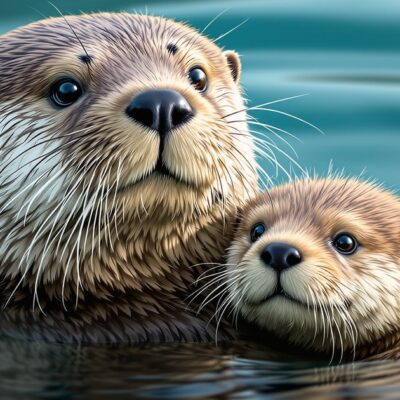
The idea developed into a program pairing young orphans with adult females that could not return to the wild. The mothers’ role was not a decorative addition to the human rescue effort; it became central to it.
The aquarium’s current account of its recovery program explains that staff evaluate maternal behavior when introducing a female to a new pup. They do not simply train every adult otter to become a surrogate mother.
That distinction keeps the story honest. This is not a claim that any two animals can be placed together and immediately form a family, or that a human plan can demand a bond into existence.
In the research described by Bay Nature in 2023, nearly half of the pups bonded with their surrogate at the first meeting, and 89 percent did so within a week. Staff observed introductions remotely, watching for behavior such as sharing food.
The waiting matters as much as the hopeful beginning. A successful pairing has to be observed in what the animals actually do, rather than assumed because people want the story to end well.
The result reached beyond a single release
The program’s test was never just whether a mother and pup looked settled together. It was what happened when the younger animal eventually left the protected setting.
Bay Nature reported that three-quarters of 64 surrogate-reared orphans in the research successfully reacclimated to the wild. That is encouraging evidence, but it is not a promise that every rescued pup survives or that rehabilitation removes the dangers of the ocean.
The aquarium describes a process that includes behavioral milestones before release and monitoring afterward. Its account says released animals have been observed foraging, grooming, resting, and raising pups of their own.
That last outcome changes the scale of the story. A rescued orphan can become more than a surviving individual: it can contribute to another generation living outside human care.
There is an ecological consequence, too. Sea otters are a keystone species, meaning their activities can strongly shape the habitats and other living things around them.
The aquarium points to Elkhorn Slough, where surrogate-raised otters and their offspring contributed substantially to population growth. Their feeding relationships also helped support eelgrass habitat, connecting an individual animal’s recovery with changes in the wider estuary.
Those effects should not turn a rescue story into a claim that one program has fixed the coast. Southern sea otters remain vulnerable to threats including shark bites, pollution, disease, and habitat loss.
The kindest ending is not always the closest one
For a member of the public, the lesson is not to imitate an otter caregiver or try to raise a stranded pup. The aquarium says its team first tries, whenever possible, to reunite an orphaned pup with its mother in the wild.
Professional assessment comes before the appealing picture of a new surrogate family. If an otter appears stranded or in trouble, keep your distance and contact the appropriate wildlife responders rather than approaching, feeding, or handling it yourself.
It is easy to measure care by how close an animal allows us to get. This program offers another measure: whether the help leaves that animal better able to live without us.
The disguise, the careful introduction, the behavioral checks, and the monitoring all serve that purpose. None is as instantly shareable as a photograph of a pup, but together they are what give the hopeful photograph substance.
A surrogate mother cannot erase how the orphan’s life began. She can help supply the care and learning that its next chapter requires.
And the humans who made that possible do not need to remain its favorite companions. For this rescue team, an otter living its own wild life is not a loss of connection; it is the point of the work.