



The worn sleeve is not the whole story
A favorite shirt can become a difficult object the moment its elbow wears through. The rest still fits, the fabric feels familiar, and throwing it away seems excessive, but keeping it means deciding what to do about that small, very visible failure.
Would you repair it if the repair could not disappear? That question sits behind a Japanese textile tradition whose beauty can be easy to admire and surprisingly easy to misunderstand.
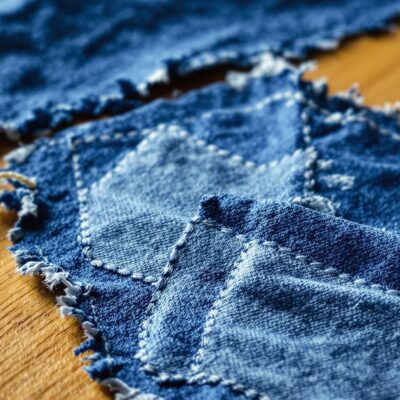
Look at patched indigo cloth and you might notice the colors first: deep blue beside a faded scrap, pale stitches crossing a darker surface. It can look like a carefully planned modern design, especially when a photograph removes the cloth from the life in which it was used.
But the Victoria and Albert Museum’s account of boro textiles asks us to look beyond the appealing surface. These are objects shaped by the practical work of keeping fabric useful, sometimes across generations of families who had little to spare.
The story is not that hardship was secretly lovely, or that every hole deserves to become an artwork. It is that something we now recognize as beautiful grew from a question much less glamorous than design: how can this last a little longer?
Before the admiration came the need
The V&A explains that boro derives from the Japanese word boroboro, referring to something tattered or repaired. It describes a practice of piecing, patching, and stitching existing textiles, including clothing and bedding, to extend their use.
In the nineteenth and early twentieth centuries, the museum notes, boro garments might pass through several generations of impoverished rural families. A worn place did not necessarily end an object’s working life; another piece of cloth could be added, and the use could continue.
That background matters when an old patched garment appears in a beautiful museum photograph. Calling it stylish is not wrong, but style alone leaves out the limited resources and repeated work behind it.
The museum connects this thrift with mottainai, a sense of regret concerning waste. That is more specific than a vague promise that buying a handmade-looking object will make our lives simpler.
There is also a distinction worth keeping straight. Boro refers to the reworking and repair of textiles, while sashiko describes stitching that can have reinforcing and decorative purposes; the words are related in this context, but they are not interchangeable labels for anything blue with white thread.
The V&A describes running stitches and areas of sashiko being used to reinforce fabric and join layers. The visible pattern is therefore not merely something placed on top of a useful object: in these examples, stitching helps the object remain useful.
The detail that changes which side you notice
One observation in the museum’s account complicates the modern fascination with rough-looking patches. The heavily patched surface that viewers admire today for its spontaneous, abstract appearance was often the back or inside of the textile.
More care could be taken in arranging the fabrics on the side that other people would see. What now attracts an admirer may not be what its maker wanted to put on display.
That is a reason to pause before treating every old repair as a deliberate celebration of imperfection. People maintaining essential clothing could care about appearance while also needing to make limited cloth go further.
The V&A gives a concrete example: a late nineteenth-century utilitarian robe in its collection, made entirely from recycled fabric and repaired with recycled indigo-dyed cotton. The museum describes it as a garment that would have been worn by a farmer or fisherman.
Even its wear requires careful language. The shredded end of the left sleeve suggests to the museum that the last wearer was left-handed; it does not give us a complete biography, a name, or permission to invent an emotional scene around the garment.
Likewise, its unusual triangular sleeves may have been influenced by the shapes of available material. A possibility is still a possibility, yet it is enough to change how we look: the design might carry evidence of practical decisions rather than an unlimited choice of supplies.
A patched robe cannot tell us everything. It can still encourage a better question than whether we would buy something that looks like it: what work did this object have to do, and what did someone do to keep it going?
A living craft, not a shortcut to a feeling
Sashiko is not only a technique encountered through old museum objects. In its archived 2018 workshop announcement, Japan Society introduced Atsushi Futatsuya, a third-generation sashiko craftsman from Gifu, as the teacher of a hands-on session.
The organization described the stitching as valued for both practical and decorative applications. This is a past event, not a current invitation to book, but it points toward something useful: there are practitioners and teachers behind the images circulating online.
Learning from that context is different from assuming a few stitches give anyone ownership of an entire tradition. A beginner can appreciate the work, learn its vocabulary, and credit the people teaching it without pretending to have mastered it.
For a practical place to begin, the V&A offers a free boro-inspired bag guide designed by textile artist Susan Briscoe. Its instructions provide a more substantial next step than trying to reconstruct a technique from an attractive photograph.
If your actual goal is repairing an everyday shirt, start by identifying the damage and the material rather than copying a pattern immediately. A weakened area around a hole, a stretchy knit, and a sturdy woven patch do not all behave in the same way.
Practicing on spare cloth first lets you see whether your stitches pull the fabric tight or leave it lying comfortably. That is a modest beginner’s exercise, not a substitute for a craftsperson’s instruction or specialist care for a valuable historical textile.
What would you choose to keep?
There is no requirement to turn your wardrobe into a personal repair project. Time, dexterity, eyesight, tools, and money affect what is realistic, and asking someone else to do a repair can be a sensible choice.
Nor does every damaged garment need saving at any cost. The useful change is smaller: noticing the moment when a single worn area makes us dismiss everything that still works.
A repair can be neat and discreet, or it can remain visible. Neither choice needs a grand explanation, and neither makes its owner a better person.
What these textiles offer is not a promise that mending will heal your life. They offer evidence that an object’s usefulness can survive visible change, and that the labor of maintaining it deserves attention alongside the pleasure of acquiring it.
That brings the story back to the shirt with the worn elbow. Before deciding its next chapter, there is room for one ordinary question: do you want this thing to keep being part of your life?
If the answer is yes, its changed appearance might not be the end of the conversation. What is the everyday object you would most like to keep using, even if its next repair showed?
Image: AI-generated illustration of patched cloth, not a photograph of a historical textile or museum object.