

The birthday that came before the beginning
Grandma Moses had already turned eighty when her first solo exhibition opened in New York. Not a retrospective celebrating a career that began in youth, but an introduction to a painter whose public artistic life was only getting started.
That detail can land differently depending on what you have quietly stopped allowing yourself to want. Perhaps there is a class you never took, a box of supplies you put away, or an interest you have learned to describe as something you would have enjoyed in another life.
Stories about late success usually arrive with an instruction attached: stop making excuses. But the life of Anna Mary Robertson Moses offers something more interesting than a scolding disguised as encouragement.
She had spent decades doing demanding work before the art world paid attention. The years before her paintings became famous were not empty years, and her new work did not require her to erase them.
The question her story raises is not whether everyone can become a celebrated artist at eighty. It is what we miss when we decide that the most visible beginning is the only beginning that counts.
Long before anyone called her an artist
Moses was born in 1860 in Greenwich, New York. According to the Smithsonian American Art Museum’s biography, she grew up on a farm and worked as a hired girl, helping with cooking, cleaning, and sewing.
Her father encouraged her to draw on old newsprint. Berry and grape juices supplied color, a small early detail that complicates the familiar claim that her creativity suddenly appeared in old age.
She married at twenty-seven and moved to a farm in Virginia, where she raised five children. Domestic and agricultural work occupied much of the life that came before the paintings now associated with her name.
It is tempting to hurry through that part of the biography, as though it were simply the long wait before the real story. Doing so would repeat the very mistake her later career helps us notice.
Her pictures drew on rural life: its landscapes, activities, buildings, and seasons. The world she had known through work became a world she could arrange in paint.
That does not mean every difficult year was secretly preparing a reward. Hard work is not made fair by a happy ending, and no one owes the world an inspiring transformation after a lifetime of responsibility.
But it does suggest a gentler way to understand a delayed ambition. A person can arrive late to a particular medium without arriving empty-handed, carrying years of observation that never appeared on a professional résumé.
A small display became a very different doorway
By her seventies, Moses was taking up painting in earnest. Both the Smithsonian and Bennington Museum’s account of her life and work describe the extraordinary distance between those later beginnings and the recognition that followed.
Her work reached viewers through places far removed from the usual image of an art-world debut. The Smithsonian describes paintings sold at country fairs alongside her prize-winning pickles, while Bennington documents a display in a local pharmacy.
Bennington dates collector Louis J. Caldor’s encounter with that pharmacy display to 1938. He bought the paintings she had completed and worked to find representation for her in New York.
The Smithsonian’s shorter biography gives a different year for the collector encounter, so that date should not carry the weight of the story. What matters here is the documented path: work made locally, seen by someone outside her immediate circle, and brought to a larger audience.
Bennington records that three of her paintings appeared in a Museum of Modern Art group exhibition in 1939. In October 1940, a month after her eightieth birthday, her first solo exhibition opened at Galerie St. Etienne.
Organized by Otto Kallir, it was titled What a Farm Wife Painted. The title itself held the contrast that would help make her famous: an ordinary social identity meeting work that demanded closer attention.
There was effort in this story, but there were also other people, institutions, and timing. Turning it into a formula about determination alone would remove the help that made the next stage possible.
The paintings were more than an age-defying headline
Once the age catches our attention, it can become difficult to look past it. Yet Bennington Museum makes a point that deserves space beside the remarkable biography: Moses had a skilled, practiced sense of color, texture, and composition.
Her elevated views allowed houses, barns, hills, and human figures to form carefully organized pictures. Scenes of maple sugaring, quilt making, country weddings, and changing weather provided more than a list of charming activities.
These were artistic choices about how to present a world. The museum describes both the nostalgic appeal of her rural scenes and their strength as arrangements of shape, pattern, and color.
That distinction protects her from being reduced to a motivational anecdote. She was not simply an older woman who picked up a brush; she made a substantial body of work that people continued to study and collect.
Her images traveled widely through reproductions, including greeting cards. Bennington records a Time cover in 1953 and a televised interview with Edward R. Murrow in 1955, signs of how far her public recognition had spread.
The Smithsonian says she produced more than fifteen hundred images before her death at 101. Those paintings make the later chapter look less like one lucky moment and more like years of sustained making.
A beginning does not need to promise a second career
There is a practical way to take this story home without turning it into another demand to achieve. Separate the activity you want to try from the outcome you think would justify trying it.
You can sketch without promising to become an artist. You can join a beginner’s class without pretending that money, health, caring responsibilities, or access have stopped being real constraints.
Choose an experiment small enough to fit the life you actually have: a borrowed set of materials, one short lesson, or an afternoon making something with what is already available. The point is not to imitate Moses’s career but to stop requiring a career before permitting an interest.
Her fame also should not become a standard against which quieter beginnings look disappointing. A drawing nobody buys can still hold your attention, and learning something without becoming exceptional is not a failed version of learning.
The museum objects associated with Moses include art supplies, a paint-stained apron, and the table she used for painting. Alongside the exhibitions and famous reproductions, these ordinary things bring the story back to the work itself.
There was a surface to work on, something to look at, and another picture to make. Before the world decided what to call her, she had something worth doing with the time in front of her.
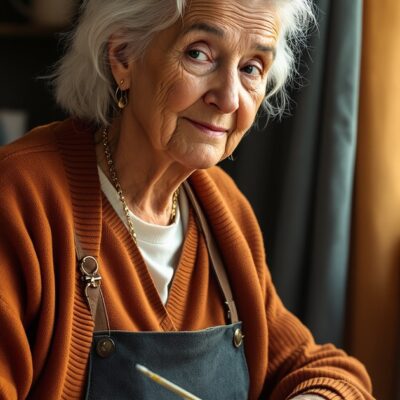
Image: AI-generated illustration of later-life painting, not a photograph of Grandma Moses or a reproduction of her artwork.