


The detail that made me read twice
I was reading a study about horses when I reached the detail that changed the whole experiment for me: when the person finally appeared, her face was neutral. No angry glare, no obvious smile, no fresh emotional clue meant to explain what happened next.
That matters because the horses had already seen her before, but only in a photograph. What the researchers wanted to know was whether something from that earlier image would carry into a later meeting with a real person.
It is easy to love the idea that animals understand us. It is much harder to separate that hope from what an experiment actually measures, especially when the result seems to touch something as personal as trust.
This 2018 study offered a small, carefully framed way into that question. It was not about a rescued horse recognizing a beloved owner, and it was not a story about an animal detecting someone’s hidden character.
It began with unfamiliar human faces, two different expressions, and a delay. For me, the interesting part was not whether a horse could notice a face in front of it, but whether that face would mean something different hours later.
A photograph, then a very different meeting
Researchers Leanne Proops, Kate Grounds, Amy Victoria Smith, and Karen McComb described the experiment in Current Biology. Their accepted manuscript lays out a design involving 48 domestic horses from four locations in East Sussex, England.
The horses were accustomed to being handled by people. Twenty-four took part in the experimental condition, while another 24 took part in a comparison condition designed to test an important alternative explanation.
First, each horse was shown a photograph of one of two women. The woman in the image had either a happy expression or an angry one, and the photograph was presented for two minutes.
Between three and six hours later, a woman appeared in person with a neutral expression. For the experimental group, she was the person from the photograph; for the comparison group, she was the other woman.
That switch was essential. If an angry photograph simply left a horse more unsettled around any human, the response could carry over to a different person too, without the horse linking the expression to an individual.
The women also did not know which emotional photograph the horses had seen. That precaution reduced the possibility that a woman might unknowingly behave differently because she expected a horse to be wary of her.
Reading those details slowed me down in a useful way. The study was not asking us to accept someone’s impression that a horse seemed unusually sensitive; it was trying to distinguish between explanations that could look similar from outside.
What the researchers watched instead of guessing
A horse cannot fill in a questionnaire about its first impression. The researchers therefore recorded observable responses, including looking direction, certain behaviors associated with stress or displacement, approach and avoidance, and heart-rate measures.
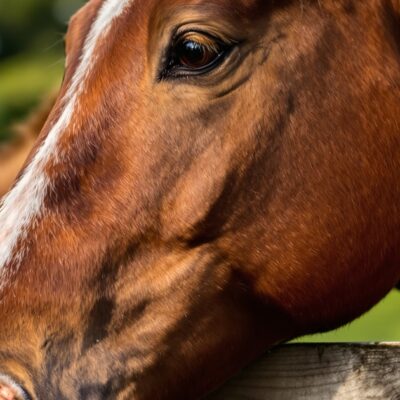
One finding involved which eye the horses used to look at the person. Horses previously shown an angry photograph spent more time viewing that same person with their left eye than horses previously shown her happy photograph.
The researchers interpreted that pattern in the context of earlier work connecting left-eye viewing with the processing of potentially negative or threatening stimuli. It was a behavioral indicator, not a direct recording of a horse’s thoughts.
The horses in the angry-photo condition also spent more time in displacement behaviors during the later meeting. The study grouped actions such as scratching, floor sniffing, and licking and chewing under that measure.
Crucially, the comparable angry-versus-happy differences were not found when the horse met the other woman instead. The pattern was tied to the person whose photograph the horse had seen, rather than simply spreading to the next human who appeared.
The University of Sussex account carried by ScienceDaily emphasizes that person-specific result. The horses had not needed a strongly pleasant or unpleasant interaction with the woman first; the earlier encounter had been with her image.
This is the point where a tempting story starts writing itself: the horse remembers your mood, remembers your kindness, knows who you are. But the actual finding deserves more care than that, precisely because it is interesting enough without those additions.
The result becomes stronger when we keep its limits
The researchers found evidence consistent with horses remembering an individual’s earlier emotional expression and using that information in a later encounter. They did not establish that horses can read intentions, detect dishonesty, or decide whether someone is a good person.
Not every measurement differed between the conditions. The paper reported no significant differences in the heart-rate measures, and no difference in the number of horses approaching the live person.
Those details keep the story honest. A finding in gaze direction and displacement behavior should not quietly become a claim that every measure showed fear, or that the animals refused to go near someone.
The study also tested a particular time window, not a lifetime. Three to six hours is meaningful evidence of retention across a delay, but it does not tell us how long this memory might last beyond that.
There were other boundaries: only two women served as the photographed and live models, the horses were familiar with human handling, and the experimental and comparison groups were tested in different years. These were not all possible horses meeting all possible people.
The authors themselves left open how such an ability develops. Experience with humans, domestication, and abilities originally useful in horse-to-horse interaction are possibilities, not interchangeable facts proved by this experiment.
A quieter way to think about being noticed
What stays with me is the gap between what a person is showing now and what an animal may have registered before. A neutral face at the later meeting did not erase every measurable difference associated with the earlier photograph.
I do not take that as a reason to feel guilty about every tired expression around an animal. The experiment cannot tell us that one bad moment permanently damages a relationship, and it offers no justification for pretending otherwise.
Instead, I read it as a reason to be less casual about assuming we are the only observers in an interaction. We study animals’ movements and expressions, while sometimes overlooking the possibility that they are gathering information about us too.
That reflection is not a horse-training method. Safe handling still requires appropriate knowledge, attention to the individual animal, and qualified help where needed; a smile is not a substitute for any of those things.
But respect can begin before we understand every mechanism. The most moving part of this study is not a promise that horses see into our souls, but evidence that a brief human expression can remain relevant after the expression itself is gone.
I began with a photograph and ended up thinking about attention. There was more happening on the other side of that look than a person might have assumed.