



The detail that made me stop reading
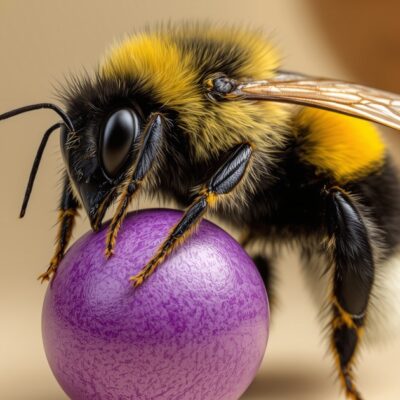
I was reading a study about bumblebees when an ordinary wooden ball became the most interesting object in the paper. Not because it contained food, or because moving it unlocked a reward, but because the bees kept returning to it anyway.
That distinction is easy to miss. A small animal pushing something around might be searching for a meal, clearing an obstacle, or reacting to an unfamiliar object, and an appealing video cannot tell us which explanation is right.
The researchers knew that too. Their question was not simply whether a bee could move a ball, but whether the behavior could meet the standards scientists use to recognize play.
The 2022 paper in Animal Behaviour, led by Hiruni Samadi Galpayage Dona and colleagues, describes a series of experiments with bumblebees. Its subject sounds almost comically modest: insects, little balls, and the routes between a nest and food.
Yet the more carefully I read the setup, the less modest the question seemed. If an animal we usually describe in terms of its work chooses something unnecessary, what might we have overlooked by watching only for usefulness?
The bees did not have to take the detour
In the first experiment, 45 bumblebees could travel along an unobstructed path to a feeding area. Beside that route were areas containing wooden balls, some movable and others fixed in place.
That clear path matters more than the charming idea of a tiny playground. If the balls had blocked access to food, pushing them would have been an obvious practical task, and the experiment would have told a different story.
Instead, the bees could avoid the objects altogether. The researchers provided food separately, and rolling a ball did not earn a sugary payment.
Across the experiment, individual bees rolled balls between one and 117 times. The team recorded 910 ball-rolling actions in total, so the finding was not based on a single insect accidentally bumping into something.
The researchers also defined what counted as rolling. A bee had to maintain contact with a ball while rotating it along the floor, with additional criteria intended to separate the action from incidental contact during ordinary movement.
I find that detail reassuring. The wonderful version of this story is not weakened by careful definitions; it becomes more interesting when the obvious objections are taken seriously.
These were not bees trained to perform a trick for a treat. The authors were studying behavior that happened without a food reward for the action itself, and that difference opened the door to another explanation.
Why a charming moment was not enough
Calling something play requires more than deciding it looks cute. The paper used five established behavioral criteria, asking whether ball rolling lacked an immediate practical outcome, was voluntary or rewarding, differed from functional actions, was repeated without being rigidly stereotyped, and began under low-stress conditions.
Those conditions help distinguish play from behaviors that merely look pointless to an observer. An animal repeatedly performing a movement under distress is not necessarily playing, and an unfamiliar action may have a useful purpose we have failed to recognize.
The researchers therefore considered explanations including food exploration, clearing clutter, and mating. Their setup and observations supported the interpretation that these alternatives did not account for the ball rolling they recorded.
There was also a pattern involving age. Younger bees rolled more balls than older bees, while males performed individual rolling actions for longer than females.
To examine whether the age result was really just a response to novelty, the team conducted another experiment comparing younger and older workers. Younger bees again showed more ball rolling, strengthening the case that age mattered rather than simply how recently an insect had encountered the objects.
None of this makes a bumblebee a miniature child. Similarities in behavior across animals are worth investigating, but they do not mean the animals experience the world in identical ways.
Still, the pattern makes the automatic dismissal harder. It asks us to replace a quick assumption with a better question: what evidence would we accept if the animal in front of us were larger and more familiar?
The empty chambers added something important
The part of the research that stayed with me involved another 42 bees and differently colored chambers. During the exposure phase, one chamber color was associated with movable balls, while the other was not.
Later, the bees were given a choice between the chambers with the balls absent. They showed a preference for the color previously associated with ball rolling, supporting the idea that the activity itself had been rewarding.
As Queen Mary University of London’s account, published by ScienceDaily, explains, this followed earlier work in which bees had learned to move balls for food. Observations of apparently unrewarded rolling helped motivate the new investigation.
The empty-chamber test matters because it goes beyond counting movements. It asks whether an experience leaves a preference that influences a later choice, even when the objects themselves are no longer there.
That does not let us read a bee’s feelings directly. The study supports a behavioral case for object play and contributes evidence to questions about positive emotional states, but it does not establish that a bee feels human happiness.
For me, that boundary is part of the appeal. We do not need to exaggerate the finding into certainty about an insect’s inner life to recognize that the old picture of a mindless little machine is inadequate.
A smaller assumption to carry outside
I do not take this paper as a reason to set up games for wild bees or interfere with their lives. A controlled laboratory experiment is not an instruction to handle an insect or test its willingness to entertain us.
The change it invites is quieter: notice how quickly a useful creature becomes only its usefulness in our thinking. We praise bees for pollinating, then sometimes talk as though that service exhausts everything worth knowing about them.
This study does not answer every question about insect welfare or consciousness. It examines one kind of behavior in a particular species under specific conditions, and broader claims need their own evidence.
But it does offer a reason to be less certain about what smallness means. A tiny nervous system should not automatically end our curiosity before observation has begun.
What I keep returning to is the open route to food. The bees had somewhere practical to go, and the researchers made sure nothing forced them to stop at the balls.
Some stopped anyway, again and again. Whatever future research adds to that observation, it has already made the question worth asking: how much of another creature’s life do we miss when we only look for the job it does?