
The pancake that changes who gets to sit down
A pancake can fall as it cools and still be doing exactly what it is supposed to do. That is a useful starting point for pannukakku, the Finnish oven pancake: a dish whose uneven surface and soft middle are not a request for an apology.
It also offers an answer to a familiar breakfast problem. When pancakes arrive one small batch at a time, somebody has to keep standing beside the stove while everybody else starts eating.
There is nothing wrong with enjoying that job. But on a morning when you would rather be part of the conversation, a pancake that cooks in one pan changes the arrangement.
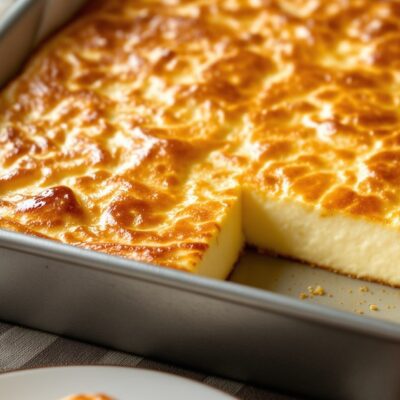
Pannukakku takes milk, eggs, flour and butter somewhere different from a stack of fluffy rounds. The result is cut into portions, with a tender, custardy interior and a golden surface, then served warm with whatever simple topping makes sense.
The surprise is not an expensive ingredient or a clever gadget. It is how much of the familiar pancake routine can disappear while something generous still comes out of the oven.
An everyday dessert, not a performance
Finnish writer Varpu Pöyry presents oven pancake as an affectionate everyday favorite on Her Finland. Her version fills a baking tray and is served with strawberry or raspberry jam, with whipped cream or vanilla ice cream as optional additions.
That matters because it gives the dish a setting beyond the elaborate weekend brunch. In her account, this is home cooking for ordinary evenings as well as occasions worth marking.
It would be a mistake to turn one writer’s memories into a claim that every Finnish family makes it identically. Even the two recipes linked here differ noticeably in their egg, flour and sugar proportions, their pans and their methods.
At Wholefully, Cassie Johnston describes her family’s version as a Christmas morning breakfast passed down through her husband’s Finnish-Canadian family. Hers is baked in a skillet or baking dish, and she explicitly warns that the dramatic puff will start settling after it leaves the oven.
Those are two documented household perspectives, not competing claims to a single perfect pancake. One emphasizes a tray-sized dessert, while the other explains a family breakfast tradition.
For a first attempt, the sensible move is to choose one version and follow its proportions. Mixing the ingredient list from one with the pan size and cooking time from another can make a forgiving dish unexpectedly confusing.
What goes into the tray
The recipe below follows the metric quantities in Her Finland’s tray-baked version, with instructions rewritten for clarity. It uses a sturdy, rimmed metal baking tray approximately 40 by 30 centimeters; do not use a flat cookie sheet, because the batter is liquid.
The original describes this quantity as enough for two adults and two school-aged children. Portions will naturally vary depending on whether you are offering it after a meal or as the main attraction.
- 2 eggs
- 100 grams butter, melted and allowed to cool slightly
- 800 milliliters milk
- 150 milliliters granulated sugar, measured by volume
- 2 teaspoons vanilla sugar
- 400 milliliters all-purpose flour, measured by volume
- 1 teaspoon baking powder
- 1 teaspoon salt
- Strawberry or raspberry jam, for serving
- Whipped cream or vanilla ice cream, optional
The flour and sugar measurements may look unusual if you normally bake by weight. They preserve the source’s Finnish volume measurements rather than introducing guessed gram conversions; a metric measuring jug is useful here.
Set out a large bowl, a whisk, a second bowl for the dry ingredients and baking parchment rated for your oven temperature. Use enough parchment to cover the bottom and sides of the tray, keeping loose paper away from heating elements.
Vanilla sugar belongs in this particular ingredient list. If you want a version designed around vanilla extract instead, Wholefully provides one, but its other quantities and baking instructions are different too.
No stand mixer is needed for the tray version. More importantly, there is no reason to turn preparation into a test of how quickly you can work: the batter needs a rest before it goes into the oven.
The stage that can look like a mistake
- Whisk the eggs, granulated sugar and milk together in the large bowl. Add the vanilla sugar and mix it through.
- In the second bowl, combine the flour, baking powder and salt. Gradually whisk these dry ingredients into the milk mixture, breaking up the larger lumps.
- Whisk in the melted, slightly cooled butter. Leave the batter to rest for 20 to 30 minutes.
- Meanwhile, preheat a conventional oven to 225°C and line the rimmed tray. Check that the tray sits level and has enough depth to hold the batter safely.
- Pour the rested batter into the lined tray. Carefully transfer it to the oven and bake for about 30 minutes, until golden brown and set in the middle rather than liquid.
- Let it cool briefly, then cut into portions and serve warm with jam. Add cream or ice cream if you want it, not because the pancake needs disguising.
The thin batter can be the moment a new cook loses confidence. Pöyry addresses that directly: it will look watery and may retain small flour lumps, so aim to break up the larger ones rather than chase absolute smoothness.
The pan matters as much as that reassurance. Pouring the same quantity into a much smaller dish makes a deeper pancake, so the original baking time is no longer a reliable promise.
Watch the middle as well as the browned edges. Soft and custardy is not the same as uncooked liquid batter; if the center still flows, it needs more cooking rather than immediate slicing.
And do not judge success by height alone. Wholefully’s separate recipe describes deflation as normal, a reminder that an oven pancake is food to eat, not a structure required to stay upright for photographs.
A little less work at the wrong moment
There is a modest kind of hospitality in getting the active work done before everyone sits down. This pancake still requires shopping, mixing and washing a bowl, but it moves the cooking away from a succession of individual portions.
While it bakes, you can put out plates and a jar of jam. You can also leave the table plain, skip the optional cream and resist the idea that a shared meal needs several supporting dishes.
None of that makes breakfast a cure for a difficult week. It simply makes room for one manageable thing: warm food that does not require somebody to keep performing while others enjoy it.
The most useful lesson is not that this recipe is effortless or that every batch will look alike. It is that a different method can let the person doing the caring join the moment they helped create.
Serve the pieces while they are warm. Let the surface settle, pass the jam, and allow an ordinary pancake to be enough.
Image: AI-generated food illustration, not a photograph of a tested batch.