




The loaf that does not ask for your whole afternoon
What stops you from making bread: the ingredients, the waiting, or the feeling that everyone else knows something you do not? A recipe can sound inviting until it asks you to judge a rising dough, keep a starter alive, or find several uninterrupted hours.
Irish soda bread offers a different starting point. There is no yeast to wake up and no bowl of dough waiting to double while the rest of your day moves on.
That does not mean nothing can go wrong. It means the things you need to pay attention to are different, and considerably easier to fit around an ordinary meal.
The useful surprise is not just how quickly the bread comes together. It is how little the plain version needs, especially if your mental picture of soda bread includes a sweet loaf crowded with raisins.
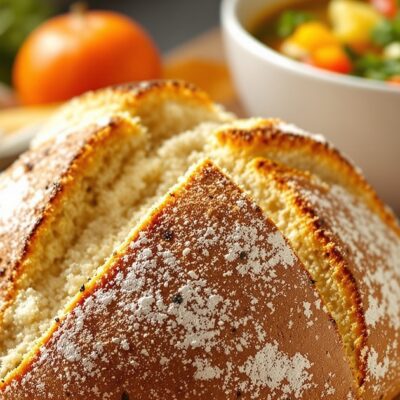
This is a bread worth meeting on its own terms: a sturdy round with a rough crust, made to be sliced and eaten rather than admired from a distance. For someone who has quietly decided that baking is for other people, that distinction matters.
Before reaching for extra ingredients, it helps to understand what is doing the work. The answer changes both the shopping list and the way you handle the dough.
Two familiar ingredients change the rules
King Arthur Baking’s discussion of Irish soda bread describes a simple traditional foundation: wholemeal flour, baking soda, salt, and buttermilk. It distinguishes that bread from sweeter Americanized versions containing ingredients such as dried fruit and caraway.
Its own published recipe sits between those styles, adding ingredients including butter, egg, sugar, and currants. That is useful context, not a reason to declare one family’s loaf wrong.
The name can cover breads with quite different textures and expectations. If you expect a sweet, tender holiday loaf and make a plain brown one, you might mistake a perfectly reasonable result for a failure.
For the straightforward version below, the lift comes from bicarbonate of soda reacting with the acid in buttermilk. Yeast is not responsible for raising it, so the long fermentation schedule of a yeast bread is not part of the method.
That difference also changes the flour question. James Martin’s easy Irish soda bread recipe for BBC Food says strong bread flour is unnecessary and recommends regular flour instead.
You do not need to turn the dough into the smooth, elastic ball that appears in many bread-making tutorials. This is one of those occasions when doing less is part of following the instructions properly.
There is something encouraging about that for a beginner. You are not skipping an expert step because you lack patience; you are learning that a different bread asks for a different kind of attention.
A small loaf you can actually make
The quantities below follow the BBC Food recipe, with the method restated in plain language. It makes one small loaf, listed by the source as serving six; how far it stretches will depend on what you serve alongside it.
- 170g wholemeal flour
- 170g plain flour, plus a little extra for the work surface and baking sheet
- Half a teaspoon of salt
- Half a teaspoon of bicarbonate of soda, also called baking soda
- 290ml buttermilk
- A little milk only if needed to loosen a dry dough
Have a mixing bowl, fork, baking sheet, sharp knife, and cooling rack ready. Preparing the tray and heating the oven first means the mixed dough does not have to wait while you hunt for equipment.
- Heat the oven to 200°C, or 180°C in a fan oven. Lightly dust your baking sheet with flour.
- Stir both flours, the salt, and the baking soda together in the bowl so the ingredients are evenly distributed.
- Make a hollow in the middle and pour in the buttermilk. Use the fork to bring everything together promptly into a soft dough.
- If dry flour will not incorporate and the dough feels stiff, add a little milk. Start with a couple of teaspoons rather than pouring in a generous splash.
- Move the dough onto a lightly floured surface. Bring it together with brief handling, shape it into a round, and flatten it slightly on the prepared sheet.
- Cut a cross into the top. Bake for about 30 minutes, checking for a loaf that sounds hollow when tapped underneath, then transfer it to the rack to cool.
Use the time as a guide rather than a promise that every oven will behave identically. The source’s timing is for this small loaf; making a much larger round is not the same as following the recipe unchanged.
If you want more bread, making two small rounds keeps you closer to the original method. For a first attempt, though, one loaf gives you a manageable place to begin.
The detail that can look like a mistake
The dough may not behave exactly like someone else’s photograph. BBC Food specifically notes that flour varies in how much liquid it absorbs, even between batches of the same brand.
That is why the instruction to judge dryness matters more than a determination never to adjust anything. A small addition of milk can be a response to the flour in your bowl, not evidence that you have already failed.
Equally, a sturdy crumb is not automatically a problem. King Arthur describes its soda bread as hearty and dense, with a craggy crust that can make thin slices awkward.
Think of this as a different style of bread rather than an unsuccessful attempt at a fluffy sandwich loaf. Cut it with a serrated knife and give the texture a chance to make sense beside soup, butter, or whatever you planned for dinner.
No buttermilk available? BBC Food suggests a half-and-half mixture of plain yogurt and milk as one alternative; keep the recipe’s total liquid quantity as your starting point and still pay attention to the dough.
The recipe contains wheat and dairy. Substituting ingredients for allergies needs a recipe designed for those requirements, rather than an assumption that every swap will behave the same way.
What would you put beside it?
The payoff does not have to be a photograph worthy of a cookbook. It can simply be a loaf you know how to make again, without having to clear a whole afternoon.
Serve it with a bowl of soup, a simple stew, or butter and jam. None of those suggestions requires a special occasion, and none turns a modest dinner into a test of how much effort you can display.
If your first round is uneven, notice something specific before making the next one. Was the dough dry, did it need longer in the oven, or were you expecting a texture this bread was never meant to have?
Those questions offer somewhere to go. Calling yourself a bad baker does not.
There is room for both the rich celebration loaf and the plain everyday bread. Understanding which one you are making lets you enjoy it without comparing it to something else.
So here is the question worth taking to your own kitchen: what meal would feel a little more welcoming with this small loaf in the middle? Start there, with the food you already eat and the people you already want to feed.
Image: AI-generated food illustration, not a photograph of the tested source recipe.