
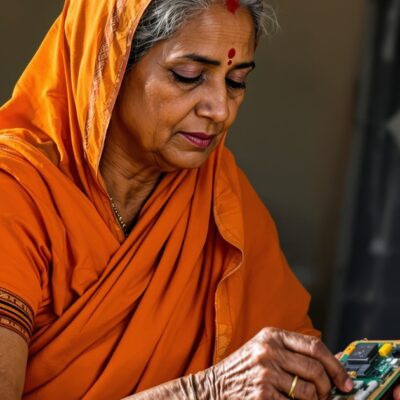



Featured image: AI-generated illustration of solar-electronics training, not a photograph of a Barefoot College participant or classroom.
The qualification that does not appear on a certificate
Some of the women learning to maintain solar lighting at Barefoot College have never had the opportunity to learn to read. Yet the work they train for includes assembling equipment, installing systems, and finding out what has gone wrong when a light stops working.
That is not a story about technology becoming magically easy. It is a story about what can happen when teaching is designed for people who have usually been left outside the classroom.
The women are known as Solar Mamas. Barefoot College, based in Tilonia in the Indian state of Rajasthan, describes a practical residential program that trains rural women from communities without electricity.
Its starting point challenges an assumption that can become invisible through repetition: first someone earns formal qualifications, and only then do we discover whether they have something technical to offer. Here, an opportunity to learn comes before that judgment.
The obvious outcome is a working light. But follow the program beyond the training room, and a more demanding question appears: who will keep that light working after the people who supplied it have gone?
A solar panel is not the whole solution
It is easy to tell an energy-access story through an object. A panel arrives, a lamp switches on, and a photograph captures the difference between darkness and light.
That moment matters. It is also only the beginning of the relationship between a household and the equipment it will rely on.
Systems need maintenance, parts need replacing, and somebody has to understand what to do when the expected result does not happen. A useful gift can become a frustrating object if the knowledge needed to care for it remains somewhere else.
According to Barefoot College’s description of its solar program, the training lasts six months and covers the design, fabrication, installation, and repair of solar products. These include solar lanterns and home-lighting systems, rather than an unlimited substitute for every kind of electricity supply.
That distinction keeps the promise realistic. Lighting a home is valuable without pretending that one installation can immediately run every appliance, power every business, or remove every difficulty a family faces.
The college says returning trainees receive equipment and spare parts to establish rural electronic workshops. They can then assemble and install lighting systems and provide maintenance and repair services locally.
What is being brought home, in other words, is not only hardware. It is the ability to respond when that hardware needs attention.
The hard part begins before anyone comes home
Six months away is a substantial commitment. A residential course cannot honestly be reduced to a cheerful slogan about believing in yourself, especially for someone whose family and community responsibilities remain at home.
Nor does the absence of formal schooling mean an absence of knowledge. Running a household, farming, managing scarce resources, and solving practical problems are real forms of experience, even when a conventional application form has no useful place to record them.
The program’s approach makes room for women who have been excluded from formal education. That does not mean every participant has the same background, the same abilities, or the same hopes for what comes next.
The Institute for Human Rights and Business’s Just Stories account describes the training as hands-on and identifies older rural women as a central group. It also describes a part of the model that receives less attention than the solar panels: local organization before deployment.
In that account, participating villages form a Village Energy and Environment Committee. The committee helps select trainees and manages a financial plan for the service.
Households contribute a fixed monthly fee intended to cover maintenance, replacement parts, and the engineers’ salaries. The account compares those contributions with previous spending on kerosene, rather than describing a service that has no continuing costs.
This is where the inspiring story becomes more substantial. It includes a budget, a person responsible for repairs, and a way to pay for that person’s work.
The change is also about who gets asked
There is a meaningful difference between receiving help and becoming the person someone turns to for help. The Solar Mamas model is built around that difference.
A woman returns with a practical responsibility: keeping a service functioning in her community. The role is not simply ceremonial, and it should not be confused with a university engineering degree.
It is specific technical training for specific equipment and tasks. That specificity makes the achievement more credible, not less impressive.
Both the college and the Just Stories account connect the work with women’s participation and livelihoods. Those are the organizations’ descriptions of the model, not proof that every village or every trainee has experienced identical results.
Funding, functioning equipment, available spare parts, and local cooperation still matter. A compelling training story does not cancel the practical conditions needed to make it last.
But the design asks a useful question of anyone who has ever dismissed a person as unqualified: unqualified for what, and under which way of teaching? Someone who has been excluded by one system may be able to learn well in another.
The most interesting shift is not that expertise has disappeared. It is that the opportunity to acquire useful expertise has reached people who were not always invited to try.
A different way to recognize potential
There is a temptation to turn a story like this into a demand: if these women can learn something new, everyone else should stop making excuses. That would miss the point.
The program describes more than individual determination. It describes training, material support, community arrangements, and a defined role waiting on the other side of the course.
Those structures matter. They make it possible to ask a person to take on a difficult new responsibility without pretending that courage alone will supply the tools.
For a reader far from Tilonia, the practical takeaway need not involve solar equipment. It might begin with how a workplace teaches a new task, how a community group recruits volunteers, or how a family talks about an older person’s capacity to learn.
Instead of deciding that someone cannot do something, ask what instruction, practice, access, and support would let them find out. And when the work is useful, recognize it with real responsibility and fair compensation rather than praise alone.
A lamp that comes on is an immediate, visible result. The quieter achievement is a community knowing who can help when it does not, and a woman having been given the training and resources to be that person.