
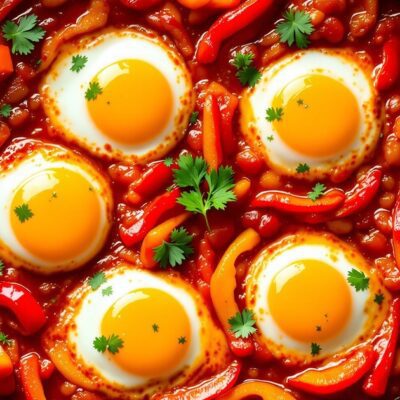




Featured image: AI-generated food illustration, not a photograph of the recipe being tested.
The dinner hiding inside familiar ingredients
When I look at a shakshuka recipe, the eggs are not the part that makes me pause. It is the instruction that comes just before them: wait until the sauce is ready.
That is a small detail with a useful promise. A meal built from tomatoes, vegetables and eggs does not need a spectacular shopping list, but it does ask you to notice what is happening in the pan.
For anyone staring at a cupboard and feeling that its contents do not quite add up to dinner, that distinction matters. Sometimes the missing ingredient is not another purchase; it is knowing what to do with the things already there.
Shakshuka brings eggs and a tomato sauce together in one pan. Good Food’s recipe and introduction describe its North African origins and its presence across parts of North Africa and the Middle East.
That broad history deserves more care than assigning the dish to one fashionable brunch menu. There are different versions, and a convenient home adaptation should not pretend to be every family’s definitive recipe.
What draws me to the two recipes here is something more practical: both make a satisfying meal from a sequence a home cook can understand. The bright centerpiece comes last, after the less photogenic work has already made room for it.
Why the pan needs attention before the eggs arrive
The Hairy Bikers’ version on BBC Food starts with onions and peppers, then adds garlic, spices, tomato purée and tomatoes. Only after the sauce has simmered do the eggs go into little wells.
Good Food’s simpler version uses onions, chilli, garlic, coriander and canned tomatoes. Its accompanying advice also emphasizes reducing the sauce before adding eggs.
The ingredient lists differ, but the shared instruction is revealing. The vegetables and tomatoes have their own cooking to do before the eggs begin their much shorter turn.
A watery sauce can leave the meal feeling unfinished. A sauce reduced too far can catch on the bottom, which is why the BBC Food method tells cooks to watch the texture and add a little water when necessary.
This is not a test of whether you possess a mysterious cooking instinct. It is a visible change: the contents become saucy rather than soupy, with enough body to hold a shallow hollow made by a spoon.
I like that the instruction gives you something to observe instead of demanding blind faith in a timer. Canned tomatoes vary, pans vary, and a fierce burner can change the result much faster than a gentle one.
The useful question is not whether you have followed the clock perfectly. It is whether the pan is ready for its next ingredient.
A small-pan version you can actually make
The recipe below is a two-person adaptation of the Hairy Bikers’ method, with the quantities approximately halved. It is not presented as an original family recipe or as a version personally tested for this article.
Allow roughly 35 to 45 minutes, depending on your chopping speed and how quickly the vegetables soften. Use a wide frying pan or sauté pan with a lid, and check that it can hold four eggs without crowding them.
- 1½ tablespoons olive oil
- 1 large onion, thinly sliced
- 2 bell peppers, cut into thin strips
- 2 garlic cloves, finely chopped
- ¼ teaspoon cumin seeds
- ¼ teaspoon caraway seeds
- ⅛ to ¼ teaspoon cayenne pepper, according to your preference
- ½ tablespoon tomato purée or tomato paste
- 1 can tomatoes, 400 grams, with their juices
- 2 tablespoons chopped fresh coriander and 2 tablespoons chopped parsley
- 4 eggs
- Salt and freshly ground black pepper, to taste
- About 40 grams crumbled feta and 4 tablespoons thick plain yogurt, optional, for serving
- Bread, optional, to serve alongside
Start with the vegetables. Warm the oil over medium heat, add the onion and peppers, and season lightly. Cook, stirring regularly, until they have softened; allow around 10 minutes, and longer if the slices are thick.
Build the sauce. Stir in the garlic for about two minutes, then add the cumin, caraway and cayenne. Add the tomato paste and stir for another minute or two without letting it burn.
Give the tomatoes their time. Add the canned tomatoes and a small splash of water, breaking up whole tomatoes with a spoon if necessary. Simmer uncovered for about 10 minutes, stirring occasionally, until thickened but still saucy.
Taste before continuing. Adjust the salt and pepper, then stir in the chopped herbs. If the mixture seems dry or starts sticking, loosen it with a small splash of water rather than increasing the heat.
The final step is gentler than it looks
Make four shallow wells in the simmering sauce. Crack each egg into a small cup first, then slip it into a well; this makes it easier to remove any shell before it reaches dinner.
Cover the pan and reduce the heat to low. Begin checking after about five minutes; the source recipe suggests five to eight minutes for set whites and soft yolks, but your pan and preferred doneness may require longer.
Do not treat translucent whites as finished. For the safest general approach, cook both whites and yolks until firm, particularly when serving people at increased risk from foodborne illness.
Scatter over the feta if using, and offer the yogurt separately. Bring bread alongside if you want something to scoop through the sauce, keeping the hot pan on a heatproof surface.
What appeals to me here is the change in pace. Earlier, the sauce benefits from stirring and adjustment; after the eggs arrive, the task becomes lowering the heat, covering the pan and checking without constantly disturbing it.
That is not a grand lesson disguised as dinner. It is simply a useful skill: different ingredients need different kinds of attention, even when they are sharing the same space.
A meal that does not need an occasion
BBC Food presents this dish as suitable for brunch or dinner. That flexibility is part of its appeal: eggs do not have to remain trapped in the breakfast category just because that is where you usually meet them.
You can keep the cayenne modest, skip the optional dairy, or choose the simpler Good Food version when peppers are not available. Naming those as adaptations is more honest than insisting every substitution preserves one fixed tradition.
The point is not to turn an ordinary evening into a performance. It is to make something warm and usable, with clear quantities and a method that tells you what to watch.
Reading these recipes, I keep coming back to that moment before the eggs. It is easy to admire the finished pan and overlook the patient softening and simmering that make it possible.
Sometimes a manageable meal begins when the ingredients stop looking like separate problems. A can of tomatoes, a few vegetables and some eggs become a sequence you can follow, and dinner feels a little less far away.