
The recipe comes with someone you cannot replace
Grandmas Project gives filmmakers a surprisingly strict assignment: film your own grandmother demonstrating one recipe, and make the film eight minutes long. Not a famous chef, not a collection of dishes, and not a sweeping family documentary with room for everything.
Those limits are what make the idea worth stopping for. A recipe can be copied into a notebook, but a person explaining it brings something that a tidy ingredient list cannot hold.
Think about the difference between knowing what someone serves and knowing how they learned to make it. The first can become familiar through years of meals; the second may still be a question nobody has asked.
This is not a claim that every grandmother loves cooking, or that every family has warm memories around a table. It is a particular documentary project about particular relationships, and its strength comes from letting those relationships remain specific.
The premise sounds small enough to overlook: a grandchild, a grandmother, a dish. But the person who devised it was trying to bring together two different family histories, and the way his original plan changed explains why the finished idea reaches beyond food.
Two grandmothers, and a project that changed shape
On the project’s official concept page, creator Jonas Parienté describes beginning to film his two grandmothers in 2005. One, whom he calls Mémé, was born in Warsaw in 1916; the other, Nano, was born in Cairo in 1933.
Both moved to France in the 1950s. For Parienté, food offered a way to explore the differences and connections between his Polish and Egyptian heritages, rather than treating family identity as a single neat answer.
His account names marinated herring and cheese boreka among the foods tied to those feelings. These are his associations with his own grandmothers, not evidence that a dish means the same thing to everyone who eats it.
Then the original project stopped. Parienté says he moved to New York, and Mémé died; the film he had first imagined did not simply continue unchanged.
That interruption matters without needing to become a warning that frightens people into recording their relatives. Real projects encounter distance, loss, work, and all the ordinary pressures that make a good intention difficult to finish.
In 2013, he describes arriving at a different possibility: the story could be made by multiple people. Instead of asking one filmmaker’s family to carry the whole idea, other grandchildren could contribute their own relationships and histories.
That change turned a personal beginning into a shared format. The connection was no longer that everyone had the same food or childhood, but that each filmmaker could approach someone they actually knew.
Eight minutes leaves no room for a generic grandmother
The official rules remain wonderfully concrete: each filmmaker films their own grandmother, demonstrating one recipe, in an eight-minute film. They create a boundary that keeps the subject from dissolving into an anonymous symbol of home cooking.
In its 2019 account of Grandmas Project, Gambero Rosso describes the aim as both strengthening contact between the people making the films and sharing these individual food histories with viewers. Its reporting places the cooking within stories of migration, changing customs, and family life.
The publication reported that fourteen films had been produced between 2016 and 2018. That is a historical count from that report, not a claim about the size of the collection today.
It also identified Parienté’s film about Nano and molokheya, alongside contributions involving dishes such as Lebanese stuffed peppers, Croatian meatballs, and Indian naan. The range makes the premise clearer: a common assignment does not have to produce an identical story.
These are not interchangeable examples of an imagined old-fashioned kitchen. Different people bring different places, choices, and circumstances to the food they make, and a film can leave those differences visible.
There is also a useful reversal in the assignment. The younger person may know how to use the camera, while the older person knows the dish; the encounter does not require either one to know everything.
That is an interpretation of the format, not a measured outcome for every participant. Still, it offers a more respectful starting point than assuming that one generation only gives help and the other only receives it.
The part worth saving is not just the instructions
The discovery here is not that grandmothers possess a secret ingredient. It is that the recipe gives two people something specific to do while making room for a larger conversation.
Asking for an entire life story can feel enormous. Asking where a familiar dish came from gives the conversation a place to begin, without deciding in advance what the answer ought to be.
A person might want to talk about who taught them, an ingredient they changed after moving, or why they prefer doing one step differently. Those are suggested questions, not scenes or quotations taken from the films.
The distinction matters because affectionate stories can easily become stories we impose on other people. An older relative does not owe anyone a moving memory, a family secret, or an explanation of something painful.
Nor does recording a recipe automatically preserve an entire culture. At most, one recording holds one person’s account at one moment, with all the value and limits that implies.
What makes that worth keeping is its specificity. You can learn a cooking method from many places; hearing why this particular person does it this particular way offers a different kind of knowledge.
Grandmas Project makes that knowledge public through a documentary series. At home, a meaningful version of the same attention can stay entirely private, or happen without a camera at all.
A smaller invitation can be enough
If the idea makes you want to ask someone about a skill, begin with permission rather than equipment. Ask whether they would enjoy showing you, and whether recording would feel comfortable or intrusive.
Be clear about what would happen to the recording. Keeping it for yourself, sharing it with relatives, and putting it on the internet are different decisions, and agreement to one does not mean agreement to all three.
Choose a manageable task and let the other person set the pace. There is no need to finish a polished film, recreate a whole celebration, or turn a relaxed afternoon into a production deadline.
You can also leave food out of it. Someone who dislikes cooking may have a repair technique, gardening habit, or practical skill they would much rather explain; that would be your own activity, not the documentary series’ recipe format.
The most generous part may be making room for correction. Let them say that you have misunderstood a step, that a memory is uncertain, or that the story is less sentimental than you expected.
A familiar meal can make it easy to believe you already know the person serving it. This project offers a quieter possibility: familiarity might be the place where a new question begins, rather than the reason to stop asking.
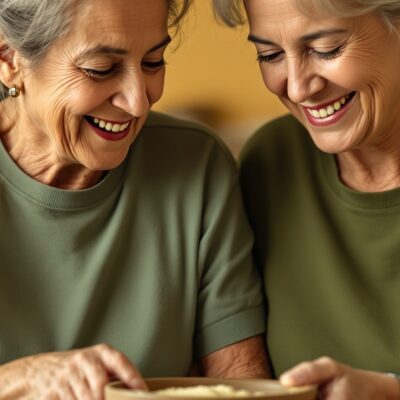
Image: AI-generated illustration of a family cooking moment, not a photograph of Grandmas Project participants.