The kitchen light was off. Only my phone glowed against the laminate counter, painting my hands a sick, electric blue. It was 2:47 a.m. on a Tuesday that felt indistinguishable from Monday or Sunday or any other stretch of darkness. I hadn’t slept through the night in three months, not since the divorce papers were signed and my father died in the same gray week, leaving me with a house full of objects that suddenly belonged to nobody. His reading glasses on the nightstand. Her coffee mug in the cabinet. I was scrolling because silence felt dangerous, because my brain treated stillness like an open invitation to replay every mistake in surround sound. Then I read the headline. New supercomputer models revealed that the Milky Way wasn’t born as one magnificent spiral hanging pristine in the void. It used to be thousands of smaller galaxies. Thousands. They collided, were ripped apart, and merged over thirteen billion years. I stared at that number until my eyes burned. Thirteen billion. I looked out the window at the patch of sky above my neighbor’s garage, the one I had ignored for thirty-four years, and felt something crack open in my chest that I had been holding perfectly still. It hurt like thawing.
A year before that night, I had been obsessed with the idea of my original self. I thought there was a version of me that existed before the grief, before the marriage that slowly turned to ash, before I learned how to cry in parking lots without making a sound. I thought healing meant excavating that woman and polishing her back to some factory settings that felt safe. I treated my memories like landmines. The failed business I launched at twenty-nine, burning through my savings and my father’s quiet pride until he finally said, “I just want you to be stable,” which crushed me more than bankruptcy because I heard the word “disappointing” in the spaces between his words. The friendship I ended with a text message I still regret, sent at midnight from a bathroom floor because I couldn’t bear being seen in my need. The version of me who believed in forever. I wanted to surgically remove each disaster and return to a clean, unbroken state that probably never existed in the first place. I went to therapy and talked in circles about my mother. I threw out every gift from my marriage, including a ceramic bowl I actually loved. I changed my hair until it broke off in brittle clumps, changed my city, changed my name in coffee orders to something sharper, as if a different syllable could trick the universe into thinking I was somebody untouched. But the ache didn’t go away. It migrated. It lived in my shoulders and my jaw and the way I flinched when people said they loved me, waiting for the clause that followed. I could smell my ex-husband’s cologne in elevators two thousand miles away. I folded my father’s sweaters and refolded them, unable to give them away, unable to wear them. I stopped looking at the sky because infinity felt like an accusation. I was convinced I was a ruined thing. A galaxy pocked with holes, leaking light. I kept waiting for someone to notice I was held together with apology and bad sleep and then decide I wasn’t worth the repair.
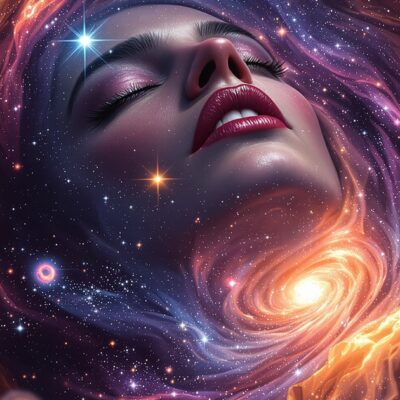
The simulation changed the metaphor entirely. The models traced those thousands of infant galaxies as they crashed together, their stars scattered, their shapes torn beyond recognition. They didn’t just bump and retreat like polite strangers. They were consumed. They were annihilated to become something larger. And the Milky Way we see now, this vast, spinning home we trust to hold our solar system and our seas and every heartbreak we have ever whispered into it, only exists because of that ancient violence. I sat with that until the sun came up and turned my apartment walls gray-pink. I realized I had been mourning my collisions as if they were defects I needed to hide from inspection. But what if they were construction? My father’s death taught me a patience I never had when he was alive, a willingness to sit with discomfort instead of fixing it with a joke or a drink. The end of my marriage taught me the difference between loneliness and solitude, a distinction that now keeps me from settling for almost-love out of fear. Even the business failure left me with a ruthlessness about my own time, a clarity I use every single morning when I say no without explaining. These weren’t stains on an otherwise perfect canvas. They were mass. They were gravity. I looked at the scar on my left hand from the window I broke the night I found out about the affair. For a year I had hidden it under bracelets. That morning, I didn’t. It was proof I had survived the breaking. I wasn’t broken. I was busy becoming, and the process was uglier than the self-help books admitted. The most terrifying part was understanding that it never stops. The Milky Way is still devouring smaller galaxies even now, slowly, quietly, adding new light to its arms. There is no final, finished version waiting at the end of a checklist. There is only the gathering, and the courage to keep your arms open for what is still arriving, even when it looks like loss.
Two weeks later, I drove to the coast where my father used to take me when I was small enough to fit in the crook of his arm. The sky there is darker than anywhere else I know, thick with stars that don’t compete with porch lights. I stood on the cliff’s edge in a wind that smelled like salt and pine, and I looked up at the band of light we call home. For the first time, I didn’t see a perfect spiral. I saw a graveyard. I saw a nursery. I saw every shattered thing that refused to stay scattered. I thought about calling my mother to tell her I finally understood why Dad kept that cheap telescope on the balcony, but instead I just let the wind hit my face until it hurt and I cried. Not the tight, controlled crying I had practiced for a year in shower stalls and steering wheels, but the kind that bends your knees and makes you a stranger to yourself. I forgave the woman I was at twenty-six, and twenty-nine, and thirty-three. I told her she wasn’t stupid for hoping. I told her the wreckage was structural, not cosmetic. The tears tasted like salt and relief. The stars didn’t look cold anymore. They looked like they were burning on purpose, holding their place.
I still wake up some nights at 2:47. I still feel the old panic sometimes, the certainty that I have lost too many pieces to ever be enough for anyone, including myself. But now I walk outside barefoot if I have to, even when the pavement is cold. I look up. I remember that the brightest path across our sky is made of everything those small galaxies lost, every star they surrendered to the crush, every shape they forgot they ever had. I am not a fixed point. I am not a destination. I am a collision in progress, a collection of every version of myself I tried to bury, still orbiting, still burning, still held together by nothing more than the weight of what I survived and the strange, stubborn light it produced. I don’t know who I will be in five years. I don’t know what new fragments are heading toward me even now, silent and inevitable. But I know I will not brace for impact the way I used to. I will open my arms. And somehow, against every expectation I had for my own small life, that is exactly enough. It is more than enough. It is home.