




The part of the story I almost overlooked
A washing machine is usually something you notice when it stops working. Until then, clean clothes can feel like one more ordinary task squeezed between everything else you need to do.
That is what caught my attention about Orange Sky, the Australian charity that began by putting laundry equipment inside an old van. The equipment is easy to understand; the more revealing part is what happened while it was running.
I do not have a personal visit to describe or a miraculous ending to offer. What I have is the organisation’s account of its beginnings, alongside reporting that helps explain why a practical service became something more than its founders first imagined.
In 2014, two friends from Brisbane, Nic Marchesi and Lucas Patchett, built a mobile laundry to wash clothes for people experiencing homelessness. They were twenty, and the starting point was a garage rather than a polished national operation.
According to Orange Sky’s own history, they installed washing machines, dryers and a generator in the van. It was a direct response to a specific problem: people needed access to clean laundry.
But an appliance does not finish its work the moment someone presses a button. There was time left over, and the founders had not entirely worked out what to do with it.
The machine started, and a different need appeared
The organisation describes meeting its first service user, a man named Geordan, and loading his laundry into a machine. Once the cycle began, the two founders were unsure what should happen next.
They sat down together and started talking. Orange Sky identifies that exchange as an important moment in discovering the role conversation would play in its work.
It is a simple beginning, but I think it deserves to stay simple. We do not need to invent what Geordan said, imagine the expression on his face or turn a washing cycle into proof that someone’s life was transformed.
The documented change is meaningful enough: an organisation created to provide a physical service began recognising the value of time spent with the person using it. The task and the relationship did not have to compete.
That distinction matters because practical help can become hurried, even when everyone involved means well. Complete the task, hand over the item, move to the next person: efficiency has its place, particularly when resources are stretched.
Yet a laundry cycle creates an unusual opening. The wait is already there, and it does not have to be treated as wasted time.
None of this means a person should have to talk to earn clean clothes. A welcoming service must leave room for quiet, privacy and the choice not to share a personal history.
The harder part was coming back
An inventive first van makes a compelling origin story. What interests me more is the less dramatic question that follows: will the service be there when someone needs it again?
In a 2017 interview with SBS, Patchett stressed the importance of returning at the same time and place each week. He described familiar faces and a non-judgmental environment as central to the work.
The same report explained how Orange Sky worked alongside other services, including food vans, drop-in centres and organisations offering housing or health support. Laundry did not have to become an answer to every problem in order to have a useful place.
That is a valuable correction to the way uplifting stories are sometimes told. Two friends did not solve homelessness by installing washing machines, and clean clothing cannot replace secure housing, safety, adequate income or appropriate care.
What they built could meet a need without pretending the larger needs had disappeared. In that sense, the modesty of the service is part of its strength.
SBS also reported on Orange Sky’s work after natural disasters, including Cyclone Marcia in 2015. Access to laundry mattered there too, for people whose ordinary routines and basic facilities had been disrupted.
Those examples make the need easier to recognise without making everyone’s situation identical. The reasons a person cannot wash their clothes vary, and a useful service has to respond to the person in front of it rather than a stereotype.
The interview is historical reporting, not a current service directory. Its old fleet sizes, running costs and national homelessness figures should not be mistaken for today’s numbers.
Why the waiting time changes the story
Orange Sky’s current account still places conversations and connection alongside its laundry work. Its timeline records later developments including shower services, remote-community operations and a school laundry program launched in February 2026.
Those changes suggest an organisation continuing to adapt its practical work, rather than simply preserving the novelty of that first van. For current locations and availability, the organisation’s own service information is the place to check.
But the detail that stays with me is smaller than expansion: the founders initially did not know what to do once the machine started. The part they had not fully planned became central to how they understood the service.
There is a useful lesson here for anyone who freezes because their idea for helping seems incomplete. You can begin with a real, limited need and remain willing to learn from the people affected by it.
That is different from arriving convinced you know what somebody else’s life requires. Listening can change the plan, and the person receiving help has knowledge the helper does not.
It also changes how I think about the word generosity. Sometimes generosity is a resource; sometimes it is the willingness not to hurry away once the resource has been handed over.
Neither kind makes the helper the centre of the story. The useful question is whether people have more choice, more comfort or better access to something they need.
A smaller promise you can actually keep
The takeaway is not that everyone should buy a van. Most of us have neither the equipment nor the training to create a mobile service, and a well-intended project still needs safeguards, funding and dependable organisation.
A more realistic beginning is to ask an established local service what support it needs. That might mean a regular volunteer shift, a requested donation or a practical skill offered within the organisation’s existing process.
Reliability deserves as much thought as enthusiasm. Before promising a weekly commitment, consider whether you can keep it, and be honest about the limits of your time.
If you meet someone using a service, you do not need to turn the encounter into an interview about hardship. Ordinary conversation, freely chosen, can remain ordinary; nobody owes a stranger a painful story.
I came to Orange Sky’s history expecting the van to be the memorable detail. Instead, I keep returning to the pause after the washing machine started and the decision to sit down rather than simply wait at a distance.
Clean clothes were never a small need. The discovery was that meeting that need could also leave space for something easy to overlook: treating the person beside you as someone worth spending time with.
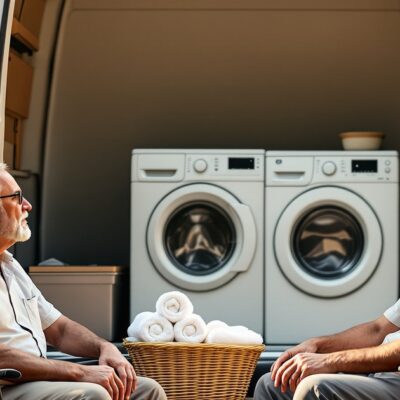
Illustration: AI-generated conceptual image, not a documentary photograph of Orange Sky, its founders or anyone using its services.