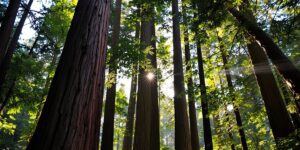





Image note: The accompanying AI-generated woodland illustration is not a documentary photograph of Fanal. The official Madeira tourism pages linked below show photographs of the real place.
The forest detail that stopped me scrolling
A forest can look like somewhere to escape to and still ask something difficult of us. What caught my attention about Fanal, on the Portuguese island of Madeira, was not a promise of an unforgettable photograph, but the way its official description treats quiet as something worth protecting.
The Madeira tourism board describes the area as a Rest and Quiet Reserve. That is a surprisingly direct idea in a world where even a walk can become something to measure, photograph, rank, and report afterward.
I am not writing this after a visit, and I cannot tell you what the air felt like on a particular morning. What I can do is follow the documented story behind the trees, because it becomes more interesting the further it moves from the idea of a beautiful backdrop.
Fanal belongs to the municipality of Porto Moniz, between Ribeira da Janela and the Paul da Serra plateau. Its celebrated trees include centuries-old specimens of Ocotea foetens, known locally as til.
For anyone unfamiliar with Madeira, that may sound like the beginning of a travel wish list. But there is another way to approach this place: not by asking how quickly we could get there, but by asking what we would otherwise fail to notice.
A beautiful place with a much longer backstory
The official Fanal visitor page places these trees within Madeira’s indigenous Laurissilva forest. It also notes that some specimens predate the island’s discovery, using the historical language of the tourism account rather than supplying exact ages for individual trees.
That distinction matters. A very old tree is impressive enough without turning an estimate into a precise birthday, or suggesting that every trunk in a photograph has survived the same number of centuries.
The broader forest has a different kind of age. According to the tourism board’s Laurissilva overview, this forest type traces its history back millions of years, to a time when related forests were more widespread across southern Europe and northern Africa.
This is not a claim that the individual trees standing today are millions of years old. It is the history of an ecosystem and its lineages, not the lifespan of one extraordinary plant.
That changes the scale of the story. What looks, at first, like a picturesque collection of trees is part of a surviving forest tradition much older than our usual landmarks.
I find that more moving than the idea of a landscape untouched by time. Time is not absent here; it is part of what makes the place worth understanding.
The frame gets wider than a single photograph
Fanal is only one part of that larger picture. The tourism board puts Madeira’s Laurissilva at around 15,000 hectares, approximately one fifth of the island, with its greatest presence in the higher northern areas.
The forest is described as subtropical rainforest, home to varied plants and animals, with many species native to the Macaronesian islands. Trees belonging to the laurel family help give it both its name and its character.
The same account records UNESCO World Heritage recognition in 1999. That designation concerns the Laurissilva, not merely the collection of especially photogenic trees that might first catch a visitor’s eye.
It is tempting to flatten all this into a familiar sentence: this place looks like a fairy tale. Yet that description leaves out almost everything that makes it real, from its living species to its place within Madeira’s protected natural heritage.
It also risks making the island seem like a stage set waiting for outsiders. Fanal may be new to someone encountering it online, but it is not unknown to the people who live on Madeira, study its forests, or care for its landscapes.
The official visitor information identifies walking routes through the area, including Vereda do Fanal and Levada dos Cedros. Those names point toward an actual place with managed access, rather than a dream location that exists only to satisfy a picture in our heads.
Anyone planning a visit should check current official trail conditions, access rules, and weather guidance before setting out. A general description of a route is not a guarantee that it is open, suitable, or safe on the day you arrive.
The invitation is not to collect another view
For me, the most useful detail remains the reserve’s emphasis on rest and quiet. It suggests a different relationship with a beautiful place: you do not have to turn it into an achievement before it deserves your attention.
That is an interpretation, not a medical claim. A forest visit is not a substitute for treatment, and being surrounded by trees does not promise that grief, anxiety, or an exhausting week will disappear.
Nor does everyone have the money, mobility, time, or freedom to travel to an Atlantic island. A story about natural beauty should not quietly become another instruction to purchase an experience that many readers cannot access.
But the question travels more easily than we do. What changes when we stop treating a place as something to capture and begin treating it as something with a life beyond our visit?
That might mean learning the name of a familiar tree rather than searching for a more dramatic location. It might mean staying on the designated route even when a better camera angle seems to be waiting just beyond it.
These are small choices, but they move admiration toward care. The forest does not benefit from how intensely we describe loving it if our behavior ignores the boundaries that protect it.
Something worth bringing home without taking it
I would rather leave this story with a question than a promise about transformation. If a place has been carrying on for centuries without us, what would it mean to encounter it without making ourselves its main event?
Fanal offers a specific starting point: old til trees, the larger Laurissilva around them, and an official recognition that quiet belongs in the experience. None of those details needs an invented legend to become memorable.
If you go, let the current local guidance shape your plans, and leave room for a visit that does not resemble someone else’s photograph. If you never go, the real images and descriptions on Madeira’s official pages still offer something worth looking at slowly.
The lesson I take from this forest is not that we should all retreat from ordinary life. It is that beauty can ask for more than our excitement: attention, restraint, and a willingness to learn what was there before we arrived.
We cannot bring an old forest home. We can bring home a less hurried way of looking at the living things already around us.