


The part of the flock I almost overlooked
I went into the flamingo research expecting to read about a crowd. What caught my attention instead was a question about the space beside one particular bird: who keeps turning up there?
A flamingo flock is easy to admire without thinking much about its individual members. Pink feathers, long necks, and a gathering at the water can become one beautiful picture, with the birds almost interchangeable inside it.
But a study published in 2020 asked readers to look more closely. Researchers following four captive flocks at WWT Slimbridge Wetland Centre in England found patterns that a quick glance could never establish.
These were not observations from a single afternoon. The work drew on data from 2012 through 2016, giving the researchers a chance to ask whether the birds beside each other were simply temporary neighbors.
That distinction is what kept me reading. Being surrounded by others and repeatedly choosing particular companions are not the same thing, even if both can look like a busy flock from a distance.
There is a temptation to rush straight to a comforting human comparison. Before doing that, though, the details deserve a little space: the birds were not being asked to perform friendship for an audience.
One pink crowd became many separate relationships
The University of Exeter research examined Caribbean, Chilean, Andean, and lesser flamingos. According to WWT’s account of the study, the flocks ranged from just over 20 birds to more than 140.
Those numbers matter because they change the question. In a large social group, an animal has potential companions beyond a single partner, and researchers can look for associations that recur within that larger set of possibilities.
The findings did not reduce flamingo social life to mating pairs. The researchers described male pairs, female pairs, and groups of three or four that regularly spent time together, alongside the relationships between mates.
Some birds also avoided particular individuals. So the pattern was not simply that every flamingo was equally willing to stand near every other flamingo, or that living in a flock erased individual preferences.
Reading that, I found myself reconsidering the word flock. It names the whole group, but it can conceal the smaller connections inside it, just as a photograph of a crowd cannot explain who came together.
That comparison is a way of understanding the question, not evidence that flamingos experience relationships exactly as people do. The study tracked behavior, and behavior gives us a clearer starting point than imagined conversations between birds.
What the researchers could document was already interesting enough. Particular birds were repeatedly associated with particular others, rather than the group amounting only to an ever-changing collection of random neighbors.
The important detail was not a single affectionate moment
The National Wildlife Federation’s coverage explains the practical measure behind the friendship language: birds that regularly sat or stood less than one neck length apart were classified as friends.
That is a useful detail to keep in view. A researcher cannot ask a flamingo to name its closest companion, but can record proximity and examine whether a repeated pattern emerges over time.
One moment of closeness would not tell the same story. Two animals can end up beside each other for many immediate reasons; repeated associations across years offer a different kind of evidence.
WWT reported that the birds’ friendships were stable over a period of years. For me, the emotional force of the finding lies in that duration, not in inventing a dramatic reunion or assigning a private thought to a bird.
There were changes within the overall pattern, too. Seasons affected social interactions, with more bonds forming in spring and summer, which WWT identified as the breeding season.
The largest flocks showed the highest level of social interactions in the reported findings. That does not give us a universal ideal flock size, but it does suggest that the available social environment deserves attention.
In three flocks, the researchers also examined foot health to look for a relationship between physical condition and social behavior. They found no link in that analysis, which should not be stretched into a claim that friendship cures illness.
The more carefully I read those qualifications, the more persuasive the central observation became. The birds did not need to behave like miniature humans for their repeated associations to matter.
Then the research stopped being merely a lovely fact
The detail that changed the story for me came in the discussion of animal care. If certain flamingos maintain close bonds, moving birds between institutions may involve more than choosing a manageable number of healthy animals.
In WWT’s account, researcher Paul Rose advised that transfers between zoos should avoid separating closely bonded flamingos. That recommendation follows directly from taking the birds’ social preferences seriously.
It is a modest sentence with a substantial implication. An enclosure can contain other flamingos while still lacking the particular companion that one bird repeatedly associates with.
The research does not establish exactly what any separated bird would feel. Nor was this a controlled experiment showing that a particular transfer caused distress, and it would be misleading to present it that way.
Instead, the findings offer keepers information that head counts alone cannot supply. Knowing which birds regularly remain close can help people consider the relationships already present when making management decisions.
There is also a limit around the setting: these were captive flocks at Slimbridge. Suggestions that such lasting bonds matter for survival in the wild are reasonable research questions, not survival outcomes directly demonstrated by this study.
Still, the practical lesson does not disappear when those limits are acknowledged. A social group is not necessarily interchangeable, and caring for it may require noticing the connections between its members.
A different way to look at the bird beside the bird
I do not take this study as a message that every animal friendship is just like ours. I take it as a reason to be slower about assuming that a crowd tells us everything important about an individual.
The researchers needed repeated observations to reveal what a visitor might miss. Their findings came from paying attention to ordinary proximity, returning to it, and checking whether the same associations persisted.
That kind of attention feels less dramatic than a rescue video, but it can still change what good care looks like. It asks people to notice not only whether an animal has company, but which company it keeps.
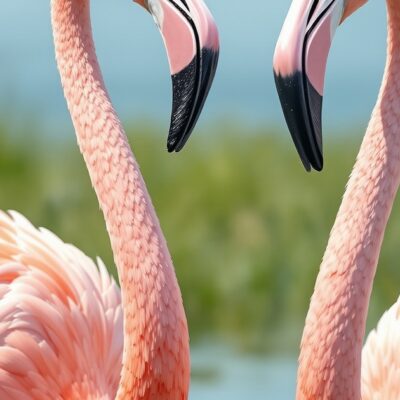
For anyone watching flamingos, there is no need to invent a backstory for the pair nearest the water. A short visit cannot establish a lasting bond, and the study gives no permission to guess one from a photograph.
What it does offer is a better question. Behind the shared color and the collective movement, are there particular neighbors whose presence keeps recurring?
I began reading about a flock. I finished thinking about how easily the individual disappears inside that word, and how much patient observation can bring back into view.
Sometimes the detail worth noticing is not the most striking bird in the picture. It is the one that keeps standing beside it.