The flowers made me look twice
At first glance, Mary Delany’s flowers look like the work of a remarkably patient painter. Petals flare against black backgrounds, stems bend, and leaves seem to catch light along their edges.
Then you discover what you are actually looking at. Those delicate shapes were assembled from cut paper, sometimes with watercolor added, and the distinction changes the experience of looking.
I find myself thinking less about a finished flower and more about the decisions inside it: where to cut, which shade to choose, how one small piece should overlap another. A familiar subject suddenly contains an unfamiliar amount of attention.
There is another detail that makes this work difficult to dismiss as simply beautiful. According to the British Museum’s image collection, Delany began making these works, which she called paper mosaicks, at seventy-two.
That fact invites an easy response about never being too old. But the more interesting question is not how an older woman managed to surprise people.
It is what the word beginning leaves out. Before the scissors and colored paper became this particular body of work, there had already been a long life of making, friendship, loss, and learning to notice.
A beginning with a life behind it
Delany was born in 1700 and lived within the social world of eighteenth-century England. Her opportunities were shaped by class and connections, and any honest account has to leave those advantages in the picture.
She was not an isolated person producing masterpieces with nothing but determination. Nor was she someone who had never worked with color or form until her seventies.
DailyArt Magazine’s account of her life and technique describes her experience with drawing, painting, fine needlework, shell-work, and plasterwork. Those activities belong to the story, even if the paper flowers eventually became its most recognizable part.
Her second husband, Patrick Delany, died in 1768. After his death, her close friendship with Margaret Bentinck, the Duchess of Portland, became an important setting for the flower collages that followed.
The duchess collected natural history specimens and antiquities. Delany spent considerable time with her, in a world where looking closely at plants was an interest people could share rather than something she had to defend.
We cannot know every feeling Delany brought to a particular sheet of paper. It would be wrong to turn bereavement into a neat explanation for her art, or to suggest that creative work erased the loss.
What we can see is that a new practice grew within an existing life. The earlier skills and relationships did not disappear when something different began.
What a flower required
The process was more demanding than cutting out a recognizable silhouette. Delany used small pieces of colored paper, arranging and layering them to build the structure of a plant.
DailyArt describes flowers made with as many as two hundred pieces of paper. Smaller shapes placed over larger ones created depth; watercolor could help refine the effect of light.
The black backgrounds were not empty in the ordinary sense. They gave the colored forms a strong visual presence, making a pale petal or a thin green stem stand out.
This is where the work becomes especially interesting to me. A flower can be appreciated in a second, but reconstructing it asks for distinctions that a quick glance skips.
Where does a petal narrow? Which part sits in front of another? What appears to be one color from a distance may need several separate choices when you try to make it.
These are questions suggested by the technique, not a transcript of Delany’s thoughts. They help explain why her images can reward slow looking even when we already know what kind of object we are seeing.
The botanical precision also attracted serious attention. The British Museum’s collection introduction records Joseph Banks’s extraordinary praise for the accuracy of her plant representations.
Her network mattered here, too: friends supplied flowers, and DailyArt reports that Banks sent specimens from the Royal Botanic Gardens at Kew. A personal practice was connected to other people’s knowledge, access, and interest.
That makes the story warmer, not less impressive. The achievement remains hers, while the conditions that helped sustain it become visible.
The part the age headline misses
Delany ultimately made 985 flower collages. DailyArt reports that she stopped in 1783 as her eyesight deteriorated.
There is no need to soften that ending into a lesson about overcoming every obstacle. Bodies change, and a practice that depends on fine visual work has real physical demands.
What stays with me is the contrast between the smallness of the materials and the scale of the attention. Paper could become a serious way of observing the natural world.
An age-based headline can accidentally suggest that everything before the celebrated beginning was merely waiting. Delany’s work suggests a different interpretation: earlier experience can acquire a new use without becoming less valuable in its original form.
Needlework did not have to be a secret audition for botanical collage. Drawing did not have to lead to a museum collection to have been worth doing.
Yet practiced hands, a sensitivity to color, and relationships with curious people could all meet in a later project. Starting something different need not mean pretending that you are starting from nothing.
This is an interpretation of one artist’s history, not a promise about everyone’s later years. Money, time, disability, caregiving, and access can change what is possible, and inspiration should not become another standard people are punished for missing.
A smaller question worth taking home
I would rather take a modest question from Delany’s flowers than a command to reinvent an entire life: is there something familiar that deserves a closer look?
For someone who enjoys making things, that might mean choosing one leaf and attempting its shape in paper. For someone who does not, it could mean looking at one of Delany’s collages and noticing where a petal overlaps a stem.
Neither activity needs to become a business, a public identity, or proof that you are using your time correctly. There is room for a private experiment that remains small.
It may also be worth asking which existing skill you have stopped counting. Cooking, mending, arranging, observing, and explaining are not empty spaces in a life simply because they do not arrive with prestigious titles.
Delany’s story cannot tell us what to make next. It can make a rigid distinction between experienced and beginner feel less convincing.
Someone can be both: experienced in noticing and new to a material, familiar with color and uncertain about a first cut. That combination is not a contradiction that needs to be resolved before beginning.
The flowers are beautiful. But the possibility I keep returning to is quieter: something you already know may still have a form you have not tried.
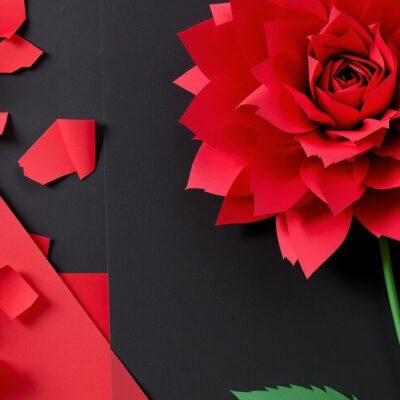
Image note: The accompanying image is an AI-generated illustration of paper-flower craft, not a photograph of Mary Delany, her studio, or an original artwork.