
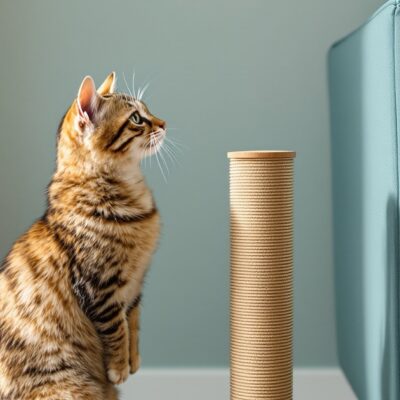




The sofa is getting attention the new post is not
You bought the scratching post, found a neat place for it, and hoped the sofa could finally relax. But what if the most useful clue is not the price of the post or the enthusiasm with which you introduced it?
It may be the spot your cat keeps choosing instead. A sofa arm offers something quite specific: a firm surface, a familiar location, and room to reach up and pull.
This is a familiar situation to consider, not an account of a particular household. The frustration is understandable, especially when replacing damaged furniture is expensive and the alternative you provided seems perfectly adequate.
Yet the question changes when you look at the room from the cat’s side. Rather than asking why an animal will not appreciate its new possession, ask what makes one scratching surface more usable than another.
Animal-welfare guidance offers a practical way into that question. It does not promise that one purchase will solve every case, but it does show why an unused post is not proof that providing one was pointless.
Before giving up on it, there are a few ordinary details worth checking. The first has nothing to do with whether the post matches your curtains.
Scratching is doing more than making marks
According to Cats Protection’s scratching guidance, scratching is normal, instinctive behavior. It helps cats maintain their claws and also serves a communication function.
Scent glands between the paw pads leave a smell on the surface. Alongside visible scratches and discarded claw husks, that scent provides information for the cat and other cats nearby.
That makes a scratch more than damage to be erased. We see a loose thread or a roughened edge; the animal is performing an activity with purposes that are not obvious from the appearance of the furniture.
All cats need an outlet for this behavior, including cats who go outside. Keeping a cat indoors does not remove the need, and buying a post does not automatically mean the particular need has been met.
Cats Protection notes that furniture can make an appealing substitute for the surfaces cats would scratch outdoors. A sturdy, tall object allows a good grip and space to dig in.
None of that requires imagining that your cat is taking revenge or sending you a personal insult. It gives you observable features to investigate instead of a motive you cannot verify.
Start with where scratching happens and what the surface offers. Is your cat reaching upward against an armchair, or pulling across a carpet with its body closer to the floor?
The post has to work when a cat actually uses it
A post can look substantial while wobbling under pressure. Cats Protection recommends a heavy, stable base so the structure does not sway or topple, and enough height for a cat to scratch at full stretch.
Village Vet’s guide to choosing a scratching post makes the same points about rigidity, stability, and height. For taller modular structures, it recommends a wall bracket for additional safety.
Follow the product’s assembly and securing instructions rather than improvising a precarious support. A scratching structure is something an animal will pull against, not merely something that needs to remain upright while nobody touches it.
Orientation matters too. Cats Protection recommends a scratching pad for cats who favor horizontal surfaces, such as carpets or stairs, while Village Vet discusses providing both vertical and horizontal options.
That is a useful alternative to buying an ever-larger version of the wrong thing. If your cat consistently scratches along the floor, another upright column may not answer the preference you are observing.
Then consider placement. A tidy corner selected because it is out of the way may not be where the activity naturally happens.
Cats Protection suggests putting a post beside the area already being scratched. It also notes that cats often scratch and stretch after waking, making the area near a sleeping spot another sensible place to try.
The location is not necessarily permanent. Once a cat uses the alternative, the charity advises moving it gradually if a different position is needed, rather than assuming the cat will immediately follow it across the room.
In a home with several cats, one shared post may also be insufficient. Both sources recommend avoiding competition over scratching facilities; Cats Protection advises a separate post for each cat, positioned in different places.
A better surface is not always the whole answer
The useful discovery is that the ignored post may be offering the wrong combination of stability, stretch, orientation, and location. But that is not the same as diagnosing every scratched sofa.
Cats Protection warns that scratching in several places, particularly around windows and doors, can be connected with insecurity and communication. Another cat in the home or nearby may be part of the situation.
In that case, adding another surface without addressing what worries the animal may leave the underlying problem untouched. The charity recommends help from a qualified behaviorist when needed.
Some cats also learn that scratching a particular object brings attention. Cats Protection advises praising use of the appropriate surface and avoiding turning unwanted scratching into the reliable way to get a reaction.
That advice is not a reason to overlook distress or a sudden change in behavior. If something has changed abruptly, or you have concerns about health or comfort, seek veterinary advice rather than treating furniture damage as an isolated training puzzle.
Encouragement can stay gentle. Village Vet suggests playing around the new structure to make it more inviting, and Cats Protection describes short, regular play sessions as another possible outlet for energy.
You do not need to make a cat perform for a demonstration. Give it safe opportunities, watch what it actually uses, and allow that information to shape the next adjustment.
A kinder question can also be a more useful one
For a first check, look at the unused post without moving the cat toward it. Is it secure, is it tall enough for a full stretch, and does its orientation match the surfaces your cat selects?
Next, reconsider the map of the room. Could an appropriate scratching surface sit beside the favored spot or near the cat’s bed, instead of being hidden where it causes the least inconvenience to people?
If you share your home with several cats, examine access as well as quantity. A resource exists on paper but may be less useful if reaching it means passing a cat that makes another animal uneasy.
None of this guarantees an untouched sofa overnight. Protecting furniture, adjusting the environment, and getting qualified help can all belong in the same plan.
The encouraging part is that an unsuccessful first purchase need not become a verdict on either you or your cat. It can become information about what the original arrangement left out.
Good care sometimes means changing the question from “Why won’t you use what I gave you?” to “What does this need to let you do?” When you look at the scratched corner again, what might it tell you about the alternative worth offering?
Illustration note: The accompanying image is AI-generated, not a photograph of a documented pet or a product assessment.