

The familiar ingredient that needs a second introduction
A Scottish oatcake can be a crisp cracker rather than anything you would slice for a birthday. But the more useful surprise comes before the baking: a recipe can ask for oats and oatmeal as two different ingredients, even when those words mean almost the same thing in your kitchen.
That is a small enough confusion to miss while making a shopping list. It becomes much harder to ignore when you are trying to bring a bowl of crumbs together and wondering whether you have somehow failed at a supposedly simple recipe.
The difficulty does not necessarily begin with your hands. It can begin with the way oats are cut, flattened, or ground, and with the names different places give those forms.
This is what makes homemade oatcakes worth more than a quick glance. They offer a modest baking project, something useful to put beside soup or cheese, and a reminder that an unfamiliar instruction may need translating rather than obeying more forcefully.
There is no elaborate equipment required for the version below. Before reaching for the rolling pin, though, it helps to decide exactly which oatcake you are making.
A Scottish staple, not one compulsory formula
Food writers Phil and Sonja at Scottish Scran describe oatcakes as a traditional Scottish food served with everything from soup to cheese and pate. Their recipe makes the firm, cracker-like kind with a snap, rather than a softer, bread-like bannock.
That distinction matters because the name alone cannot tell you the texture to expect. Nor does tradition mean every published recipe must contain precisely the same ingredients.
Scottish Scran uses two forms of oats, butter, salt, and hot water. Katie Hiscock’s Scottish oatcake recipe at Good Food Middle East includes wholemeal flour, a little sugar, and bicarbonate of soda as well.
Both are useful reference points, but they are different formulas. Taking the water quantity from one and the dry ingredients from the other is not the same as following either recipe.
The recipe below follows Scottish Scran’s oat-only approach, with the instructions rewritten and the ingredient terminology made explicit. It makes roughly fifteen oatcakes, although cutter size will change the number.
There is something welcoming about food that does not demand a special occasion. An oatcake can accompany a leftover bowl of soup or a few pieces of cheese without turning the meal into an event that requires more work than you have energy for.
What the word oatmeal is hiding
In the Scottish Scran recipe, oatmeal means ground oats, finer than the flakes used for the other half of the mixture. It does not mean a bowl of cooked breakfast porridge.
The writers explain that oat names vary between countries, and that particle size affects the finished result. Large pieces can make it harder for the mixture to hold together; grinding everything very finely creates a different texture.
For their method, use plain porridge oat flakes or rolled oats alongside finely ground oats. If you only have rolled oats, the authors suggest breaking some down further in a blender to create the finer portion.
Look at the contents, not only the largest word on the packet. You want one portion with visible flakes and another that is ground more finely, rather than two packages that contain essentially the same thing.
Do not casually swap in hard, steel-cut pieces. In their clarification beneath the recipe, the writers say those firmer pieces need more cooking and are not what they recommend for this method.
Water deserves the same attention. Their instructions begin with a few tablespoons and ask the cook to let the oats absorb it before deciding whether to add more.
This is not permission to ignore measurements. It is a reason to use a measured starting point and then notice the dough, rather than pour in all the water you imagine it might eventually need.
A small batch you can actually make
For approximately fifteen oatcakes, gather the ingredients below. This version contains butter; check all ingredients against any dietary requirements rather than assuming that an oat-based recipe is suitable for everyone.
- 100g plain porridge oat flakes or rolled oats
- 100g finely ground oats, called oatmeal in the source recipe
- 25g butter, melted
- 1 teaspoon salt
- 2–3 tablespoons hot water to start, with another 1–2 tablespoons available if needed
- A little extra ground oatmeal for the rolling surface, if needed
Heat the oven to 180C/350F and line a baking tray with baking paper. Mix the two oat portions and salt in a bowl, then stir in the melted butter so it is distributed through the dry mixture.
Add the initial hot water gradually, stirring with a spoon. Give the oats a chance to take it up, then add a little more only if needed to bring the mixture together into a cohesive, paste-like ball.
Let the mixture become comfortable to touch before using your hands. Bring it together gently, transfer it to a nonstick rolling surface or one lightly dusted with ground oatmeal, and roll it approximately 5mm thick.
Cut circles with a biscuit cutter or the rim of a suitable glass. Move them carefully to the tray, keeping their thickness reasonably consistent so the smaller-looking pieces are not also much thinner than their neighbors.
Bake for 25–30 minutes, turning the oatcakes once during baking, as Scottish Scran directs. Let them cool before serving; the intended result is a firm oatcake rather than a soft breakfast pancake.
If the mixture is difficult to handle, review the oat texture and whether the water has been absorbed before changing several things at once. This is a source-adapted recipe, not a claim that every brand of oats will behave identically.
Something useful beside an ordinary meal
Once cool, the oatcakes need very little ceremony. Scottish Scran suggests cheese and pickle, soup, or a range of toppings; choose something you already enjoy rather than treating the serving suggestions as another shopping assignment.
Make a plain batch first if the method is new to you. There will be time to explore herbs, seeds, or other variations after you know what the basic mixture feels like and how it bakes in your oven.
The practical lesson reaches beyond this particular tray. When a recipe seems inexplicably difficult, check whether its familiar words describe the same ingredients you have in front of you.
That is a kinder and more useful starting point than deciding you are simply bad at baking. Sometimes the missing skill is not confidence or effort, but knowing which question to ask before adding another splash of water.
A few oatcakes will not transform a busy week. They can, however, become something homemade beside an ordinary meal, without requiring a celebration, a family legend, or a perfect circle.
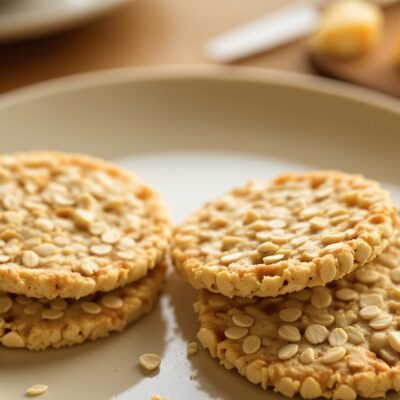
Illustration note: The accompanying image is AI-generated, not a photograph of a tested batch or a documented Scottish kitchen.