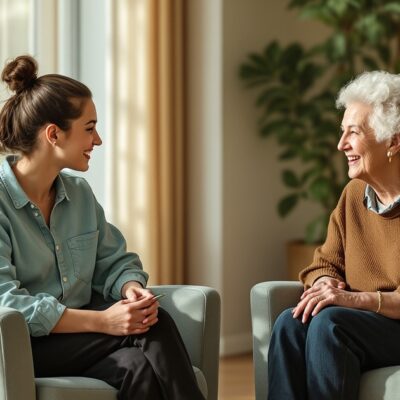




Illustration: AI-generated scene of an intergenerational conversation, not a photograph of Judson Manor or the people in this story.
The address that did not fit the expectation
Would you expect a music student’s favorite part of a rent-free apartment to be the neighbors? In a Cleveland retirement community, one young resident gave a reporter an answer that made the housing arrangement sound very different from a bargain.
In October 2014, CBS News interviewed Marissa Plank, then a 24-year-old student at the Cleveland Institute of Music. She was living in a one-bedroom apartment at Judson Manor, alongside residents decades older than herself.
The practical offer was straightforward: a place to live in exchange for musical performances. For someone studying music, that is an understandable reason to consider an unusual address.
But Plank was not talking as though she had merely found a clever way to reduce her bills. She told CBS she was not looking forward to graduating because it meant leaving.
That is the tension worth staying with. Something that began as an exchange of accommodation for a useful skill had become an attachment to particular people, and the people gaining from it were not only the older residents.
This is a look back at that reported encounter, not a claim that the same students still live there. Its question remains surprisingly close to home: who might become your friend if your daily routine gave you the chance to find out?
A sensible arrangement meets a familiar assumption
According to Judson’s student-resident program page, the residential partnership with the Cleveland Institute of Music began in 2010. Graduate-level students moved into Judson Manor in Cleveland’s University Circle neighborhood.
The operator describes complimentary accommodation in return for cultural programming across its three retirement communities. This was not simply a visiting concert with everyone going home afterward; students were becoming residents themselves.
That distinction changed what was possible. An audience can appreciate a musician without ever knowing much about the person carrying the instrument, while neighbors have opportunities for conversations that do not require a stage.
The original welcome was not entirely free of hesitation. In Steve Hartman’s 2014 CBS report, some residents had initially worried that college students would bring wild parties with them.
It was an assumption about an age group, not a description of the particular young people who eventually moved in. By the time of the report, residents were speaking positively about having the students there and describing them as friends.
There is something recognizable about that change. People can seem predictable from a distance because a category supplies the details we have not actually learned: student, retiree, younger neighbor, older neighbor.
Living nearby did not make everyone identical. It offered a chance for real individuals to replace the imaginary ones, without requiring either generation to stop being itself.
The exchange was no longer moving in one direction
The simplest version of this story would make the students the generous ones. They brought performances into a retirement community, and the older residents received the benefit.
Plank’s own account complicates that version. She told CBS that the arrangement had become more like a family than a job, and said she thought she was getting the better end of the deal.
Those were her descriptions of her experience, not a measured finding about every student or resident. Still, they matter because they challenge the idea that being younger automatically places someone on the giving side of a relationship.
Judson’s program account describes exchanges that went well beyond music. Residents shared art lessons, cooking tips, career advice and relationship advice while the students shared their musical skills.
That list is revealing precisely because it is ordinary. It does not require an older person to deliver a grand speech about life, or a younger person to become a symbol of hope.
A cooking suggestion can be useful because somebody knows how to make something. An art lesson can happen because somebody has a skill worth learning, not because a program has assigned them the role of being inspiring.
Seen that way, the arrangement was not only about bringing youth into an older community. It also gave young adults access to people whose experience, interests and company could make their own lives richer.
The direction of care could change from one conversation to the next. That is a more equal picture of friendship than a permanent division between helpers and people being helped.
The important part was not a perfect match
A rent-free apartment and regular performances created the opening, but neither can guarantee affection. The reported friendships should not be turned into a promise that every shared building will produce the same result.
People need privacy, compatible expectations and the freedom not to socialize. Older adults do not owe students endless advice, and students are not substitutes for professional care or paid staff.
Nor does this reporting establish that intergenerational housing cures loneliness or improves anyone’s health. It documents a particular program and people’s accounts of relationships within it, which are meaningful without becoming medical evidence.
What it does offer is a different way to think about opportunity. The residents did not have to agree on every interest before they could discover one worth sharing.
Music supplied a reason to meet, and living in the same community allowed the relationship to become something other than a single performance. The formal exchange made room for an informal one.
Judson still describes the student-resident program on its website, but its page is not a promise of an available apartment or an invitation to arrive unannounced. Anyone interested in participating would need to check current arrangements directly with the organization.
A smaller version can begin closer to home
Most readers cannot redesign a retirement community or offer a student an apartment. The useful takeaway is smaller: look for a shared activity before deciding that an age gap leaves nothing to talk about.
A community music group, an organized art session or a recurring neighborhood activity can provide a natural starting point. Asking about the activity itself is often more respectful than arriving with a ready-made story about what somebody’s age must mean.
If you are helping organize something, ask participants what they actually want to contribute and receive. A person may want to teach, learn, listen or simply enjoy being there without becoming anyone’s project.
And if an invitation is declined, let it remain an invitation. Connection matters more when it includes the freedom to choose it.
The lasting surprise in Plank’s account is not that a young musician found older people pleasant. It is that a practical housing decision led her to describe leaving as a loss.
Free rent explained the arrangement. It did not fully explain what she valued about living there.
Have you ever become close to someone whose stage of life looked nothing like yours? If so, what gave you the chance to see a person where you might once have seen only an age difference?