




The instrument is still yours
An instrument can sit untouched for years without becoming less yours. What becomes harder to claim is the place you might take beside other people who still play.
Perhaps you remember enough to know what you have forgotten. Perhaps the thought of a room full of fluent young musicians makes returning feel more intimidating than starting did.
I was drawn to the New Jersey Intergenerational Orchestra because its invitation does not treat that hesitation as the end of the story. On its website, returning musicians appear alongside young musicians and experienced players as people it actively welcomes.
That is a small distinction with a large practical question behind it. How do you put people with different ages, abilities, and musical histories together without making some of them feel like visitors?
The answer is not simply to say that music brings everyone together. The organization has built different routes into ensemble playing, with expectations that make the invitation more concrete.
For me, that is where this becomes more interesting than a feel-good picture of children and older adults sharing a stage. A shared interest opens the door, but the way the room is arranged determines who can actually stay.
A welcome with more than one entrance
According to NJIO’s account of its history, string educator Lorraine Marks founded the organization in 1994. It began with more than sixty musicians of different ages and developed into an organization with three orchestras.
The independent Creative Aging Resource entry from Lifetime Arts, dated 2022, also describes its founding in 1994 and its combination of different participation levels and public performances. This is an established approach, not a brand-new experiment being presented as a discovery.
On the organization’s current website, the three main ensembles are called Prelude, Intermezzo, and Symphony. They differ by the musical readiness they ask of players, rather than being described as separate rooms for separate generations.
Prelude is for beginning-level musicians who already have a basic understanding of notes and rhythms and are ready to play in an ensemble. Previous ensemble experience is not required, and the organization specifically describes it as suitable for people returning to playing.
Intermezzo serves advanced beginners and intermediate musicians, using arrangements of classical pieces. Symphony is aimed at intermediate to advanced players and performs original full versions of symphonic works and concertos.
Those distinctions matter. A welcoming group does not have to pretend that everyone is ready for the same piece; it can make room by offering a sensible next step.
I find that more encouraging than being told to stop worrying and simply be confident. Confidence is easier to consider when you can understand what the first rehearsal might ask of you.
The labels stop telling the whole story
We often describe intergenerational activities as older people teaching younger people. That can be part of the picture, but it leaves out the possibility that age and musical experience will not line up neatly.
A young player may have practiced consistently for years. An older player may be returning after a long interruption, or may be learning an instrument they never had the chance to study earlier.
These are possibilities, not portraits of particular NJIO members. They are useful because they interrupt an assumption: a birth date does not tell you who needs help with a passage.
NJIO’s stated vision emphasizes musicians learning through interactions with professionals and with one another. It describes musical growth alongside a common aim of artistic excellence within players’ capabilities.
That last qualification is worth keeping. Taking people seriously does not require asking them to perform beyond their current ability, and meeting them where they are does not mean giving up on improvement.
There is something generous about a shared task that lets both things be true. You can contribute now and still have something to learn next week.
It also gives conversation a practical starting point. Instead of having to explain an entire life to someone from another generation, musicians have rhythms, entrances, and passages to work on together.
That does not guarantee friendship, and the sources here do not establish a particular mental-health effect. The concrete opportunity is enough: people who might otherwise remain in age-separated routines are invited into sustained creative work.
The rehearsal has somewhere to go
The part I would not want to lose is that the music is meant to reach listeners. NJIO is not only offering people a room in which to practice privately beside one another.
Its current program descriptions include an Outreach Orchestra that performs approximately once a month at places such as nursing homes, assisted living facilities, specialized schools, libraries, and other community venues. The stated aim is to reach audiences who may be unable to attend traditional concerts.
That changes the shape of the invitation. Someone returning to an instrument is not merely recovering an old skill; there is a possible path toward using that skill in a shared public activity.
It would be wrong to turn every listener into a lonely person waiting to be rescued by a performance. People attend music for many reasons, and access is a practical issue as well as an emotional one.
But taking performances to different settings makes a simple point visible. Participation depends partly on where an activity happens, not only on whether somebody wants it badly enough.
The orchestra’s mission also includes affordable-admission and free concerts. Specific events and arrangements should be checked directly rather than assumed, especially if travel or accessibility needs will shape a visit.
What stays with me is the movement in both directions: opening ensemble playing to different musicians, and bringing the resulting music toward different audiences. Neither side has to be treated as an afterthought.
A return can begin with a question
If this story makes you think about an instrument you once played, you do not need to turn that feeling into a promise tonight. A useful first step is to find out what joining would actually involve.
NJIO’s joining page asks about your instrument, playing history, and preferred ensemble. It also explains a real limitation: Prelude is strings-only, while wind, brass, and percussion chairs in Intermezzo and Symphony depend on availability.
Ask about current placement, rehearsal times, membership costs, accessibility, and any preparation required. If you live elsewhere, those are sensible questions for a local community orchestra or music school too.
There is no failure in discovering that a particular arrangement does not fit. Transport, money, care responsibilities, and health are real considerations, not excuses to be overcome by an inspirational paragraph.
What I take from this orchestra is not that everyone should perform or that returning will be easy. It is that an unfinished relationship with music does not automatically have to remain unfinished.
A good invitation can leave space for the player you are now, rather than demand the player you used to be. And the people beside you do not have to be your age to understand why that matters.
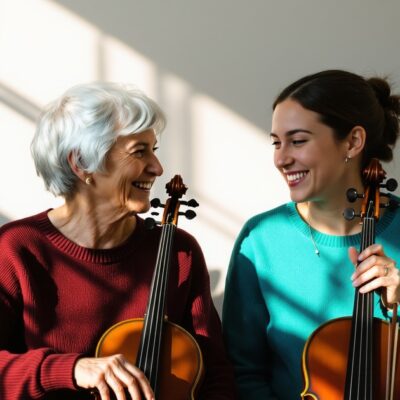
Illustration: AI-generated conceptual image, not a photograph of NJIO musicians.