

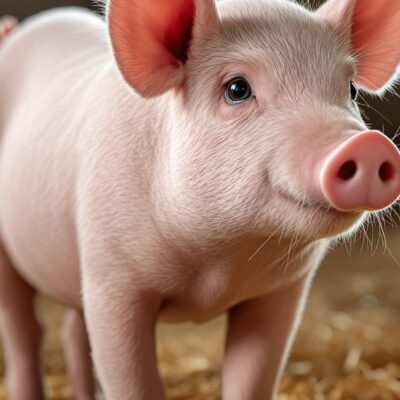

Illustration: AI-generated image of a domestic pig, not a photograph of the study or its animals.
The snout was doing something unexpected
A pig using a joystick sounds like the beginning of a funny video. What caught my attention was a less obvious question: how much of the challenge belonged to the animal, and how much belonged to the equipment we had put in front of it?
In research published in 2021, four pigs learned to move a joystick with their snouts while a cursor moved on a computer screen. The aim was to steer that cursor into a target, not simply to push a lever and collect food.
That gap between the movement and its consequence is what makes the task interesting. The pig had to act in one place while something meaningful happened somewhere else.
I find the picture appealing, but the results deserve more than a cheerful claim that farm animals can play games. There were differences between the pigs, limitations in the apparatus, and a familiar caretaker whose presence complicated the idea that treats explained everything.
This is an older experiment worth revisiting, not a discovery announced this week. Its most useful surprise is not that a pig can resemble a person at a computer, but that looking carefully at an unfamiliar learner can change the questions we ask.
A game with no instructions the player could read
The original paper by Candace Croney and Sarah Boysen describes two Yorkshire pigs, Hamlet and Omelet, and two Panepinto micro pigs, Ebony and Ivory. The work used a computerized task adapted from methods used with other animals.
Before the screen task, the pigs practiced approaching and moving a mock joystick. Training then connected attention to the screen with manipulating the real control.
On the monitor, a cursor began near the center and targets appeared as walls around the edges. Contact with a target produced a sound and a food pellet, with verbal and tactile reinforcement from the experimenter as well.
With targets on every side, moving far enough in almost any direction could succeed. Removing walls made the choice more demanding: now the animal had to direct the cursor toward a particular available target.
That is why a successful movement alone was not enough to establish learning. The researchers compared correct first movements with what would be expected by chance under different target conditions.
It is easy to imagine understanding a task as an all-or-nothing event. Either the player gets it or does not, and the score supposedly tells us which.
But this setup required several things at once: seeing the screen, moving a control with a snout, and connecting that movement with a distant cursor. Difficulty with any one part could make the whole performance look weaker.
The score did not tell the whole story
All four pigs performed above chance on the one-wall condition in the researchers’ analysis of their final trials. Their performance was not identical, and none met the stricter task-acquisition criteria previously used with primates.
That second point matters as much as the first. The paper supports meaningful learning in this task, not a claim that every pig mastered the game or performed like a chimpanzee.
CNN’s reporting on the study highlighted the differences between Ebony and Ivory. On one-wall targets, Ivory’s reported accuracy was 76 percent, while Ebony’s was 34 percent.
Those figures describe particular animals in a particular experiment. They are not an intelligence ranking for their breeds, and they certainly do not tell us everything either pig could learn.
The physical difficulties were striking. The researchers found that all four pigs were farsighted and positioned the monitor to accommodate their vision, but still could not know precisely how well each animal could discriminate the targets.
Eye position relative to the snout created another complication. The pigs sometimes had to look at the screen, move the joystick, then check what had happened, rather than comfortably watching and steering at once.
The larger Yorkshire pigs also had less room to reposition themselves. They tended to do better with vertical movements, while moving toward targets on the left or right could require a change in stance.
I would hesitate to call that simply getting the answer wrong. Some errors may have reflected the interface, the available space, or a movement the animal could not easily make.
The authors also acknowledged a less flattering possibility: the pigs might not have fully understood some aspects of the task. Keeping both explanations in view is more honest than choosing whichever makes the happiest headline.
The person beside the machine still mattered
Then there was the detail that kept me reading. On occasions when equipment failed to deliver a pellet after a correct response, the pigs continued responding correctly with verbal and tactile reinforcement from the experimenter.
That person was also their primary caretaker. The researchers reported that verbal encouragement could help restart training when a demanding task had led to reluctance.
It is a moving observation, but it needs a careful boundary. This was not a controlled comparison proving that affection mattered more than food, or that pigs preferred praise to a meal.
Instead, it showed why the relationship surrounding an experiment deserves attention. The authors suggested that a strong bond with the experimenter might have contributed to the animals’ willingness to participate.
The study was exploratory and small, with changes to equipment and procedures along the way. Training opportunities also differed, so the results should not be polished into a perfectly balanced contest.
What stays with me is the combination: learning was visible, obstacles were real, and the person offering encouragement was not merely background scenery. None of those facts cancels the others.
A better question before deciding someone cannot learn
The researchers suggested that touchscreens might offer a more suitable way to investigate pigs’ cognitive abilities. Their conclusion was not that every animal needed a gaming setup, but that a test should fit the animal being tested.
That distinction leaves a useful human reflection without pretending this experiment studied people. Before judging a learner, we can ask what the task requires beyond the skill we actually want to understand.
Can the person see the instructions? Reach the controls? Try again without embarrassment? Those are practical questions, not promises that every difficulty will disappear with a kinder explanation.
For animals, the takeaway is not to recreate a laboratory challenge at home or demand a clever performance before offering good care. Their needs do not depend on impressing us with a human-looking accomplishment.
I would rather let this story loosen a quick assumption. A clumsy attempt may contain more learning than it first appears to, and a low score may tell us something about the setup as well as the participant.
The joystick makes a memorable picture. The more lasting question is whether we have made room for the learner in front of us, or only for the learner our equipment expected.