
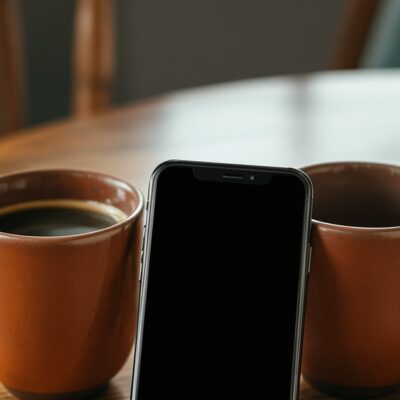




Featured image: AI-generated illustration of a quiet table, not a photograph of a research setting.
The small object that became a big warning
A phone did not have to ring, light up, or interrupt anyone to become the subject of an unsettling claim. Early research suggested that simply having one nearby could make a conversation between strangers feel less close.
It is an idea that fits easily into everyday frustration. You finally find time to sit with someone, and the device beside their cup seems to represent everyone else who might need them.
But a familiar feeling and a reliable scientific effect are not the same thing. That distinction becomes especially important when a finding starts turning into a rule about how thoughtful people should behave.
Perhaps you prefer an empty table when you talk. Perhaps you keep your phone visible because you are waiting for news from a caregiver, arranging a ride, or using an accessibility tool.
Neither detail, by itself, tells the whole story of your attention. And when researchers went back to investigate the original phone claim, the story became more complicated than a simple instruction to put everything away.
That complication is worth hearing, because it offers something more useful than another reason to feel guilty. It asks us to separate the object in front of us from the way we treat the person across from it.
What the first conversations seemed to show
Psychologists Andrew Przybylski and Netta Weinstein investigated whether a nearby mobile phone could influence the quality of a face-to-face exchange. Participants who did not know one another talked while either a phone or a notebook was placed nearby.
As Christian Jarrett explained in a 2012 British Psychological Society report, one conversation task asked people to discuss an interesting event from the previous month. Afterward, they answered questions about their experience with the other person.
The original results suggested that people in the phone condition felt less positive about the interaction and less close to their conversation partner. A second experiment considered whether the topic mattered, comparing more meaningful conversation with a mundane discussion.
The meaningful exchanges appeared particularly vulnerable to the nearby phone. The finding was striking precisely because nobody had to start scrolling for a difference to appear.
One proposed explanation was that a mobile device might bring wider social networks to mind, competing with the immediate encounter. That was a possible explanation, not a direct demonstration of what every participant was thinking.
Even the early report raised questions. Would the same thing happen among people already close to each other, and did the phone change conversational behavior or only how participants later rated it?
Those questions can disappear when a study becomes a memorable piece of advice. A result about strangers in a particular setting can start sounding like a verdict on every dinner table.
Another team put the warning to the test
Researchers Claire Linares and Anne-Laure Sellier returned to the question in a 2021 paper published in PLOS ONE. Across two experiments, their analyses included 356 participants in 136 groups.
They again brought together people who had not previously met and placed either a smartphone or a notebook nearby. The participants discussed an interesting event from the past month, following the earlier conversation task.
This was not a test of someone repeatedly checking messages while another person spoke. Participants left their own belongings, including phones, outside the study room; the device in the room belonged to the experiment.
The later research also added creativity tasks. Groups designed a toy, and participants eventually completed questionnaires about the experience, including measures of relationship quality.
There were differences from the original work that matter when interpreting the comparison. The newer experiments used a smartphone rather than an older cellphone, included three-person groups as well as pairs, and collected relationship ratings after the additional tasks.
In the first experiment, the researchers examined pairs separately to make the comparison more direct. The second experiment used three-person groups, so it should not be mistaken for a perfect repeat of the original setup.
These details may seem less exciting than the original warning, but they are where confidence in a claim has to be earned. A compelling idea needs to survive more than the moment when it first sounds right.
The result did not follow the familiar script
The later team did not reproduce the original negative effect on relationship quality. They also did not find an effect of the phone’s mere presence on creativity.
That does not establish that a nearby phone can never matter. A failure to detect an effect is not proof that the effect is impossible in every population, conversation, or setting.
The authors discussed several limitations and possible explanations, including changes in how ordinary smartphones had become. Their data were collected in 2018, years after the original experiments, and many participants were young adults.
It is possible that the meaning of a visible device had changed. But the researchers presented that as a possibility, not a fact their experiments had settled.
The more defensible conclusion is narrower: the harm attributed to a phone simply being present was harder to find than the earlier work suggested. That is different from claiming that interruptions, distraction, or ignoring someone are harmless.
For an ordinary conversation, this distinction can be a relief. You do not need to treat a silent rectangle as a machine that automatically drains warmth from the room, nor dismiss someone who says your checking habit makes them feel overlooked.
A better question for the person across the table
A practical response is to discuss attention rather than prosecute the location of a device. Ask what would help the next conversation feel comfortable, instead of assuming that one visible object reveals somebody’s priorities.
If you need to remain reachable, explain that before you begin. If you want a short stretch without interruptions, make a clear, mutual request rather than quietly testing whether the other person guesses correctly.
These are suggestions for negotiating a shared moment, not an intervention proven by the experiments above. The research does not supply a universal household rule or determine what any particular friend needs.
Putting a phone away can still be a considerate choice. So can making room for someone who uses it to communicate, monitor a health need, or manage a responsibility they cannot simply suspend.
What matters is not winning an argument about whether technology is good or bad. It is making the expectations visible enough that neither person has to invent the other’s intentions.
The hopeful part of this story is that a relationship need not depend on perfect table etiquette. There is room for explanation, adjustment, and a second attempt at being present.
A study can help us ask better questions without answering every one of them. This time, the question worth carrying into your next conversation may be less about where the phone goes and more about what being available to each other actually means.