
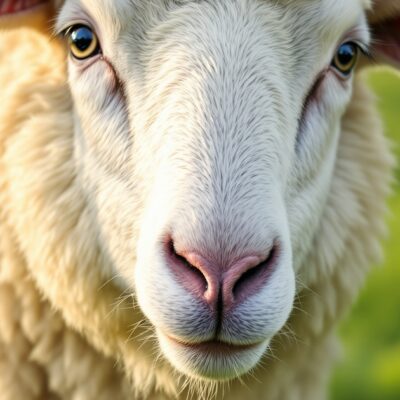




A familiar face in an unfamiliar place
If an animal knows you, how much of you does it actually recognize? Your voice, your footsteps and the arrival of food can all be tangled together, making a familiar response harder to explain than it first appears.
A photograph removes some of those clues. It cannot walk across a yard or speak, and it does not carry the moving, three-dimensional presence of the person an animal meets every day.
That is what makes a small sheep study from 2017 worth returning to. At the University of Cambridge, researchers put human faces on screens and gave eight sheep a series of choices.
The famous faces made an easy headline: Barack Obama, Emma Watson, Jake Gyllenhaal and Fiona Bruce were among the people in the photographs. But the most relatable part of the experiment concerned someone whose name did not need to be famous at all.
It concerned a handler the sheep already knew. Before that photograph entered the test, however, the researchers had to establish something less sentimental and more demanding: could these animals learn a face in a picture, and then recognize it when the picture changed?
The reward was simple; the question was not
According to Cambridge’s account of the research, the sheep moved through a specially designed pen toward two computer screens. Choosing the correct image meant breaking an infrared beam near that screen and receiving food.
A wrong choice brought a buzzer and no food reward. Through training, the animals learned to associate the selected celebrity portraits with the rewarded choice.
That detail matters because nobody was claiming a sheep had followed an election or watched a film. The celebrities were recognizable to human readers; for the sheep, they were faces introduced through the task.
After training, the animals chose between a learned celebrity face and an unfamiliar face. They selected the learned face about eight times out of ten.
That was an encouraging result, but a careful reader can still ask a fair question. Had the sheep learned something about a person, or merely become good at choosing a particular arrangement of light and dark on a screen?
Those possibilities are not identical. A photograph can become familiar without an observer necessarily recognizing its subject across different photographs.
So the researchers changed the view. Instead of relying only on front-facing portraits, they presented the familiar faces photographed at an angle, making the task harder without changing whose face was being shown.
Changing the picture made the test more revealing
The sheep did less well when the angle changed, but their choices remained above chance. Cambridge reported a performance drop of about 15 percent, describing it as comparable to the drop people show on this kind of task.
That does not mean a sheep understands a face in every way a person does. It means that, within this particular experiment, changing the viewpoint did not erase the animals’ ability to distinguish the learned faces.
The BBC’s independent report identified the participants as eight female Welsh Mountain sheep. That is a small, specific group, not a survey of every breed, age or living situation.
The size of the study should keep the story measured, not make it disappear. A modest experiment can still demonstrate a capacity that a casual glance at an animal would never reveal.
There is also a useful distinction between recognition and emotion. These choices were not a test of whether the sheep liked a celebrity, understood a facial expression or felt affection toward the person in a photograph.
Recognizing who is there is one question; interpreting how that person feels is another. The BBC noted that recognizing different expressions was a possible subject for future investigation, rather than something this work had already established.
With the picture task in place, the researchers could move to a different kind of familiarity. This time, the face would belong to someone known through ordinary contact rather than screen-based training.
The person behind the photograph already mattered
The handlers typically spent around two hours a day with the sheep, according to Cambridge. Their faces therefore belonged to the animals’ real surroundings, not just to a sequence of rewarded images.
When a handler’s portrait appeared among the test images, the sheep chose it over an unfamiliar face about seven times out of ten. They had not been trained beforehand to select that handler’s photograph.
That last distinction is easy to lose in a cheerful retelling. The animals had learned how the screen task worked, but recognizing the handler’s picture was not simply a repeat of learning the celebrity portraits.
Cambridge also described an observed checking pattern when the sheep first encountered the handler’s photograph. The animals looked between the unfamiliar face and the familiar handler’s image before choosing, a behavior the university characterized as a double take.
We do not need to supply an inner monologue for that moment. The observable result is interesting enough: familiarity formed with a living person helped the sheep make a choice involving a flat image.
There was a broader scientific purpose, too. The researchers were developing ways to assess sheep cognition, with potential use in studying changes associated with neurodegenerative disease; this was not simply a contest to declare a farm animal clever.
A quieter way to look at the animal looking back
The study does not prove that a sheep misses its handler, loves everyone it recognizes or wants attention from a passing visitor. It also does not turn a photograph into a reliable home test of an animal’s bond with you.
Its honest payoff is smaller and, in some ways, more generous. An animal that can look interchangeable from a distance may be making distinctions among the people who repeatedly enter its world.
For anyone visiting a farm or sanctuary, that offers a reason to slow down rather than demand a response. Follow the staff’s instructions, give animals room and avoid assuming that familiarity with one person means comfort with every stranger.
You do not need an animal to approach you for the encounter to count. Watching without reaching, chasing or offering unauthorized food leaves space for behavior that is not being forced into a human idea of friendliness.
And for the rest of us, there is a simple change of attention available. Instead of asking whether an animal is impressive enough to deserve interest, we can ask what our quick assumptions prevent us from noticing.
Have you ever seen an animal respond differently to someone it knew well? The useful part of that memory may not be the explanation we immediately gave it, but the specific behavior we can describe—and the questions we remain willing to ask.
Image: AI-generated illustration, not a photograph of the research animals or experiment.