



The Rancher Who Said Yes
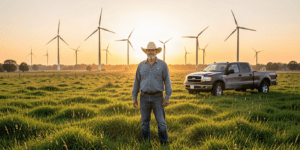
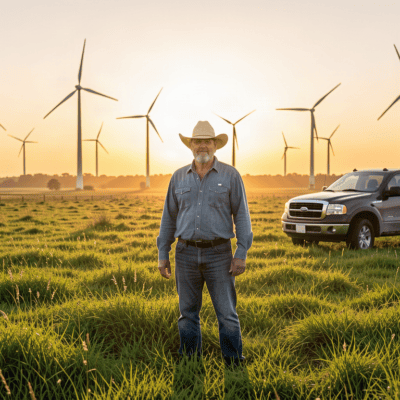
In the rolling grasslands of West Texas, where the horizon stretches uninterrupted for miles and the wind never stops blowing, Tim Mohler did something his neighbors thought was reckless. He signed a lease allowing wind turbines on his cattle ranch. That was fifteen years ago.
At the time, the towers seemed like an intrusion. Steel giants looming over grazing land that had remained unchanged for generations. His fellow ranchers warned him about noise, about falling property values, about what future buyers would think. They told him he was selling the soul of his ranch for a quick paycheck.
Tim listened to every concern. He sat through tense meetings at the local cattle association. He heard the same fears repeated until they became a chorus of opposition. Then he signed anyway.
Today, those turbines generate half his total income. His ranch has not shrunk. His cattle still graze beneath the spinning blades. And his neighbors, once his loudest critics, are knocking on his door asking how he did it.
The Skepticism Was Real
Wind energy in ranching country faced fierce resistance in the early 2000s. Ranchers saw their open horizons as sacred. The idea of industrial machinery piercing that landscape felt like a violation.
Tim heard every objection. The turbines would scare the cattle. The maintenance roads would fragment the grazing land. The noise would drive everyone crazy. And worst of all, the contract would lock him in for decades.
He visited operating wind farms before signing. He talked to ranchers who had already made the leap. He read the fine print until his eyes burned. Then he made his decision based on one simple fact: cattle ranching alone was not enough anymore.
The Numbers Nobody Expected
The first turbines went up in 2010. Tim watched them rise from his pickup truck, section by section, until they stood taller than anything for miles around. Each blade was longer than a semi-trailer. Each tower required a foundation deeper than his well.
Then he waited for the problems his neighbors had predicted. He watched his cattle carefully during those first weeks, looking for signs of stress or altered grazing patterns.
The cattle did not care. Within weeks, they were grazing directly beneath the towers, using the access roads as convenient paths through the pasture. The shade from the turbine bases became favored resting spots during the brutal midday heat.
The noise was audible but barely noticeable against the constant West Texas wind. On most days, the turbines blended into the background of a landscape already full of mechanical sounds: pumps, generators, trucks on distant highways.
The checks started arriving quarterly. At first, they were modest supplements to his cattle income, enough to cover maintenance and property taxes with some left over. But as energy prices climbed and the turbines proved more efficient than projected, the payments grew steadily.
Within five years, wind revenue matched his cattle revenue. By year ten, it had surpassed it. Today, the turbines generate roughly half his total income, with cattle making up the rest. The diversification has made his operation more stable than any single-income ranch in the county.
A New Kind of Ranching
Tim Mohler now runs what he calls a hybrid operation. Cattle graze during the day beneath spinning turbines that convert the same wind that blows dust across his land into electricity for cities hundreds of miles away.
The maintenance crews have become part of his community. Technicians in hard hats stop at his gate to ask about road conditions. The company that owns the turbines maintains the access roads better than the county ever did.
Those access roads he once feared have actually improved his operation. Moving cattle between pastures used to involve driving through fields, tearing up grass, creating erosion problems. Now he uses the paved turbine roads, saving time and protecting his land.
The steady quarterly income from the turbines has insulated him from the brutal volatility of beef prices. When droughts hit and feed costs spike, the turbine checks keep coming. When cattle prices crash during a market glut, the turbines spin regardless.
His neighbors, once vocal critics, have started asking different questions. Not whether he regrets it, but how they can get the same deal. Several have signed their own leases in the past three years. The landscape that once symbolized resistance to change now represents something else entirely: adaptation that pays.
The View From the Pickup
Tim still drives his ranch at dawn, checking fences and water tanks. The turbines are just part of the scenery now, white blades turning against the sunrise. He does not think of them as industrial equipment anymore. They are infrastructure, like the windmills his grandfather built or the solar pumps he installed in the nineties.
On windy days, he parks near the base of the tallest tower and watches the blades slice through the air. Each rotation generates enough electricity to power a home for a day. His ranch produces thousands of those rotations every hour.
Ranching has always required adapting to what the land offers. Generations before him adapted to drought by drilling deeper wells. They adapted to falling beef prices by diversifying into hunting leases. Tim adapted to a new reality where the wind itself had value.
In West Texas, the land offers wind. Tim Mohler was one of the first to treat that wind as a crop worth harvesting. The harvest has been better than anyone imagined. And the view from his pickup has never looked more secure.
The next generation of ranchers is growing up with turbines as normal. Children who were born after the first towers went up have never known a ranch without them. To them, the spinning blades are as natural as the wind that moves them.
Sources: Good News Network, Associated Press