

A small fish, an unexpectedly large question
A cleaner wrasse is small enough to be easy to overlook. Yet in a laboratory study, a piece of shrimp beside a mirror became part of a question usually reserved for animals we already consider clever.
The surprising detail was not simply that the fish approached a reflection. What mattered was the sequence of its behavior, and what researchers kept watching after an earlier part of the experiment appeared finished.
Published in November 2025, the Scientific Reports study by Shumpei Sogawa and colleagues investigated how quickly bluestreak cleaner wrasse responded to marks on their bodies after encountering a mirror. It also examined how their behavior changed afterward.
That second question makes this more than another animal intelligence contest. A pass or fail can make a tidy headline, but it can also encourage us to stop observing just when an animal starts doing something harder to categorize.
There is an ordinary human habit hiding in that problem. We decide what we expect another creature to do, watch for that action, and risk overlooking everything that does not fit the task.
These fish gave the researchers a reason to keep watching. The result is intriguing, but the boundaries around it matter as much as the surprise.
The researchers changed the order
The familiar mirror mark test asks whether an animal responds to a mark on its own body that it can see only through a reflection. A response directed toward that spot can be evidence of mirror self-recognition, although what it establishes about broader self-awareness remains debated.
Cleaner wrasse are especially interesting subjects because of their everyday work. In their natural habitat, they remove and eat small external parasites from other fish, making unusual spots on a fish’s body relevant to their lives.
Earlier experiments typically gave fish time with a mirror before introducing a mark. That approach leaves a timing problem: if recognition happened early, a later test could miss when the important change occurred.
This team reversed the order. Nine fish with no previous mirror exposure received a brown mark on the throat before the mirror was revealed, allowing researchers to watch what happened from the first encounter.
The procedure was conducted under an approved animal research protocol; it was not a simple home aquarium game. The researchers filmed the fish and examined the sequence of responses, including aggression toward the reflection and movements they interpreted as checking the relationship between body and image.
Six of the nine fish attempted to scrape the marked throat within two hours of mirror exposure. One additional fish later showed throat scraping, while two did not show that response during the observations described.
The variation matters. This was not every fish performing the same action on cue, and the small sample should remain visible whenever the finding is discussed.
Finishing one test did not finish the story
The researchers continued observing after the first mark-directed scraping. They compared the fish’s earlier behavior with later interactions, rather than treating every movement near the mirror as the same kind of response.
Early aggression and later mouth contact could look superficially similar if reduced to a quick description. The team examined differences including fin movement, swimming speed, and how the fish moved along the mirror.
They interpreted the later patterns as exploration of the mirror’s properties, distinct from the initial response to a possible rival. That interpretation rests on observed differences, not on the fish explaining what they intended.
Then came the shrimp. On the third and fourth days of mirror exposure, three fish were recorded picking up pieces from the tank bottom, carrying them upward, and dropping them close to the reflective surface.
The fish followed the sinking pieces and touched the mirror with their mouths. The authors proposed that the animals were exploring how an object moved in relation to its reflected image.
That is the fascinating possibility: attention shifting beyond the fish’s own body to something moving beside it. But a recorded sequence and an explanation of that sequence are not interchangeable, even when the explanation is persuasive.
Calling the fish little scientists would be a metaphor, not a result. The paper documents behavior and offers an interpretation; it does not show that the animals understood mirrors in the same way a person does.
Still, a piece of food being lifted and released makes the question more concrete. There is something to observe, compare, and investigate further, rather than merely a charming label to attach.
The disagreement is part of the discovery
Mirror research has a long-running interpretive problem: recognizing a bodily image, using reflected information, and possessing a rich sense of self may not be the same achievement. A single test cannot easily separate every possible meaning.
In a 2019 PLOS Biology commentary, primatologist Frans de Waal questioned strong conclusions from earlier cleaner wrasse experiments. He raised concerns about interpreting scraping and about marks that could combine visual information with physical sensation.
That commentary predates the 2025 study and is not a direct response to its new observations. It is useful context for understanding why a report of fish passing a mirror test should not become an announcement that every question about fish consciousness has been settled.
De Waal also challenged a simple divide between animals that possess a self and animals that possess none. He argued for a wider range of tests and a more gradual understanding of different capacities.
The newer paper makes a different, stronger argument about what rapid recognition implies. Keeping those perspectives distinct gives readers an honest picture of a field where evidence can be striking without interpretation becoming unanimous.
We can be impressed by the observations without pretending uncertainty has disappeared. In fact, the uncertainty supplies the next questions: which behaviors recur, under what conditions, and what alternative explanations can better experiments rule out?
A reason to watch without demanding a performance
The humane takeaway does not depend on deciding that a fish thinks exactly like us. It begins with recognizing how easily an unfamiliar animal can be reduced to a few assumptions before anyone has looked carefully.
This study is not an invitation to mark a pet fish or repeatedly confront it with a mirror. Research procedures, trained observation, and welfare oversight are not interchangeable with trying to reproduce an appealing clip at home.
Nor should an animal have to perform an impressive trick to deserve appropriate care. A fish that never gives us a recognizable demonstration still has species-specific needs, and a failed test is not a measure of its worth.
What we can borrow is the researchers’ willingness to keep observing after the expected milestone. That is a useful form of attention: less eager to award intelligence, more willing to notice a pattern that complicates our first explanation.
The shrimp did not answer every question about a fish’s inner life. It gave researchers another observable behavior to investigate, and gave the rest of us a reason to be slower with the word simple.
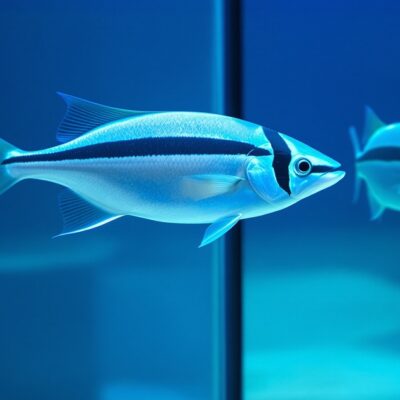
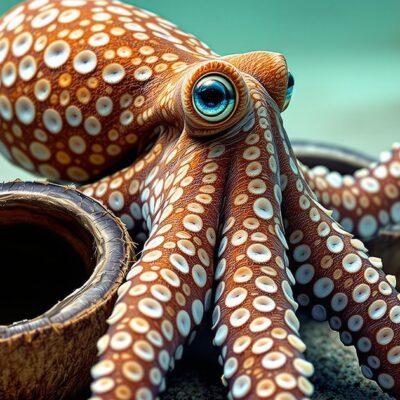
Illustration note: The accompanying image is AI-generated, not a photograph of the experiment or its fish.