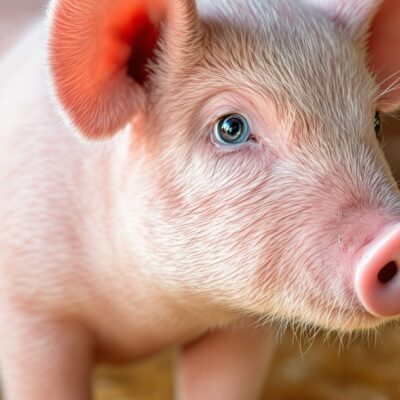



Featured image: AI-generated illustration of a domestic pig, not a photograph of an animal in the study.
A gentle hand does not tell the whole story
The pigs met the same familiar person, and both kinds of interaction involved gentle touch. Yet when researchers changed how that person behaved, the animals did not behave quite the same way either.
That is the intriguing starting point of a study published in 2024. It was not a comparison between a kind handler and a frightening stranger, which makes its question more interesting than a simple reminder to be nice.
For anyone who cares about animals, there is a recognizable tension here. You can mean to offer comfort and still have to ask whether your version of a pleasant encounter matches the experience of the creature receiving it.
A hand moving gently is something we can see. What an animal expects from that hand, or how much influence it has over what happens next, is harder to read.
Researchers Suzanne Truong, Oceane Schmitt and Jean-Loup Rault investigated that problem with young pigs at the University of Veterinary Medicine Vienna’s research farm. Their findings offer neither a shortcut to an animal’s feelings nor a dramatic verdict against touch.
Instead, they reveal why familiarity, timing and the freedom to respond deserve a place in the conversation about care.
The person was familiar, but the pattern changed
The original Scientific Reports paper describes several weeks of preparation before the comparison began. The pigs gradually became accustomed to human presence, contact and the test environment, rather than being introduced to everything at once.
During that preparation, the interacting researcher encouraged voluntary approaches and responded with gentle stroking or scratching. Individual preferences about contact were also observed, so the encounters were not treated as though every pig wanted exactly the same thing.
The main comparison used two five-minute sessions on consecutive days. Each pig experienced both conditions, and the order was counterbalanced: some began with the freer interaction and others with the more structured one.
In the free-form condition, the pig could approach and the human responded to its attempts to interact. This resembled the style the animals had already encountered during preparation.
In the imposed-contact condition, the researcher followed a standardized sequence instead. Gentle contact happened according to that schedule, with periods when the person did not respond to the pig’s attempts to engage.
The word “imposed” needs care here. This was not an experiment in trapping an animal for unwanted cuddling: if a pig moved two steps away during the approach, the researcher withdrew and waited for the next scheduled bout.
What changed was the organization of the interaction. The familiar person was still there, but the familiar back-and-forth was no longer operating in quite the same way.
The easy answer did not arrive
The researchers expected the free-form sessions to produce stronger signs of engagement and positive feelings. Their results did not deliver that tidy conclusion.
Across the 28 pigs included in the main test-behavior analysis, the measures did not establish a clear preference for either style. Approach timing, contact initiated by the pigs and tail-wagging measures did not provide the predicted advantage for free-form interaction.
That matters because it stops a tempting story before it starts. This study cannot honestly be reduced to “pigs loved choosing and hated being touched on a schedule.”
There were differences, though. The pigs spent more time exploring the pen during the free-form sessions and made more low-pitched vocalizations, or grunts, during the structured sessions.
The French Reference Centre for Animal Welfare’s research summary highlights those same findings. It is a summary of this experiment, not a separate replication confirming what every pig will do.
More grunting might sound like an obvious complaint to a human reader. But the authors explain that low-pitched vocalizations can occur in positive as well as negative situations, so the sounds alone cannot settle whether the experience felt good or bad.
Likewise, more exploration is an observed behavior, not a direct translation of happiness. The animals may have been paying different amounts of attention to the person, and the reasons for that difference remain open.
The interesting result is not a secret dictionary of pig emotions. It is that changing the pattern around a gentle act changed parts of the animals’ response.
The history of an encounter travels with it
One possible explanation lies in expectation. The pigs had learned one style of interaction during preparation, then encountered a person who sometimes behaved differently from that familiar pattern.
The authors suggest this might have increased attention to the human or created frustration when expectations were not met. A change in the animals’ influence over the encounter is another possibility, rather than a proven explanation.
Those possibilities are related but not interchangeable. Because the free-form condition resembled prior experience, the study cannot cleanly separate the effect of having more choice from the effect of encountering something more predictable.
The limitations are substantial enough to keep in view. This was a small study with one interacting human, and that person knew the hypotheses; the authors also report statistical cautions associated with the exploratory analysis.
Two pigs were excluded from the main test-behavior analysis because their sessions ended early after distress reactions. That detail belongs in the account, not outside it because it complicates a reassuring story.
None of this makes the research worthless. It makes the lesson more precise: to understand an interaction, look beyond the category of touch and consider the individual, its previous experience and what actually happens during the exchange.
Care can include room for an answer
For a person looking after pigs, the practical starting point is observation rather than a universal petting technique. Work with an experienced keeper or veterinarian, respect safe handling routines, and notice approaches, withdrawals and changes from the animal’s usual behavior.
Do not treat a grunt as automatic permission to continue, or turn a refusal into a challenge to win. Necessary care still has to happen, but optional affection does not need to become a test of how much contact an animal will tolerate.
This experiment does not supply a prescription for every species, and it does not prove a rule about human relationships. Its human takeaway is simpler: good intentions are a beginning, not a substitute for paying attention.
There is something encouraging in that distinction. Being caring does not require you to interpret every sound perfectly or insist that your first attempt was the right one.
It gives you permission to slow down, notice a response and adjust. Sometimes the most thoughtful part of an encounter is not the gesture you prepared, but the space you leave for the other living creature to answer.