A brush was worth more effort than expected
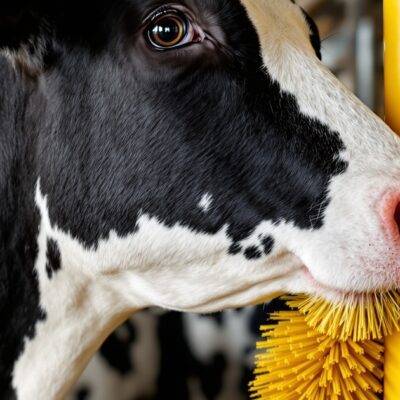
Ten dairy cows helped researchers discover something surprisingly easy to overlook: a chance to scratch and groom could be worth serious effort. The animals were not simply using a brush because it happened to be within reach.
In a study published in 2018, they pushed a weighted gate to get to it. As the researchers made the gate harder to open, the cows gave them a way to measure how much that opportunity mattered.
That changes the question behind a familiar, charming sight. Watching a cow lean into a brush might make someone smile, but a smile does not tell us whether the brush is a pleasant extra or something the animal strongly wants.
The researchers needed more than a cute moment. They needed a comparison, and they chose one with real weight: access to fresh feed.
There is a quiet emotional pull in that setup. An animal cannot fill out a survey about the things missing from her day, but she can make an effort to reach them.
The experiment did not translate a cow’s thoughts into words. It did, however, make a preference harder for people to dismiss.
The everyday behavior that housing can interrupt
Grooming is not an invention of modern farm equipment. Cattle lick themselves and one another, and in naturalistic environments they can rub against trees or other abrasive surfaces to reach places their tongues cannot easily reach.
The original Biology Letters paper explains that grooming helps remove dirt, parasites, and other material from skin and hair. It also notes that indoor dairy housing can lack suitable surfaces for this behavior.
That is where an automated mechanical brush comes in. It offers a grooming surface within the housing system, rather than requiring a cow to make do without an appropriate place to scratch.
It would be tempting to stop there and call the equipment useful. The more difficult question is how important that usefulness is from the animal’s side.
A resource can look optional to the person arranging a space while occupying a very different place in the life of the animal living there. Watching whether an animal uses it is a start, but watching what she will do to reach it tells researchers more.
The team therefore used motivation testing: increase the work required to obtain something, then observe when the animal stops doing that work. This is a behavioral measure, not a direct reading of feelings.
It also creates a useful challenge to human assumptions. Instead of deciding beforehand that grooming belongs near the bottom of the list, the researchers let the cows’ behavior help establish its importance.
The gate made the question harder
The participants were ten healthy, pregnant, lactating Holstein cows. After getting used to the experimental setting, they learned to push open a weighted gate without a trainer present.
The study then tested four consecutive conditions: access to the mechanical brush, access to fresh feed, access to the same space with no brush, and access to the brush again. The empty space served as a comparison for the possibility that the cows simply wanted to go somewhere.
Weight was gradually added to the gate’s pulley system. The researchers recorded how much weight each cow would push before she no longer opened it.
The second brush test mattered because the conditions were not presented in a balanced order. Testing the brush at both the beginning and the end gave the researchers a partial check on whether its position in the sequence affected the result.
There was another practical complication: food could not be restricted continuously in the same way as access to a brush. The feeding condition therefore used a different testing schedule.
For that condition, cows had been without feed for approximately an hour and a half and without fresh feed for approximately fifteen hours. Each then had a fifteen-minute individual opportunity to open the gate for fresh feed.
For the brush and empty-space conditions, they had continuous access to the gate, with weight added every three days. Those differences matter when interpreting the comparison; this was not a simple choice between a brush and a meal placed side by side.
What the cows’ effort actually showed
The cows pushed similar weights to reach the brush and the fresh feed. They pushed less weight to reach the empty space, and the two brush tests did not show a difference in the weight they would push.
A UBC research report hosted by Farmwest describes many cows pushing weights of 23 kilograms or more to reach food or the brush, with some pushing 41 kilograms or more. Those figures refer to weights in the gate setup, not objects the cows were lifting.
The report is an explanation of the same experiment, not a second independent study. Its practical conclusion matches the paper’s: access to the mechanical brush was an important resource for these cows.
That is a strong finding without being an unlimited one. Similar performance in this test does not mean grooming is biologically interchangeable with food, or that a cow would choose scratching over eating under every circumstance.
The authors also acknowledged a possible physical ceiling. Some cows continued trying after they had reached their recorded failure weight, so inability to open the gate could reflect physical difficulty rather than a disappearance of motivation.
Pregnancy complicated the picture too, because the gate pressed against a cow’s side as she passed. The researchers suggested that future work could test other tasks or cows that were not pregnant.
A small comfort deserves a serious question
The most moving part of this research does not require pretending that we know exactly what a cow feels. The animals repeatedly worked for access to something people might otherwise treat as an accessory.
That effort offers a more grounded reason to care than a human caption about a smiling cow. It puts observable behavior behind the argument that opportunities to groom belong in discussions of animal welfare.
A brush alone cannot tell us whether an entire housing system meets an animal’s needs. This study did not establish that installing one resolves every welfare concern, and its small group should not be mistaken for every cow in every setting.
But careful limits do not make the central result trivial. They keep it useful: here were ten cows, a measurable obstacle, and clear evidence that access to grooming mattered.
The broader invitation is to notice the difference between keeping an animal alive and paying attention to the activities she is motivated to perform. Neither sentimentality nor indifference is a substitute for asking that question well.
Sometimes better care begins with a dramatic rescue. Sometimes it begins with a less spectacular discovery: what looks like a little comfort from outside the pen is important enough for the animal inside it to push for.