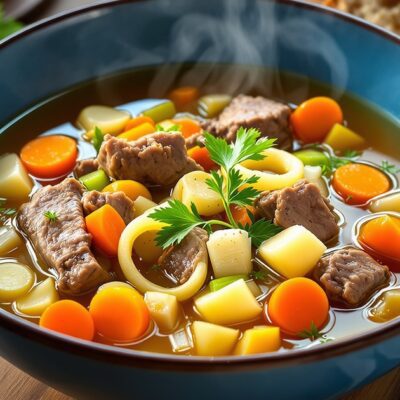



Featured image: AI-generated food illustration, not a photograph of a tested batch or a particular Welsh kitchen.
The bowl that used to arrive in two parts
A Welsh meal now served in one comforting bowl was traditionally often eaten in two courses. First came the broth; the meat and vegetables followed afterward, giving the liquid a moment of its own.
That detail changes how you look at cawl. What appears to be a straightforward lamb and vegetable stew has a history that asks you to notice something easily overlooked: the part of dinner you might otherwise treat as background.
Perhaps you recognize the modern version of that problem. You have bought decent ingredients, set aside an afternoon, and still find yourself worrying that a simple pot of food will not seem special enough.
It is tempting to keep adding things. Another seasoning, another topping, another little task that turns feeding people into a performance.
Cawl offers a different starting point. The question is not how many additions the pot can hold, but whether the broth is something you actually want to eat.
That is not an argument against ambitious cooking. It is an invitation to make one ordinary dinner with a clear purpose, and to let the ingredients do the work they came for.
A tradition with room for more than one kitchen
The Welsh Government’s Wales.com guide to cawl describes a hearty broth of meat and seasonal vegetables, with recipes varying between towns and even households. It also records that older two-course way of serving it.
Today, lamb, potatoes, leeks, and other vegetables commonly share the bowl. Bread and Welsh cheese often sit beside it, turning a soup or stew into an unhurried meal.
The variation matters. You do not have to imagine one perfect grandmother’s recipe, unchanged in every kitchen, to respect a dish with a long local life.
Chef Alex Vines, whose recipe appears on Wales.com, explains that available meat and vegetables shaped different versions. His approach browns the lamb first, while earlier methods placed the meat and vegetables into the pot without that step.
The Hairy Bikers’ BBC Food recipe gives another practical example: lamb neck goes straight into stock, followed later by the vegetables. It recommends making the cawl ahead and refrigerating it overnight before reheating.
Neither version turns the meal into a race. Both make room for a slow-cooking cut to become tender, and both treat the vegetables as part of dinner rather than decoration.
That gives a home cook a useful kind of confidence. There is more than one legitimate route to the bowl, but there are still things worth paying attention to along the way.
What to put in the pot, and when
The following four-serving version follows Alex Vines’s Wales.com recipe, with the instructions restated here for a home kitchen. Allow around twenty minutes for preparation and roughly three hours or more for gentle cooking; tenderness matters more than an exact finish time.
- 1 tablespoon vegetable oil
- 800 grams lamb neck on the bone
- 2 onions, finely diced
- 4 thyme sprigs, 2 bay leaves, and 2 rosemary sprigs, tied together
- About 1.5 litres cold water, or enough to cover the lamb by a few centimetres
- 3 carrots, peeled and cut into rounds about 1 centimetre thick
- 2 leeks, thoroughly washed, with the white parts cut into thick rounds and the green tops finely sliced and kept separate
- 1 small swede, also called rutabaga, peeled and diced
- 2 potatoes, peeled and each cut into eight pieces
- Up to 1 teaspoon salt initially, adjusted to taste, plus black pepper
- Optional parsley, crusty bread, and Caerphilly cheese for serving
Warm the oil in a large, heavy pot over medium heat. Brown the lamb on all sides, allowing about five minutes or a little longer as needed, then lift it out and soften the onions in the same pot for about five minutes.
Return the lamb, add the water and herb bundle, and bring the liquid to a boil. Lower the heat to a gentle simmer and cook for ninety minutes, skimming the surface when needed.
Add the carrots, white leek rounds, swede, and potatoes, along with salt and pepper. Continue simmering gently for another sixty to ninety minutes, checking that the vegetables and meat are tender.
Lift out the lamb carefully with tongs and place it on a board or plate. When safe to handle, separate the meat from the bones, remove any small bone fragments, and cut or pull the meat into generous pieces.
Return the meat to the broth with the sliced leek greens. Simmer for another five minutes, remove the herb bundle, and taste before adding more seasoning.
The part that cannot be rushed into submission
The main cooking lesson is not a secret ingredient. It is the difference between bringing a pot to the boil and leaving it there: after the initial boil, the recipe calls for gentle simmering.
Keep checking rather than turning the burner up because dinner feels late. If the liquid is disappearing too quickly, lower the heat and add a little water so the contents can continue cooking without catching.
The meat should be tender enough to separate from the bone comfortably. If it still resists, give it more time and check again; a clock cannot tell you everything about a particular piece of lamb.
It also helps to taste a spoonful of broth before serving. If it seems flat, adjust the seasoning gradually rather than assuming the answer must be another expensive ingredient.
Both cited recipes discuss the appeal of cawl the next day. That is an option, not a rule that requires leaving a pot on the counter overnight.
If making it ahead, divide it into shallow containers, cool promptly, and refrigerate within two hours. Reheat only the portion needed until steaming hot throughout, stirring so the middle heats as well as the edges.
A dinner that leaves room for the people eating it
Serve the cawl in bowls with bread and, if you like, Welsh cheese on the side. A little parsley adds freshness, but there is no need to turn every serving into an elaborate arrangement.
The old two-course custom is interesting because it gives the broth attention, not because everyone should copy it. You can honor that idea simply by tasting what you have made before deciding it needs something more.
There is a practical generosity in a meal that can be prepared ahead. It lets the person who cooked spend less of the gathering making last-minute decisions, although someone still has to plan, shop, and wash the pot.
No stew removes those responsibilities. But this one offers a manageable sequence: start the meat, prepare the vegetables, wait for tenderness, and make the final adjustments with a spoon.
That can be enough for a good dinner. Not because simplicity is automatically better, but because feeding people does not always need an extra flourish to count as care.
Sometimes the part worth noticing has been in the bowl all along.