



The question was not whether a goat wanted the food
If an animal keeps investigating a latch, what do you call it: troublesome, persistent, or curious? The answer can say as much about the person watching as it does about the animal.
A goat working at a food box is an especially tempting subject for a quick judgment. We can see the reward, we can see the repeated movements, and it is easy to decide that there cannot be much more to the story.
But a research team working with goats at Buttercups Sanctuary in Kent asked a question that could not be answered in one entertaining clip. They wanted to know what would happen when an unfamiliar task became familiar, and then the animal went a long time without encountering it.
Their 2014 study in Frontiers in Zoology involved a box, a food reward, and a sequence of movements. It was not a contest to find the cleverest farm animal, and it was not evidence that every goat would respond identically.
What makes it worth revisiting is the space between the sessions. Learning to get something you want is one achievement; returning to an old problem after months away asks something different.
A familiar appetite met an unfamiliar mechanism
The box required two linked actions. A goat first had to pull out a lever using a rope held with its lips or teeth, then lift the lever with its mouth or muzzle so that food dropped into a bowl.
These were adult animals accustomed to people, not goats encountering human handling for the first time. Twelve entered the training, and the researchers helped them learn rather than simply putting down the apparatus and expecting an instant solution.
That assistance is an essential part of the account. Initially, the goats did not show much interest in operating the lever, so the team divided the learning process into stages and directed attention toward the relevant parts of the box.
The lifting action came before the complete sequence. Once that step was learned, the goats had to pull and lift in order, and success meant obtaining the reward on three consecutive trials.
Nine of the twelve goats learned the whole task. Among those successful animals, training took an average of twelve trials, with individual totals ranging from eight to twenty-two.
Those numbers are more useful than a blanket claim that goats solve puzzles immediately. They show learning over repeated opportunities, with differences between animals and a clear standard for deciding when the task had been learned.
There were also reasons not to turn the other three goats into a simple failure category. Two were removed because they tried to use their horns and risked damaging the box; another learned the lifting step but did not complete the sequence.
The extra lesson did not produce the expected advantage
Some goats had an additional opportunity before their own trials: they watched a familiar goat perform the task. The observer could see a demonstrator complete the sequence before taking its turn with the apparatus.
It sounds like an obvious advantage. If you have ever wished someone would demonstrate an unfamiliar tool rather than explain it, the idea feels immediately reasonable.
Yet the successful goats that had watched a demonstration did not learn the task faster than those trained without one. The researchers did not find evidence of social learning in this particular test.
The BMC account of the research highlighted that contrast alongside the memory result. The full paper, however, gives good reasons to keep the conclusion narrower than a claim that goats never learn from one another.
The comparison involved small groups, and only two of the original observers successfully learned the complete sequence. The authors also discussed the difficulty of the task and whether the delay between demonstration and testing could affect what the observers used.
A result about this arrangement is not a permanent label for a species. It tells us that an apparently helpful demonstration did not create the measured advantage here, not that watching another animal can never be useful.
That distinction offers a practical habit for anyone who cares for animals: describe what happened before deciding what it means. An animal not responding as expected is information about the situation, not automatically a verdict on its ability.
Then the box came back
The first memory test took place roughly a month after learning. All nine successful goats completed the sequence within a single trial, with recorded solving times ranging from twelve to ninety-one seconds.
Later, eight goats faced the task after a much longer interval of roughly nine to ten months without contact with the box. They again solved it within one trial, this time with recorded times between six and seventy-two seconds.
The remaining goat had a different timetable, with an intermediate memory test, so it should not be casually folded into the same long-interval comparison. The paper keeps that distinction, and the story is stronger when we keep it too.
These timings also need a little context. The researchers measured from the animal’s interaction with the apparatus and excluded periods such as eating, looking away, or an experimenter adjusting the bowl; they were not simply timing everything from entry into the pen.
Even with those boundaries, the result is striking. A sequence that had required assisted learning could be performed again after months without practice on the apparatus.
The authors suggested recognition of the box followed by memory for the learned skill as a likely explanation. They did not establish the precise memory mechanism, and they did not claim to know what the goats consciously remembered about earlier sessions.
A better question to bring to the next encounter
There is no need to turn this into a human intelligence ranking or a claim that goats are secretly people. The finding is interesting on its own terms: familiar farm animals retained a learned way of solving an unusual problem over a substantial interval.
It also changes the emotional weight of that first impression. A goat investigating something is not necessarily just getting in the way; there may be a history of learning behind behavior that looks repetitive from the outside.
This experiment is not a reason to build an improvised food-locking device or withhold ordinary meals to test an animal. Research apparatus and supervised procedures do not automatically translate into safe enrichment at home or on a farm.
A gentler takeaway is available without testing anything. Give an animal time, notice what it has already learned, and ask experienced carers or a veterinarian about safe, species-appropriate opportunities to explore.
Respect does not have to wait for a spectacular performance, either. The goats that did not complete this task were no less deserving of good care than the ones that did.
Have you ever watched an animal return to something familiar after a long absence and wondered what it retained? This study does not answer every version of that question, but it gives us a reason to ask it with more curiosity and fewer assumptions.
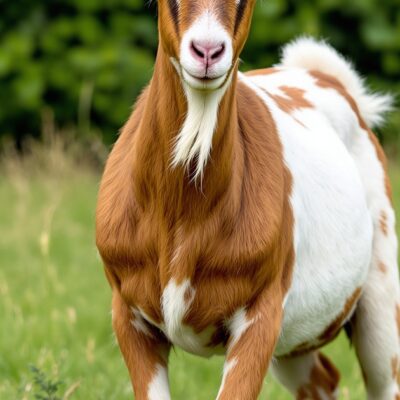
Accompanying image: AI-generated illustration of a domestic goat, not a photograph of the study animals or apparatus.