

The pancake that does not need to stay whole
A broken pancake is not always a cooking mistake. In Austria’s Kaiserschmarrn, the pieces are the point, but that does not mean every part of the process can be careless.
That is the comforting contradiction at the center of this dish. You can stop worrying about presenting one perfect golden circle, while still learning a few small techniques that make the difference between a light, warm mouthful and a heavy one.
The ingredients are familiar: eggs, flour, milk, a little sugar, and fat for the pan. Nothing on that shopping list suggests that you will eventually take apart the thing you have just spent time helping to rise.
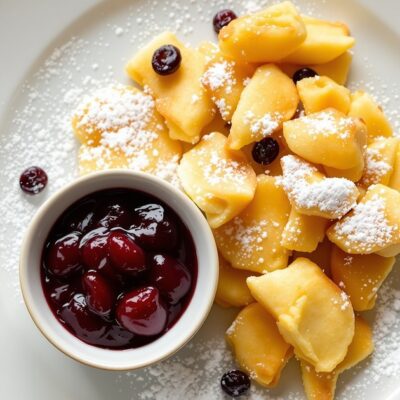
Yet the finished plate is not a rescued failure. It is a dish with its own identity, usually served with powdered sugar and fruit compote, and it deserves to be understood on those terms.
For anyone who finds cooking discouraging when the result does not look like the photograph, that offers a useful change of emphasis. Here, an uneven edge can belong on the plate; the part worth protecting is something you cannot measure with a ruler.
Two cooks agree on the dish, not the easiest route
Ursula, the Austrian writer behind Little Vienna’s Kaiserschmarrn recipe, describes it as a family dish eaten as a sweet main course or dessert. She gives an oven-assisted method designed to make a potentially awkward stovetop maneuver easier.
Her explanation is practical: a large pancake may still be liquid on top when its underside is ready to turn. Finishing it in the oven sets the surface before the next stage, reducing the need to wrestle with uncooked batter.
Tanya at Swiss Family Fun describes the same problem but prefers cooking on the stove. She finds the oven can make the result drier and points out that a pale upper surface may need additional browning afterward.
These are not instructions to combine at random. They are two experienced cooks making different trade-offs between handling, moisture, browning, and the equipment available to them.
Both accounts put beaten egg whites near the center of the method. Both also warn against taking the whipping too far, because very stiff whites become harder to incorporate into the batter.
That agreement is more useful than searching for one supposedly effortless version. A forgiving shape does not remove the need to pay attention; it gives you a different thing to pay attention to.
The recipe below follows Little Vienna’s oven-assisted proportions and sequence, with instructions written here in fresh wording. It makes two sweet main-course portions or four dessert portions, depending on appetite and what else you serve.
Start with a small list and a pan that can take the heat
Gather everything before separating the eggs. You need a large oven-safe frying pan, at least 10 inches across, and a handle that is genuinely safe at the baking temperature.
- 4 large eggs, separated
- 125 g all-purpose flour
- 200 ml milk
- 2 tablespoons granulated sugar, divided
- 1/8 teaspoon salt
- 1/2 teaspoon vanilla extract
- 1 tablespoon clarified butter, neutral oil, or unsalted butter
- Powdered sugar, for a light dusting
- Plum compote or applesauce, to serve
Raisins are optional in the source recipe, not a test of whether you have made the dish correctly. For this straightforward version, leave them out; the fruit alongside already provides a contrast to the pancake.
First, heat the oven to 200°C conventional, or 180°C fan. Put the whites in a clean mixing bowl and keep the yolks in a separate bowl large enough to hold the finished batter.
Beat the whites with the salt and one tablespoon of sugar until they hold soft-to-firm peaks. Stop before they become so rigid that folding them through another mixture turns into a struggle.
Build the yolk mixture by whisking the yolks with roughly half the milk, the vanilla, and the remaining tablespoon of sugar. Stir in the flour until smooth, then add the rest of the milk.
That order has a purpose: a thicker mixture is easier to smooth before the final liquid goes in. Pouring everything together at once may seem faster, but it can leave you chasing little pockets of flour.
Lighten, then fold. Stir about one third of the beaten whites into the yolk mixture, then gently fold in the remainder, preserving as much of their volume as you reasonably can.
The moment that changes what success looks like
Warm the fat in your pan over medium heat. If using ordinary butter, do not let it burn; pour in the batter, spread it evenly, and let the base begin cooking for about one minute.
Transfer the pan to the oven and bake for approximately 10 to 12 minutes, until the pancake is puffed and its surface is set, ideally with golden color. Ovens and pans differ, so treat that time as a guide rather than permission to stop watching.
If the top remains pale, inspect the bottom carefully with a spatula instead of simply extending the bake indefinitely. Little Vienna specifically cautions against allowing the underside to scorch while waiting for the upper surface.
Now divide it into quarters and turn the sections using two spatulas. Keep the pan over low heat if already well browned, or briefly use medium heat to color a pale side.
Then tear the quarters into bite-size pieces, reducing or switching off the heat as appropriate. Check that no wet batter remains inside before serving, and remember that the handle is still dangerously hot after its oven visit.
This is the point where neatness stops being useful. Irregular pieces are expected; crushing them into a dense pile or continuing to cook long after they are ready is not the goal.
A warm plate without a presentation exam
Serve promptly with powdered sugar and plum compote or applesauce alongside. The fruit gives each person a way to adjust the sweetness and moisture of a forkful without changing the entire batch.
Little Vienna identifies plum compote as the traditional accompaniment, while both sources describe other fruit options. You do not need to invent a family connection or buy a specialty jar to make an honest version at home.
If you want to try the stovetop approach another day, follow a complete recipe for that method rather than abandoning the oven halfway through this one. The thickness of the batter in the pan and the heat beneath it affect whether the center cooks before the base becomes too dark.
There is a modest human lesson here, but it is not that every mistake becomes wonderful. Some things still need correcting: scorched butter, raw batter, an unsuitable pan.
What changes is the standard you choose to judge. A plate of Kaiserschmarrn does not ask you to preserve a flawless outline; it asks you to make something tender, cooked through, and good to share.
That is a manageable ambition for an ordinary kitchen. The pancake can come apart, and dinner can still come together.