



A workshop can hold more than tools
Knowing how to do something is not always the same as having someone to do it with. A skill can remain perfectly useful long after the job, household routine, or familiar group that once gave it a place has changed.
That is what caught my attention in a small study about Men’s Sheds. I expected an account of woodworking, but the question underneath it was more personal: what happens when people of different ages have a reason to need each other’s company?
The answer was not a dramatic rescue or a promise that making things cures loneliness. It was an account of people sharing tools, advice, and practical tasks in a setting where conversation had somewhere to begin.
The UK Men’s Sheds Association describes Sheds as places where people come together to make, repair, and repurpose things, including projects for their communities. Connection and conversation belong alongside creation in its description.
That combination interests me more than the idea of a room full of equipment. A workshop can provide a reason to arrive without asking a newcomer to explain everything that brought them through the door.
But putting people in the same room does not automatically make a relationship. The more revealing part of this story is what some members found they could offer once they were there.
The useful question was not who knew the most
In a 2025 research abstract published in Innovation in Aging, Melinda Heinz and Katie Cullen reported interviews with ten members of an intergenerational Men’s Shed in the United States. The interviews were recorded, transcribed, and examined for recurring themes.
This was a small qualitative study, presented in a journal supplement. It was not a trial assigning people to different activities, and it cannot tell us what every Shed member experiences.
Its value is more specific: it records how some participants described the relationships forming around their shared work. Among the themes was the transmission of experience between generations.
Older members spoke about finding purpose in offering advice and perspectives to younger members. Younger members appreciated guidance in learning to use woodworking tools and equipment.
I would resist turning that into a story about wise older people fixing inexperienced younger people. Age does not determine who has expertise, and being able to use a tool does not mean a person knows how to teach it.
What seems more useful is the relationship between a particular skill and a particular question. Someone wants to learn; someone else can help; both have a reason to return to the conversation.
That is different from simply telling a person that they still have plenty to contribute. Here, contribution can become an actual task rather than a reassuring phrase.
Then the work reached beyond the workbench
The researchers identified another theme: community outreach. Members described connections with youth organizations, including visits involving Cub Scouts and helping homeschooled children build birdhouses.
Those examples come from participants’ reported experiences. The abstract does not provide a full program schedule, identify an opportunity readers can join today, or establish that every Shed runs activities with children.
Still, the birdhouse example makes the idea easier to understand. A shared project gives people something concrete to discuss: what they are making, how the parts fit, and what needs to happen next.
It also provides more than one way to take part. In a suitably organized activity, planning, explaining, checking, and encouraging can matter alongside the physical work itself.
Those are possibilities for designing an activity, not additional observations from the study. They are worth considering because a narrow definition of usefulness can exclude people who have valuable things to offer.
A person may have knowledge but limited strength. Another may have enthusiasm but need a slower explanation, an accessible workspace, or permission to ask a question twice.
Good intentions do not remove those practical needs. Nor does an appealing story justify informal access to dangerous equipment or unsupervised activities with children.
Any youth involvement needs the organization’s safeguarding arrangements, appropriate supervision, and suitable tasks. A welcoming workshop should make safety part of belonging, not an obstacle someone feels embarrassed to mention.
The hopeful part does not need a miracle
The UK association says Sheds can support wellbeing and reduce isolation. Its website also reports that a 2023 survey found many regular attendees felt connected with their wider community.
That is the association’s account of survey responses, not proof that attending causes a particular health outcome. People who participate regularly may differ from people who never attend or stop going.
The American interview study has its own limits. Ten accounts can reveal meaningful experiences without establishing how common those experiences are, how long they last, or whether another kind of group would work equally well.
I find those limits reassuring rather than disappointing. They leave room to value the reported relationships without selling a workshop as a treatment for grief, depression, or every difficult transition.
The modest promise is already worthwhile: a place where a person can be useful, learn something, and spend time with others around a shared interest. Not everyone will want that particular place, and nobody owes a group their participation.
The detail that stays with me is the older members’ sense of purpose in sharing what they knew. They were not described only as recipients of company; they were people whose perspectives could matter to someone else.
Being supported and being able to contribute are not opposites. A thoughtful community can make room for both without demanding that everyone contribute in the same way.
A reason to come back
If a Shed sounds appealing, start by contacting a local group rather than assuming its name tells you everything. The UK association provides a way to find Sheds, but individual groups may differ in membership, activities, facilities, and availability.
Ask whether beginners can visit, what costs are involved, and how instruction and equipment safety work. Ask about access needs before making a journey, and confirm any age or membership requirements directly.
For families, a smaller version might be an agreed, low-risk project with someone who enjoys sharing a skill. Mending a fabric item or sorting materials for a craft could provide a starting point, if both people genuinely want to do it.
That is a suggestion, not a substitute for professional instruction where hazards are involved. The point is not to recreate a workshop at home but to give the relationship a manageable shared purpose.
I would begin with an invitation rather than an assumption about what an older or younger person needs. Ask what they enjoy making, what they would like to learn, and whether they would welcome some company.
A finished object can be satisfying. But the more hopeful possibility is that, somewhere between the first question and the next attempt, two people find a reason to meet again.
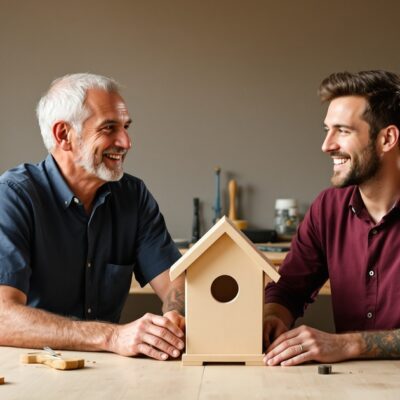
Image: AI-generated illustration of adults sharing a woodworking activity, not a photograph of study participants or a particular Men’s Shed.