
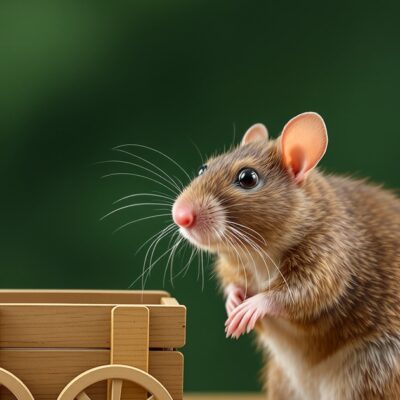

Featured image: AI-generated illustration of a rat beside a miniature vehicle, not a photograph of the study or its equipment.
The tiny car is not the whole story
What would you notice first about a rat learning to drive? Probably the car, which is understandable when the driver is small enough to fit inside a food container and the reward at the end is cereal.
In 2019, researchers at the University of Richmond reported teaching rats to operate miniature vehicles. It was the kind of research that could disappear into a funny clip before anyone reached the question underneath it.
But the interesting comparison was not between rats and human motorists. It was between animals whose lives before the driving lessons had offered different opportunities to interact with their surroundings.
The team, led by behavioral neuroscientist Kelly Lambert, wanted a task more complicated than recognizing an object or pressing a bar. Moving a vehicle toward a reward required the animals to connect what they did with where the car went.
That changes the story from a novelty into something worth sitting with. Before deciding that one animal is a quick learner and another is not, how much should we ask about the world each had been allowed to explore?
The answer does not come with a promise that a toy car makes anyone happier. It comes with a small experiment, a useful distinction, and a reason to look beyond the most entertaining part of the picture.
A different kind of driving lesson
The researchers built their vehicle using a clear plastic container, an aluminum floor, wheels, and three copper bars. As BBC reporting from October 2019 explains, a rat standing on the conductive floor could complete an electrical circuit by touching a bar.
The bars allowed the animal to move the vehicle in different directions. This was not a rat holding a miniature steering wheel, despite how easily the phrase driving rat invites that image.
Seventeen rats took part in the research described by the university. Training happened in rectangular arenas, and cereal rewards helped motivate the animals to reach their destination.
That reward matters when interpreting the result. The experiment did not show that the rats spontaneously invented driving, nor did it establish that every movement was performed simply for enjoyment.
It showed that, with training and suitable equipment, animals could learn an unusual sequence of actions. Their behavior was more flexible than an account limited to a familiar laboratory task might suggest.
There is a useful difference between being carried somewhere and learning how your own action changes your position. The latter requires feedback: touch, movement, another attempt, and eventually a more successful route.
We do not need to give the rats human ambitions to find that impressive. The task was interesting precisely because it asked something unfamiliar of them and made their choices visible.
The part that happened before the wheels moved
The animals had not all experienced the same housing conditions. Some lived in complex, enriched environments with interesting objects to interact with, while others lived in standard laboratory cages.
According to the University of Richmond’s original research announcement, the enriched-environment rats learned the driving task, while animals housed in standard cages had difficulty learning it. The university identified the published paper as “Enriched Environment Exposure Accelerates Rodent Driving Skills.”
This was not a contest in which all the preparation had been equal. The animals brought different histories of interacting with their surroundings into the arena.
That does not mean the study identified a single magic object, or that adding any toy produces the same outcome. Enrichment is a description of a more complex environment, not a guarantee attached to something sold in a shop.
Nor should difficulty with this particular task become a verdict on an animal’s overall intelligence. A driving arena measures performance under specific conditions; it cannot contain everything a rat can perceive, learn, or do.
Still, the contrast deserves attention. If we look only at the final performance, we can miss the experiences that helped make that performance possible.
For anyone who has ever struggled with something that seemed effortless to someone else, that distinction may feel familiar. The research is about rats, not proof of a theory about human success, but it gives us a concrete reason to resist judging ability without context.
The researchers also looked beyond performance
The team did not rely only on watching how the rats drove. They measured corticosterone and dehydroepiandrosterone, or DHEA, in the animals’ feces to investigate physiological changes during training.
The university reported an increase in the ratio of DHEA to corticosterone over the course of driving training. The researchers interpreted that pattern as a healthier stress-hormone profile.
That is narrower than saying the rats told scientists they felt relaxed. Hormone measurements provide evidence about physiology; they are not a direct translation of an animal’s private experience.
There is another distinction worth keeping clear. The university announcement also describes a separate, earlier conference-presented comparison between rats that drove and rats transported as passengers in remotely controlled vehicles.
In that comparison, the driving rats had higher DHEA levels than the passengers. It helped motivate the researchers’ interest in control over the environment, but it should not be casually folded into the published housing-and-driving experiment as if everything came from one test.
The wider research program raised questions about learning, stress, and the opportunities an environment provides. It did not establish a treatment for human anxiety or depression, and it offers no reason to tell someone struggling with mental illness that they simply need a new hobby.
The hopeful part is the question, not an instant prescription. What changes when a living creature has opportunities to act, explore, and learn something it could not do before?
A better question to take away
The kindest response to this story is not to make a pet perform for a camera. Research equipment and supervised training are not an invitation to build an improvised electrical vehicle or push an animal through a frustrating task.
Instead, the findings invite us to think about opportunities rather than spectacle. For an animal in human care, that means seeking species-appropriate welfare advice rather than assuming the most entertaining activity is the best one.
For ourselves, the takeaway can stay modest and human. Before calling someone incapable, consider whether they have had enough time, support, and safe opportunities to practice.
That is an ethical reflection, not a clinical conclusion from a rat experiment. It does not erase differences between people or pretend that effort removes every barrier.
But it leaves room for a less final judgment. Not being able to do something yet can be a starting point for asking what is missing, rather than the end of the conversation.
The tiny vehicles earned the attention. The different lives before the first lesson are what make the research worth remembering.
When you think of a skill that once felt beyond you, what helped most: being told to try harder, or being given a better chance to learn?