
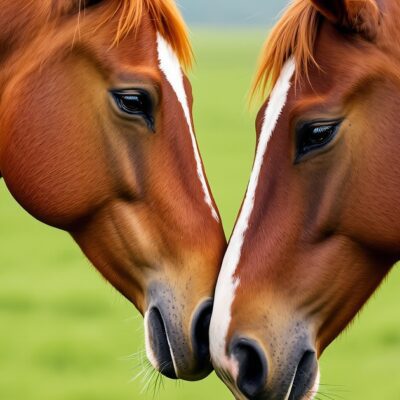
Illustration: AI-generated horses, not photographs of the animals in the studies.
The scratch that deserves a longer look
Two horses stand alongside each other, facing opposite directions, working their mouths through each other’s coat. If you have watched mutual grooming, you may have wondered whether you were seeing practical coat care, companionship, or something harder to name.
That question becomes more interesting when you stop looking only at the movement. Which horse approaches which companion, and does the same pair find each other when their surroundings change?
A study of two established groups of Quarter Horse mares followed those questions into an ordinary management routine. The researchers were not teaching the horses a trick or asking them to choose between photographs.
They watched the animals together in pasture and in smaller holding pens. What changed was not simply the number of grooming sessions: their length and the partners involved made the picture more complicated.
It is an appealing story because the gesture looks familiar. Most of us recognize the difference between having people nearby and having a particular person we seek out.
But a horse does not need to become a stand-in for human friendship to deserve careful attention. The more useful question is what its own choices might tell us about the conditions we provide.
The same mares in two different settings
The 2023 paper by Emily Kieson, Amira A. Goma and Medhat Radi examined two socially stable herds at a Quarter Horse veterinary and breeding facility in Oklahoma. One contained 85 mares and the other 115.
The mares were between six and twenty years old and had lived at the facility for at least two years. Their groups remained intact as they moved between pastures.
In pasture, the horses had room to spread out, graze and choose their distance from other animals. As part of the facility’s routine, they were also brought into smaller pens so mares needing reproductive examinations could be separated.
Those holding areas offered less space and more restricted resources. Researchers also observed behaviors such as increased movement, muscle tension and vigilance, which supported their description of those settings as more stressful.
That context matters. These were observations during normal operations, not a controlled experiment in which confinement was the only difference between otherwise identical situations.
Space, access to resources and opportunities to move apart changed together. The findings can point toward a social response without proving that one factor alone caused it.
The researchers counted mutual grooming only when the second horse reciprocated. One animal starting to groom another was not enough to qualify as a session in their analysis.
More grooming did not mean a simpler answer
The researchers recorded much more frequent mutual grooming in the smaller pens. They observed 118 sessions there, compared with six in pasture footage, and also analyzed frequency relative to the video time.
The sessions in the smaller pens were shorter on average. Pasture sessions averaged about 163 seconds; those in confined settings averaged about 41 seconds.
This is where a reassuring interpretation can become too easy. More apparently friendly contact is not automatically evidence that an environment is better for the animals living in it.
In these observations, increased grooming occurred alongside signs of stress. A behavior that looks comforting can be part of coping with a difficult situation rather than proof that the difficulty does not matter.
The partners offered another clue. Nearly all observed grooming involved a horse sticking with a particular partner; the detailed results describe one horse engaging with multiple partners in one video.
That exception is worth keeping in the story. The research does not establish that every horse has exactly one permanent best friend, or that a single recorded interaction can reveal an entire social life.
The authors interpreted the pattern as consistent with a social coping response sometimes called “tend and befriend.” Put more plainly, familiar partners may matter when circumstances become more demanding.
Still, the research involved mares at one site, and only a few pasture grooming sessions were captured. It should invite better observation, not become a universal rule about every herd.
Another herd adds a useful complication
A separate 2020 study by Masaki Shimada and Nae Suzuki examined nine feral Misaki horses at Cape Toi in Japan. Instead of assuming grooming meant one thing, the researchers tested different possible functions.
They considered social affiliation, the repair of relationships after aggression, and grooming’s practical role in body care. Their observations included proximity, aggressive interactions, kinship and grooming.
Pairs that groomed more also tended to spend more time near each other, even after the analysis accounted for recorded kinship. That supported a connection between grooming and affiliative relationships.
But the team did not find a corresponding relationship between aggression and mutual grooming. Their results did not support treating the behavior as a reliable way of making up after conflict in that herd.
Horses that received more grooming from others also spent less time grooming themselves. The authors interpreted this as consistent with a maintenance function as well as a social one.
So the satisfying answer is not that coat care was secretly irrelevant. Something can be useful to the body and part of a relationship at the same time.
These two studies are not interchangeable: one examined large domestic mare groups in different settings, the other a small feral herd. Together, they make a stronger case for noticing context than for attaching a single emotional label to every scratch.
What changes when we notice the partner?
For someone caring for horses, the practical starting point is observation rather than an experiment. Notice which animals choose to remain near one another when they genuinely have room to move away.
Watch across different days and routines, not just during one photogenic moment. Grooming, peaceful proximity and the ability to avoid unwanted contact all add information that a snapshot leaves out.
Do not crowd horses together to encourage bonding or separate companions just to test their response. Management decisions need to account for safety, individual compatibility, resources and advice from an experienced equine professional.
A sudden change in behavior also deserves attention rather than a sentimental explanation. A horse avoiding contact or behaving differently may need a broader welfare or veterinary assessment, not simply a new companion.
The encouraging part is that better care can begin with a more precise question. Instead of asking only whether a horse has company, we can ask what choices that company allows.
For the rest of us, there is a modest human takeaway, not a scientific prescription for our own relationships: being surrounded and feeling supported are not necessarily the same thing. We can appreciate that distinction without pretending to know exactly what a horse feels.
If you watch horses regularly, have you noticed a pair choosing each other when there are other companions available? The quiet pattern across ordinary days may be more revealing than the moment that first catches the eye.