

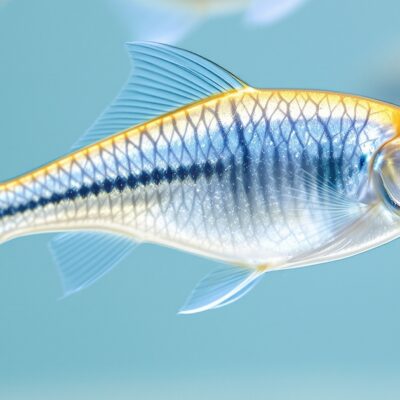

Featured image: AI-generated illustration of zebrafish, not a photograph of the research animals or experimental tanks.
A change the fish could see but never touch
The pebbles never went into the water. In a study of laboratory zebrafish, researchers placed pictures beneath the tanks instead, giving the animals something different to look at through the floor.
That sounds almost too small to matter. No elaborate underwater landscape, no new swimming space, no object a fish could explore with its body: just an image outside the glass.
Yet that modest change became part of an experiment with a serious question behind it. When people decide that an animal’s home is adequate, how much are they overlooking because they see it from the outside?
For someone who keeps fish, the tension is familiar even without a laboratory. Clear water and an orderly tank are reassuring to look at, but a pleasing view for the person is not a complete account of life for its inhabitants.
The research does not offer a magic aquarium upgrade. It does offer a surprisingly concrete example of why small animals deserve more careful questions than whether they are being fed and kept alive.
And the most useful part is not simply that the fish responded. It is how the researchers checked whether that response meant anything beyond a passing preference.
Why an empty tank can seem like the practical choice
The study, published in PLOS ONE in May 2024, examined adult zebrafish in laboratory housing. These small fish are widely used in research, making the conditions of their everyday lives a substantial animal-welfare concern.
The authors describe a familiar obstacle to improving those conditions. Researchers may hesitate to add material inside tanks because of concerns about hygiene, health, and the work of maintaining the system.
The paper also notes that evidence supporting those concerns is sparse. Still, the team designed an intervention that could avoid the objection altogether: put the visual enrichment outside the water.
That choice matters because it separates two things people easily bundle together. An environment can be straightforward to maintain without being as good for its occupants as it could be.
Pictures of pebbles had been investigated before. What this team wanted to examine was whether benefits would appear in standard, barrier-free laboratory tanks, alongside a second kind of evidence rather than preference alone.
A fish spending time on one side of a tank is informative, but it is not a full welfare assessment. As the authors explain, a preference might sometimes mean choosing the less unpleasant of two options.
So the researchers compared the pebble pictures with something already meaningful to zebrafish: access to other zebrafish. They also planned a separate assessment involving cortisol, a hormone associated with the stress response.
The first answer depended on who shared the tank
In the preference experiment, a pebble picture covered the area beneath half of a tank. Its position changed between the front and back, helping the researchers separate a preference for the image from a preference for a particular location.
They also tested visual access to fish in neighboring tanks. Some experimental fish lived alone, while others shared their tank with other zebrafish.
This was not a person standing nearby and deciding that a fish looked cheerful. Recorded behavior was assessed by a blinded observer, with the animals’ positions counted repeatedly.
The result had a complication worth keeping. Singly housed fish preferred the enriched side regardless of whether it was at the front or back; group-housed fish showed the preference when enrichment was at the back.
That qualification makes the story more useful, not less. It shows why saying that every fish simply chose the picture would flatten what the experiment actually found.
The researchers found no significant difference between the strength of preference for the pebble image and for visual access to neighboring fish. But looking through glass at companions is not identical to swimming with them, and neither comparison establishes everything an animal needs.
The second experiment moved from where the fish spent time to a physiological measurement. This time, pictures covered the entire area beneath selected tanks for a week.
At the end, the team measured cortisol in tank water. That allowed them to assess a stress-related indicator without turning the finding into a guess based only on appearance.
The picture mattered, but it did not replace company
Tanks with pebble-picture enrichment had lower cortisol levels than barren tanks. Group housing also reduced cortisol, and the group-housed fish with pebble pictures had the lowest levels of the treatment groups.
The combination is the detail to remember. The experiment did not reveal a reason to remove companionship and replace it with decoration; it found benefits from providing both forms of enrichment.
There were clear limits. The work tested adult zebrafish, one type of pebble imagery, and relatively short periods, so it cannot establish lasting benefits for every fish species or every aquarium.
A separate 2019 study comparing zebrafish and three-spined sticklebacks makes the species point especially clear. Researchers tested shelter provided by artificial plants and by shade above the tank.
The sticklebacks preferred both forms of shelter over open areas and favored shade over plants. The zebrafish did not show a preference for either shelter in that test.
That does not cancel the pebble-picture findings, which tested a different intervention. It warns against treating the word fish as though it describes one set of needs and preferences.
Nor does a lower cortisol reading prove that an animal’s life is now ideal. The 2024 authors explicitly describe their intervention as a small improvement within laboratory housing, not the best environment zebrafish could possibly have.
A kinder question to bring to the glass
The practical takeaway is not to slide a picture beneath any aquarium and declare the job finished. A tank is a heavy, fragile system, and moving an established one casually is not an experiment to copy from a research paper.
Instead, start with the species you actually care for. Seek reliable, species-specific husbandry guidance about space, compatible companions, cover, water conditions, and opportunities for normal behavior rather than buying whatever looks appealing.
Enrichment cannot substitute for those basics. An animal that stops eating or changes its behavior needs appropriate assessment, not an assumption that a new decoration will solve the problem.
What the studies offer is a change in attention. A detail that seems minor from our side of the glass may be worth investigating from the other side, and the answer may differ between animals.
There is something encouraging in that without needing to invent a fish’s thoughts. Care can improve when people test their assumptions, notice the response, and accept an answer more complicated than the one they hoped for.
The fish did not need to perform affection for the experiment to matter. Their choices and physiology were already reasons to take their surroundings seriously.
Sometimes a better home begins with a larger budget or a more difficult change. Here, a picture beneath a tank reminded researchers of a smaller first step: stop assuming that an environment has nothing left to say.