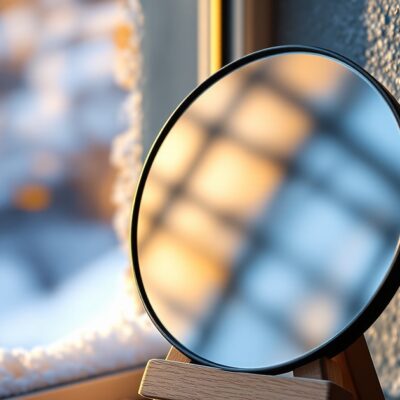




Image note: The accompanying AI-generated still life illustrates reflected sunlight. It is not a photograph of Rjukan or a reconstruction of its sun mirrors. The linked sources show the actual town and installation.
The sunshine was visible, but out of reach
What would it feel like to look up at a sunny mountainside while your own street stayed in shadow? Not because a storm was passing, and not because you had missed the morning, but because the landscape would keep doing this for months.
That is the difficulty behind one of Rjukan’s most unusual sights. This Norwegian town sits in a steep valley where the mountains block direct winter sunshine from reaching the bottom, even when the sky above is clear.
It is tempting to call it a town without daylight. That would be wrong: shade is not the same as continuous night, and the distinction is exactly what makes the story interesting.
The light was there. People could see where it fell, just not necessarily feel it on the street where they were standing.
For anyone who has ever chosen a kitchen chair because it catches the afternoon sun, the desire is easy to understand. Sometimes the thing that makes a place feel welcoming is not another attraction or another purchase, but a few ordinary minutes in a better patch of light.
In Rjukan, turning that wish into something public required far more than moving a chair.
A wish that outlasted its first opportunity
According to VisitRjukan’s account of the Sun Mirror, bookkeeper Oscar Kittilsen proposed a mirror in 1913. The town’s founder, industrialist Sam Eyde, wanted to make the idea happen, but the technology available then did not make it practical.
That older proposal matters. It keeps the story from becoming a neat tale about one person noticing something that everyone else had somehow overlooked.
Residents had understood the problem long before the equipment existed to address it this way. Wanting winter sunshine was not a new insight; finding a workable route for it was the challenge.
The artist Martin Andersen later returned to the idea. VisitRjukan dates that renewed effort to 2005, and the completed installation was unveiled in 2013, a century after the earlier proposal.
In the Guardian’s November 2013 reporting, Andersen described taking his young child out in a buggy and having to travel farther along the valley as the season changed to find sunshine. That is a specific, human starting point, rather than an abstract engineering puzzle.
A walk with a child does not automatically become a public artwork. Between noticing a need and meeting it lie feasibility questions, money, permissions, technical expertise, and the patience to keep working when the original excitement fades.
The elapsed years are part of the achievement. They are also a reminder that a useful idea can be real long before it is ready.
The argument was about more than the weather
Rjukan’s answer was not unanimously welcomed before it arrived. The Guardian’s contemporary reporting describes residents questioning whether the money should instead support care for older people, schools, roads, or cycling infrastructure.
Those objections deserve to remain in the story. A charming photograph of a sunny square cannot answer every question about how a community should spend its resources.
The report described a total project cost of five million Norwegian kroner, with the municipality contributing one million and other funding coming from elsewhere. These are historical figures from the 2013 account, not a statement of today’s operating costs.
One retired resident interviewed then still wondered about future maintenance even while acknowledging that standing in the reflected sunshine felt pleasant. There is nothing contradictory about holding both thoughts.
It is possible to value beauty and ask who will maintain it. It is possible to enjoy an invention and still think carefully about what else a town needs.
That makes the story more useful than a simple contest between dreamers and pessimists. Public places belong to people with different priorities, and a project becomes public partly through having to face those differences.
Andersen’s aim was also narrower than lighting an entire town. As he explained to the Guardian, he wanted a concentrated place where people could spend a short time in the sun.
The limitation was not an accidental footnote. It helped define what the project was actually trying to give.
A small part of the square changed the experience
The finished Sun Mirror uses three computer-controlled mirrors mounted high on the mountainside. They follow the sun and redirect its rays down onto the town square, rather than producing artificial light.
VisitRjukan lists each mirror as seventeen square metres and describes the resulting patch of sunlight as an ellipse covering approximately six hundred square metres. The installation is mounted at 742 metres above sea level.
Those details explain both the ingenuity and the boundary of the result. This is a particular sunlit area, not a replacement sun for every house, pavement, or winter afternoon.
It also depends on sunlight being available to reflect. Anyone planning a visit should check current local information and weather rather than expecting the same effect on every date or under every sky.
The Guardian’s reporter observed people pausing in the illuminated square after the opening: parents with children, older residents on benches, people photographing the unfamiliar sight. Those observations belong to that reported moment in 2013, not to an invented scene happening today.
What gives the scene its emotional weight is its modest scale. Nobody needed to claim that winter had disappeared for the improvement to matter.
The mountains remained, and the shaded streets remained. What changed was the availability of a shared place to stand in the light.
What would make your own town easier to enjoy?
Rjukan already had a tradition of celebrating the sun’s return. VisitRjukan dates Solfesten to 1925, another indication that the town’s relationship with seasonal light did not begin with its mirrors.
The installation sits within that longer local history. For visitors discovering it now, the respectful approach is to see an existing community adapting its surroundings, not a place waiting for outsiders to notice it.
There is a practical question here that travels well beyond Norway: what small, shared improvement would make everyday life in your own neighborhood more welcoming?
It might be shade rather than sun, a bench with a backrest, an accessible route, or a public space where people can linger without buying anything. The answer should come from the people who use the place, including those whose needs are easiest to overlook.
None of those changes replaces adequate housing, care, or reliable public services. Rjukan’s debate is a reason to take those responsibilities seriously, not an invitation to decorate over them.
Still, a limited improvement need not be dismissed simply because it cannot fix everything. Sometimes the honest ambition is to change one part of an ordinary day, and make that change available to more than one person.
Which small place near you could offer something like that, if somebody asked a different question about it?