




The thing I almost looked past
A blank sheet of paper does not usually ask for much attention. We notice what someone puts on it: a drawing, a message, the first sentence of something they have been trying to say.
Reading about Japanese washi made me reconsider that habit. Before there is anything on the surface, there is already a remarkable amount of knowledge inside it.
That sounds like a poetic way to describe stationery, but the practical details are more interesting than the metaphor. A thin sheet can begin with long plant fibres, careful preparation, water, and movements that determine how those fibres come together.
The finished material can look quiet enough to disappear behind the work it supports. Yet its ability to support that work is precisely where the skill lives.
I was particularly struck by a distinction that is easy to overlook: delicate-looking does not necessarily mean weak. In this craft, the relationship between those two qualities is more complicated than a quick glance allows.
And the story is not simply about preserving an old method unchanged. It is also about the decisions makers keep making so that something useful can remain useful in another person’s hands.
A sheet is not just a flat surface
Japan House London’s introduction to washi explains that the name literally means Japanese paper. It identifies three plant sources used in its production: kozo, or paper mulberry, mitsumata, and ganpi.
The long fibres help produce durable papers. That material difference matters before any decoration, colour, or finished design enters the picture.
Japan House describes washi production centres including Echizen, Mino, Sekishu, Tosa, and Inshu. Its account of Echizen, in Fukui Prefecture, places the craft in a cluster of five villages rather than treating Japanese papermaking as a single interchangeable practice.
That specificity matters to me. Calling something an ancient tradition can make the people responsible for it fade into the background, as if the objects somehow kept arriving without anyone having to learn, work, or adapt.
The same introduction describes the Iwano family’s transmission of papermaking skills across generations. It discusses the strong, absorbent hosho paper made by Iwano Ichibei IX and its usefulness for printing.
Those are not merely qualities to admire in a display case. They are qualities that another maker can depend on when placing an image onto a sheet.
Paper, in other words, is doing a job. The beauty is not separate from that job, and the person who makes the surface is part of what another person’s work can become.
The movement only makes sense after the preparation
The familiar image of handmade paper often centres on a screen being lifted from water. It is an appealing moment because something that looked dispersed begins to look like a sheet.
But Japan House’s description of the nagashi-zuki method gives that movement a more precise meaning. A plant-derived viscous substance is added to the pulp mixture, and a bamboo-netted frame is rocked back and forth and from side to side.
The mixture flows over the screen, allowing long fibres to become closely interwoven. The strength of the resulting paper is connected to those fibres and the way the maker brings them together.
For a second view, I turned to Hidakawashi’s account of its materials and process. This is a producer describing its own contemporary operation, which includes papermaking machines, not a claim that every washi workshop works identically.
Its explanation starts well before sheet formation. Kozo material is cooked, washed, cleared of impurities, and disentangled, with processing adjusted according to the intended product.
The company describes trying to put numerical values to judgments traditionally made through a papermaker’s skill. Yet it says the disentangling of fibres remains an area where data alone is not enough.
That detail changes how I understand the finished sheet. What looks uniform may depend on someone noticing differences in the raw material and responding to them rather than following a fixed sequence without thought.
The producer also explains that neri thickens the fibre mixture but does not act like glue. Even an ingredient that might seem obvious from a distance turns out to have a more particular role.
The surprise is how many lives paper can have
I expected to read mostly about writing and printing. Japan House’s list of uses reaches much further: sliding screens and partitions, umbrellas, lamps, and garments, alongside books and artwork.
That does not mean any sheet can do every job. It means paper is a family of materials and possibilities, with different qualities suited to different purposes.
Hidakawashi makes the same distinction in a different way. Its account describes selecting kozo varieties and adjusting processing to meet customers’ requirements, rather than presenting one recipe as the answer to every need.
Japan House also describes Awagami Factory’s development of papers for contemporary uses, including compatibility with offset and inkjet printing. In that account, continuity does not require refusing new tools or new demands.
This is the part I find most hopeful. A tradition can be respected without being treated as if its best days must always belong to the past.
There is room for inherited skill and present-day problem-solving in the same story. The task is not merely to reproduce an appearance; it is to understand what the material needs to do and preserve the knowledge that makes doing it possible.
Seen that way, a blank sheet is not empty. It is ready, and readiness can be the result of considerable effort.
A different way to notice ordinary things
None of this means we have to replace everyday supplies with precious handmade objects. A tight budget is real, and learning to appreciate a craft does not have to begin with buying something.
A more accessible beginning is to ask a better question when something ordinary catches our attention. Instead of only asking what it costs or how it looks, ask what makes it work.
For paper, that might mean learning which fibres were used, whether it was handmade or machine-made, and what the maker intended it for. Those answers are more useful than assuming that every product carrying the word washi has the same origin or properties.
It can also mean giving credit to the people who prepare the conditions for someone else’s visible achievement. A finished print attracts attention, but the surface beneath it was not inevitable.
I do not take that as proof that every quiet effort will eventually receive applause. Often it will not, and skilled work deserves fair recognition rather than a comforting slogan.
What this craft offers is a clearer way of looking. Something can seem slight, simple, or nearly invisible while carrying choices that make a real difference.
The next time a beautiful image holds my attention, I want to remember to look at what is holding the image. There may already be another person’s story there, before the first mark begins.
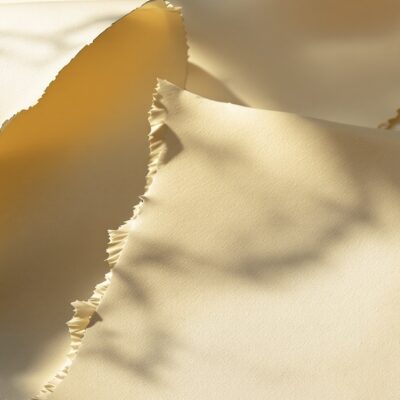
Image: AI-generated illustration of blank handmade paper, not a documentary photograph of a named workshop or product.