
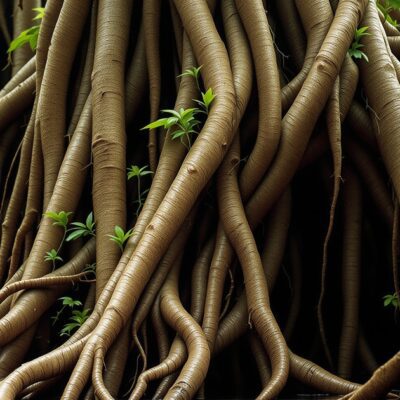




Featured image: AI-generated illustration of living-root architecture, not a documentary photograph of a specific bridge in Meghalaya.
A crossing with a different kind of deadline
What would you begin if you knew someone else might have to finish it? Not because you had failed, but because the work itself needed more time than one person could reasonably promise.
In the Khasi and Jaintia Hills of Meghalaya, in northeastern India, that question has a practical answer. Communities have trained living tree roots across rivers and ravines, creating crossings that develop through years of growth and repeated human attention.
The photographs can be arresting: roots joining into thick networks, a footpath suspended between wooded banks, the forest appearing to hold itself together. But the most interesting part is not how closely a bridge resembles something from a fantasy film.
It is the ordinary need underneath the extraordinary shape. People need to reach fields, markets, and neighboring villages in a landscape where steep valleys and monsoon-swollen waterways can make a short journey difficult.
These are not abandoned curiosities that outsiders suddenly discovered. They are structures rooted in local knowledge, and understanding their beauty means looking beyond the photograph to the people who keep them useful.
Once you do that, the question changes. Instead of asking how nature made something so remarkable, you begin asking what kind of work made this relationship with nature possible.
The forest did not build them alone
A 2019 study in Scientific Reports describes how builders use the aerial roots of Ficus elastica, the Indian rubber tree. These roots can grow down from branches, thicken, and join with one another through natural grafts.
Builders guide the roots where they are needed rather than simply waiting for a tree to happen across a river. The researchers describe roots wound around a framework, commonly made from bamboo, and directed toward the opposite bank.
After roots reach the ground, continued growth and the addition of other roots help develop the structure. Closely intertwined roots may fuse, creating connections that become difficult to distinguish as separate strands.
That explanation makes the bridges more impressive, not less. The people shaping them must work with a living material whose development cannot be reduced to placing identical pieces in a fixed arrangement.
There is no single neat template. The study describes structures with features resembling several familiar bridge types, and points out that continuous growth and maintenance make their mechanics complex.
Nor is there a universal countdown to completion. The researchers explicitly say their data cannot establish a standard time from the beginning of construction to full functionality; span, growing conditions, and other factors matter.
So the easy promise that every root bridge becomes usable after a set number of years misses the point. This is knowledge applied to a particular place, not a shortcut that can be ordered and delivered anywhere.
The work a beautiful photograph leaves out
A living bridge is not a bridge that looks after itself. Its growth is part of what makes it remarkable, but it does not remove the need for maintenance or make it immune to damage.
The researchers recorded tasks including pruning and tying roots, removing mosses and other plants, laying material on the walkway, and clearing connecting paths. Responsibility varied: some bridges were tended by individuals or families, others by villages or groups of communities.
That variation matters. It keeps us from turning different communities into one simple story, and it reminds us that a beautiful structure can depend on arrangements that are largely invisible to a visitor.
Reporting by Barasha Das for Mongabay in November 2024 brings that work into closer focus. Her account describes local women preparing bamboo strips and helping maintain the structures, alongside other community members undertaking construction tasks.
It also describes living-root ladders, railings, and resting platforms. The bridges are part of a wider practice of adapting routes through difficult terrain, rather than isolated showpieces built for an audience.
But attention can bring pressure as well as appreciation. Mongabay reported concerns about increasing tourism, nearby construction, and the challenge of keeping traditional management arrangements effective as livelihoods change.
Some bridges in the earlier scientific survey were untended. Interviews also suggested that past structures had been lost to events including floods, fires, and landslides, a useful correction to the tempting idea that living architecture lasts forever.
Admiration alone cannot protect something. If we notice only the finished crossing, we can overlook both the effort that sustains it and the conditions that put it at risk.
The part that has to reach the next generation
The most hopeful detail in Mongabay’s account is not a record-breaking span. It is the description of younger people learning from elders who know how to work with the roots.
In that 2024 reporting, Morningstar Khongthaw described young people apprenticing during the monsoon, when young roots are woven. The article also reported efforts to document the process and preserve knowledge through a community heritage initiative.
That is a different kind of conservation from keeping an object unchanged behind a barrier. A living structure changes, and the ability to care for it has to remain alive as well.
The tree is only one part of the inheritance. The other part is knowing what to do next: where to guide growth, what needs attention, and how to involve someone who will still be there later.
There is a human reassurance in that idea, although it should not become a demand that everyone sacrifice themselves for the future. Long projects need support, shared responsibility, and room for people’s lives to change.
The bridges offer a concrete example of continuity without pretending that continuity happens automatically. Their story includes teaching and upkeep, not just the dramatic moment when a person first imagines a crossing.
What would you help someone else carry forward?
Most of us will never train a root across a river. We can still recognize the difference between wanting to leave something behind and helping someone else learn how to care for it.
That might mean teaching a younger neighbor a repair skill, recording the steps of a family recipe with permission, or making a volunteer role easier for the next person to take over. These are comparisons, not claims that an everyday task is equivalent to this specific Indigenous tradition.
The useful question is smaller than a grand declaration about legacy: who could continue this, and what would they need from me? Sometimes the answer is clear instructions; sometimes it is patient practice together.
If you hope to visit Meghalaya’s living-root structures, approach them as places connected to local lives, not scenery owed to visitors. Seek current local guidance about access and conditions, respect community rules, and resist treating a delicate living structure as a climbing frame.
For those encountering them from far away, there is still something worth taking seriously. Beauty here is inseparable from usefulness, and usefulness depends on people returning to do work that a photograph cannot show.
What is one thing in your own community that survives because somebody keeps coming back to care for it? The answer may be less spectacular than a bridge, but it deserves to be noticed while those people are still here.