


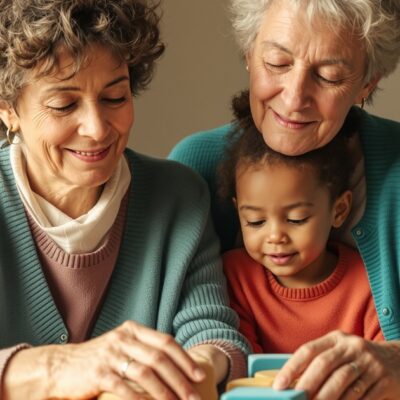


Featured image: AI-generated illustration of an intergenerational activity, not a photograph of Providence residents, children, or facilities.
The railing that made me stop reading
A railing outside a preschool classroom sounds like an ordinary safety feature. In a 2016 PBS NewsHour report from Seattle, however, the explanation for one particular railing made me pause: it was there for the older adults.
Administrator Charlene Boyd explained that residents using wheelchairs could use it to help themselves stand and watch the children through a window. The classroom was inside Providence Mount St. Vincent, a community that also provided care for older people.
I was drawn to the preschool’s unusual address. But that small piece of the building told a more interesting story than the address alone.
Someone had considered not just whether different generations could occupy the same place, but how a person could actually participate. An invitation means less when the room, the timing, or the physical effort keeps you outside it.
There is a familiar frustration underneath that detail. We can care deeply about someone while letting our daily routines carry us past each other, waiting for a special occasion to make contact feel possible.
At the Mount, the idea was to make contact less exceptional. What caught my attention was how much ordinary work that apparently simple idea required.
A preschool was only the beginning
According to Cat Wise’s May 2016 PBS NewsHour report, administrators added the preschool in 1991. This was not a newly announced experiment, and the encounters described in that report should not be mistaken for scenes happening today.
Providence’s published Intergenerational Learning Center description explains the approach: planned and spontaneous activities bring children and residents together through music, dancing, art, meals, storytelling, and visits. The organization describes these opportunities as part of the community rather than an occasional outside performance.
That difference matters. A holiday concert can be lovely, but it does not offer the same kind of repeated familiarity as people becoming recognizable parts of each other’s surroundings.
The program description also makes clear that this is child care, with teachers, age-group arrangements, and an educational approach. The older residents are not simply being substituted for professional staff.
In the PBS report, director Marie Hoover described multiple scheduled visits for classrooms each week. Alongside those arrangements, there was room for encounters that were not the day’s central event.
That is the part I find useful beyond this particular building. Connection needs both a structure that makes it possible and enough freedom that people do not feel they are performing it for someone else’s benefit.
A shared address alone cannot do that. Adults still have to organize the day, attend to individual needs, and make participation workable.
The residents were doing more than receiving a visit
The PBS report followed Mary McGovern, who was ninety-five at the time, reading to toddlers. She did not need a trip across town to find them; the children were down the hall.
That scene could easily be reduced to a sentimental picture of young people cheering up an older person. Yet McGovern was also contributing something: her attention, her voice, and an activity the children could join.
Elsewhere in the report, retired surgeon John Goss and a five-year-old worked together on painting. Goss described the child helping him and the two of them working together, rather than presenting the encounter as one person rescuing the other.
That changes how I understand the appeal. Being cared for is essential when you need care, but it is not the only role a person should be allowed to have.
Another recorded activity brought children and residents together to prepare sandwiches for people experiencing homelessness. Resident Annie Carter, then ninety-two, described talking with her young partner about their work.
They had something to do together. The task gave the conversation a reason to exist without requiring either person to produce an inspiring speech.
These are observations from a reported visit, not proof that every participant experienced the same thing. They do, however, show why the program is more interesting than a photograph of two age groups in one room.
The older people were readers, painting partners, and contributors. The children were participants with something to offer, not a treatment prescribed for someone else’s loneliness.
The meaningful part was not a miracle
I am wary of stories that turn a warm encounter into a claim that illness, grief, or isolation has been solved. Nothing in these reported moments justifies promising that children reverse dementia or that shared activities replace skilled care.
Providence lists intended benefits such as opportunities to share knowledge, increased interaction, and children’s familiarity with older adults and disability. Those are the program’s stated benefits, not a clinical trial establishing what will happen for every person.
The historical report also contains a simpler, more believable account. Harriet Thompson, who was ninety-three, described joining a singing activity after hearing it on her way toward the dining hall.
Her enjoyment did not need to become evidence of a medical breakthrough to matter. A good part of an ordinary day can be valuable without fixing the rest of a life.
That is where the story became most moving to me. Its strongest promise is not transformation on demand, but room for a person to have another kind of moment.
Respect also means leaving space for people who prefer quiet or do not want to join. Neither age nor living in a care setting removes someone’s right to their own preferences.
A smaller version of the same invitation
Most of us cannot put a preschool inside a care community. But we can examine the smaller barriers between wanting contact and making it comfortable.
A useful starting point is a shared activity someone actually likes: sorting garden seeds, working on a simple craft, or reading together. These are suggestions, not accounts of activities witnessed at the Mount.
Ask before arranging it, and keep the invitation easy to decline. Consider hearing, mobility, energy, and the practical assistance someone may need rather than assuming goodwill will handle everything.
If children are involved, responsible adults should supervise and coordinate with caregivers or facility staff. A caring visit should respect safeguarding and health rules, not bypass them in pursuit of a touching moment.
Then let the activity be ordinary. It does not need a camera, a public post, or a visible emotional breakthrough to count.
I keep returning to that railing because it makes the idea concrete. Someone noticed a possible barrier and changed the environment instead of merely asking people to try harder to connect.
Sometimes the next generous step is not a grand gesture. It is making the thing you already hope will happen a little easier for another person to choose.